

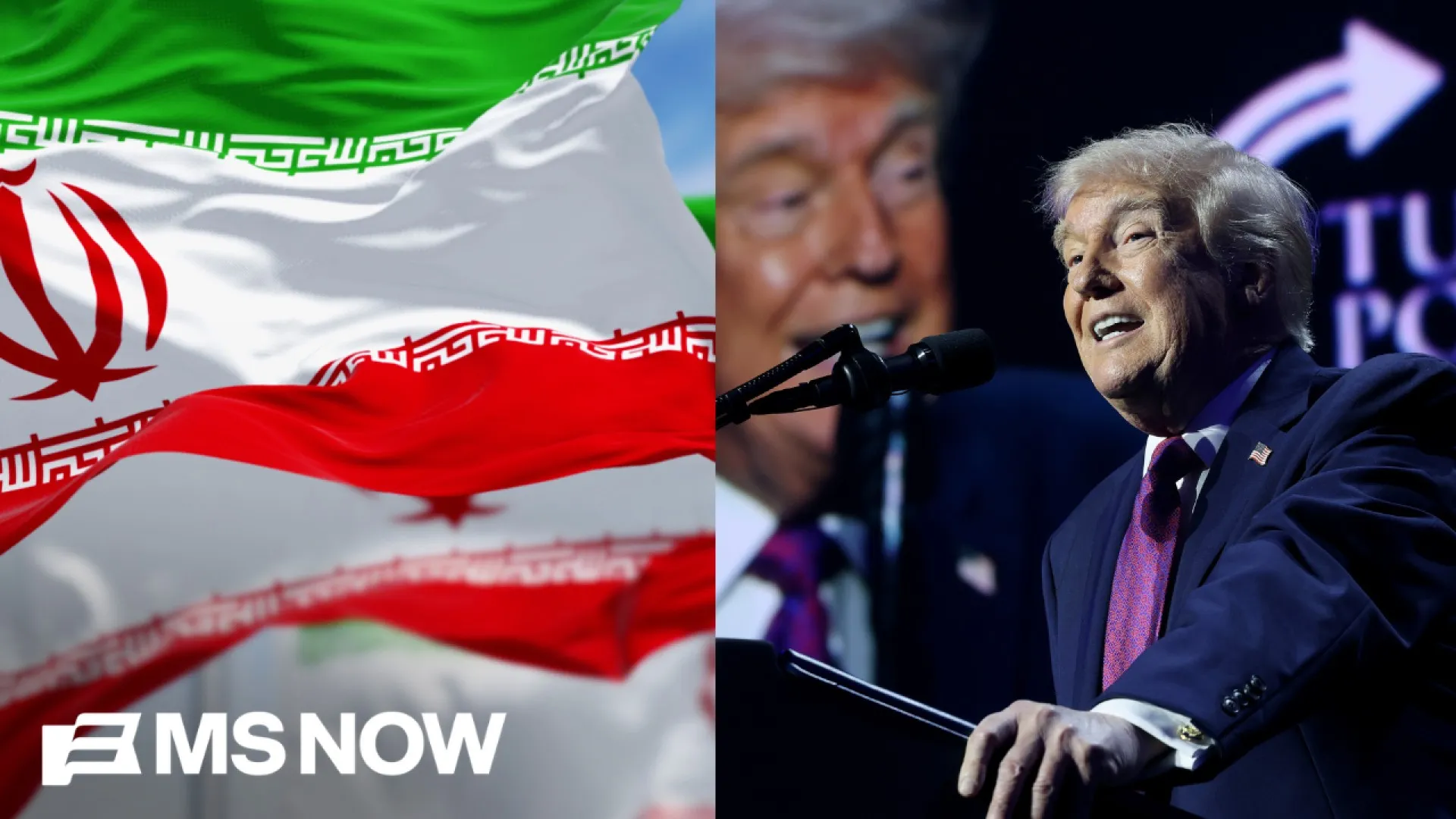
President Donald Trump announced Sunday afternoon that the U.S. military attacked and seized an Iranian cargo ship attempting to bypass the American blockade of the Strait of Hormuz. This action has cast a shadow over a new round of peace talks that the president had announced earlier in the day.
“The U.S. Navy Guided Missile Destroyer USS SPRUANCE intercepted the TOUSKA in the Gulf of Oman, and gave them fair warning to stop,” Trump stated on Truth Social. “The Iranian crew refused to listen, so our Navy ship stopped them right in their tracks by blowing a hole in the engineroom. Right now, U.S. Marines have custody of the vessel.”
The U.S. Central Command later Sunday afternoon confirmed the U.S. military action in a post on X, which included a 34-second video clip that the Pentagon said depicted the encounter.
Trump asserted that the vessel was under U.S. sanctions “because of their prior history of illegal activity. We have full custody of the ship, and are seeing what’s on board!”
Earlier, Trump had indicated that American negotiators would return to Pakistan Monday night for negotiations, following accusations from both Iran and the United States of violating a two-week ceasefire set to expire on Wednesday. However, Iranian state news reported early Sunday morning local time that claims of a “second round of negotiations in Islamabad are false,” citing the U.S. posture and its blockade of the strait.
Iran had accused the U.S. of violating the ceasefire by blockading its ports, while the U.S. accused Iran of violating the agreement by firing on two Indian-flagged ships on Saturday.
“A Total Violation of our Ceasefire Agreement!” Trump posted on Truth Social Sunday morning, reiterating that his delegation of negotiators would return to Islamabad.
Pakistani Prime Minister Shehbaz Sharif, who has emerged as a key mediator in the conflict, stated that he “had a warm and constructive conversation” with Iranian President Masoud Pezeshkian on Sunday, but did not confirm if Iran had agreed to a second round of diplomatic talks.
In a Sunday call with MS NOW’s Jacqueline Alemany, co-anchor of “The Weekend,” Trump revealed that the U.S. delegation would include his special envoy to the Middle East, Steve Witkoff, and Jared Kushner, the president’s son-in-law. He mentioned that Vice President JD Vance would not join this round of negotiations for security reasons, despite leading their delegation last week.
However, after the call, two senior U.S. officials informed MS NOW that Vance would, in fact, lead the delegation to Islamabad on Monday evening to commence a second round of peace talks, hoping to end the conflict. In response to a request for comment from MS NOW regarding the change, the White House offered no further clarification.
Trump again on Sunday threatened to destroy Iranian civilian infrastructure if Iran fails to reach a deal, with the two-week ceasefire expiring this week and the strait remaining closed to Western shipping.
“We’re offering a very fair and reasonable DEAL, and I hope they take it because, if they don’t, the United States is going to knock out every single Power Plant, and every single Bridge, in Iran,” Trump declared in his Truth Social post. “NO MORE MR. NICE GUY!”
Under international law, the destruction of every power plant and bridge in Iran by the U.S. could be considered a war crime, as some serve civilian purposes. Diplomats from the region have suggested to MS NOW that such threats could be interpreted by Iranians as a sign of Trump’s desperation for a deal.
Iran did not immediately respond to Trump’s threats or his announcement that U.S. officials would return to Pakistan late Monday. However, a spokesman for Iran’s Ministry of Foreign Affairs suggested on Sunday that the two sides remain far apart, calling the U.S. military blockade of Iran’s ports “not only a violation of Pakistani-mediated ceasefire but also both unlawful and criminal.”
A senior Iranian official told The Associated Press over the weekend that Iran was not prepared to hold new face-to-face talks with U.S. officials and that the country would not hand over its enriched uranium to the United States.
Iranian officials had stated earlier this weekend that no ships would be permitted to pass through the strait, a critical waterway for 20% of the world’s oil, as long as the U.S. military blockade remained in effect.
Trump’s announcement that U.S. negotiators are heading back to Islamabad and his renewed threats to destroy Iranian infrastructure follow a chaotic back-and-forth between Washington and Tehran over the past two days. Iran had initially announced the strait would reopen after Israel and the Iranian-backed militant group Hezbollah in Lebanon reached a 10-day truce. Iran reversed course after Trump declared the U.S. blockade would “remain in full force.”
The U.S. and Iran continue to clash on several key issues. Trump reiterated in his call with MS NOW on Sunday that Iran “cannot have a nuclear weapon, and they’ve agreed to that.”
The U.S. has demanded Iran completely halt its uranium enrichment, proposing in recent negotiations that it suspend all nuclear activity for 20 years. Iran rejected this, emphasizing its right to enrichment. Iran has called on the U.S. to lift its crippling sanctions and return Iranian assets frozen in overseas banks.
Emily Hung contributed to this report.
#USIranTensions #StraitOfHormuz #MiddleEastDiplomacy #PeaceTalks #MilitaryAction #IranSanctions #NuclearDeal #TrumpAdministration #Geopolitics #CeasefireViolations