

The consequences of wars fought thousands of kilometers away rarely feel immediate to Australians. Yet, the latest conflict in the Middle East has begun to permeate everyday life in tangible ways.
Beyond dominating headlines and social media feeds, it has subtly exposed the structural weaknesses of a nation deeply integrated into global systems but not always insulated from their shocks.
Samantha Hepburn, a professor of law at Deakin University specializing in energy regulation and policy, states that the domestic ramifications of the current crisis are less about Australia’s geopolitical role and more about the country’s dependence on fragile globalized systems. This particularly includes a fuel supply system built on long, vulnerable chains with limited buffers against disruption.
“The Iran conflict has revealed multiple structural weaknesses in Australia’s energy security framework,” Hepburn told SBS News.
“It highlights the fact that Australia’s supply chain is geographically concentrated and fragile, and we cannot simply assume that the boats will keep coming with supplies.”
History suggests this is not an anomaly. The 1973 oil crisis caused fuel prices to skyrocket globally, while the COVID-19 pandemic demonstrated how rapidly supply chains can unravel.
Similarly, the war in the Middle East has escalated into a global stress test, tightening energy markets, disrupting shipping routes, and straining geopolitical alliances. For Australia, the implications extend far beyond foreign policy, impacting the core of how the country powers its economy, secures its reserves and borders, and prepares its institutions for crises.
Experts assert that the question is no longer whether Australia is exposed, but rather how prepared it is to respond.
Energy Security Risks: A Strategic Blind Spot
Australia is frequently characterized as an energy superpower, being one of the world’s largest exporters of liquefied natural gas and coal. Yet, beneath this outward strength lies a paradox: the nation remains heavily reliant on imported refined fuel.
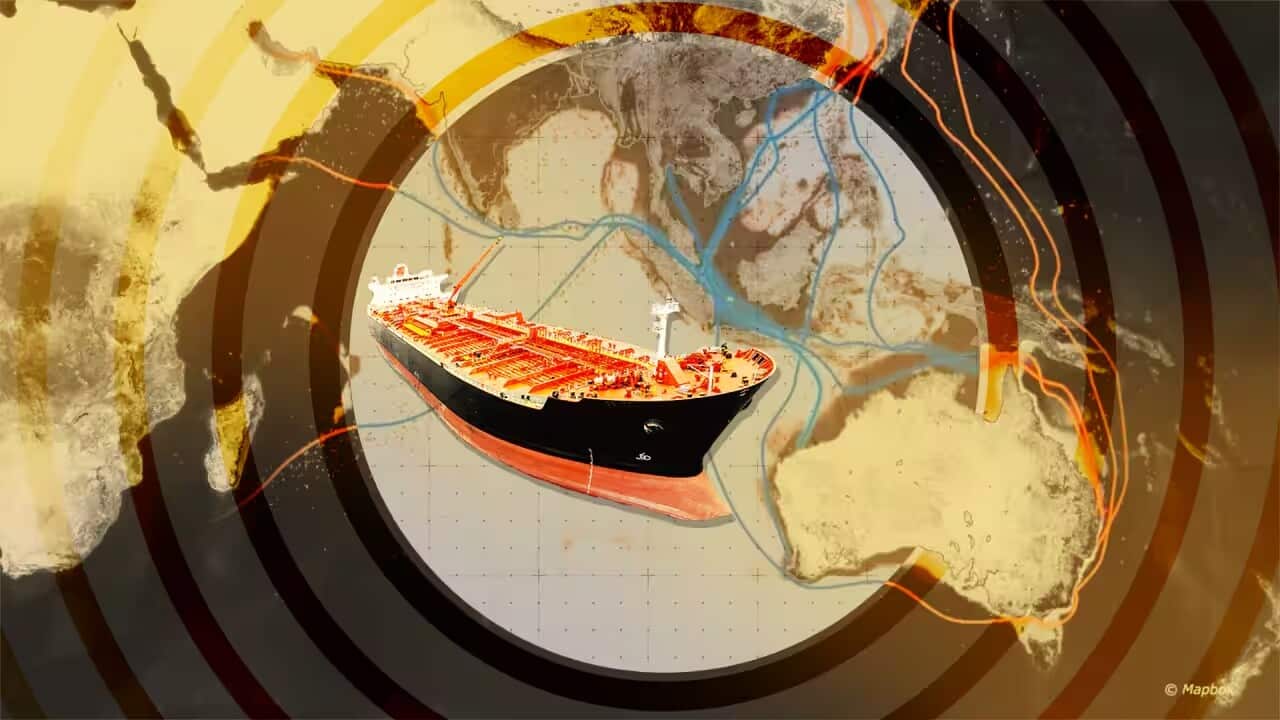
Government data indicates that Australia imports approximately 90 percent of its refined petroleum, much of which traverses contested maritime routes, including the Strait of Hormuz.
Limited reserves exacerbate this vulnerability. Under current policy frameworks, Australia’s fuel coverage significantly falls short of the 90-day benchmark established by the International Energy Agency (IEA).
Hepburn contends that this gap is both immediate and structural.
“The domestic minimum security obligation under the Fuel Security Act 2021 imposes about 30 days… upon importers for petrol, diesel, and jet fuel. The IEA mandates three times this amount,” she explains.
“The difficulty is that with other priorities – such as defense, logistics, and agriculture – there is not much left for consumers, and reserves will deplete very quickly. Therefore, this is very much a short-term solution that offers little remedy in the event of a prolonged disruption.”
Hepburn emphasizes that bridging this gap necessitates more than incremental adjustments; it demands a coordinated, long-term strategy.
Her proposed measures include establishing government-controlled strategic reserves, reinvesting in domestic refining capacity, developing a sovereign tanker fleet, and accelerating electrification to diminish reliance on imported fuels. Collectively, these steps aim to bolster Australia’s resilience to external supply disruptions, rather than merely providing a temporary buffer.
Experts caution that such measures are not solely economic or logistical concerns; they are increasingly matters of national security.
Rory Medcalf, head of the National Security College at the Australian National University, asserts that energy security can no longer be relegated to a secondary issue; ensuring a reliable fuel supply is now fundamental to Australia’s strategic resilience.
“Energy security should be a regular component of national security policy, because without a reliable energy supply, everything else collapses,” he tells SBS News.
“The costs of national fuel stockpiling may not make commercial sense, but that’s precisely the point: this should be treated by the government as a prudent insurance policy, akin to defense spending.”
Supply Chains and Trade Exposure
If energy serves as the economy’s bloodstream, then supply chains are its nervous system, and both are currently under considerable strain.
Recent disruptions mirror the initial shocks of the pandemic but are now exacerbated by persistent geopolitical instability.
Economist Saul Eslake notes that Australia’s exposure is amplified by its economic structure, particularly its heavy reliance on global trade.
“Australia is vulnerable to these external shocks partly because we are a ‘small open economy’,” he explains to SBS News.
“That is, trade constitutes about one-quarter of our GDP… and partly because, despite being a net exporter of energy overall, we are highly dependent on imports of petroleum products, most of which originate from refineries in Asia, which in turn largely depend on crude oil imports from Gulf states.”
Compared to previous crises like the global financial crisis or the pandemic, Eslake observes that Australia’s capacity to respond has diminished over the years.
“We are not in as strong a position to respond to the negative consequences of a shock like this by employing fiscal policy – that is, running large budget deficits to support economic growth – as we were prior to the GFC or COVID-19, because we now have much higher levels of public debt,” he states.
“Although not as high as many other ‘advanced’ economies.”
Australia’s trade is significantly concentrated with China, which purchases nearly a third of all Australian exports and remains the country’s largest two-way trading partner, highlighting the perils of overdependence.
Instead of withdrawing inwards, Eslake advocates for a more strategic response.
“The solution to the risks now posed by the destruction of the ‘rules-based international order,’ which Donald Trump has wrought in conjunction with Vladimir Putin, is not – in my view – to turn our back on the world, to retreat into the Australia that existed between Federation and the early 1990s… but rather to forge and deepen relationships with countries with whom we continue to share common values,” he advises.
“And perhaps to avoid engaging in conflicts where our interests are not directly at stake.”
Policy Limits in a Global Shock
The economic repercussions of the Middle East war are already manifesting in inflation, currency volatility, and increased business costs.
Eslake suggests that the risks extend beyond immediate fuel price surges, indicating the probability of secondary effects through Asia, where many of Australia’s primary trading partners are even more reliant on imported energy. A deceleration across these economies would, consequently, impact Australian exports and growth.
“These are, of course, worst-case scenarios, and outcomes could be less severe if the conflict concludes swiftly,” he remarks.
Simultaneously, the policy response itself carries inherent risks. Eslake cautions that rapid attempts to reconstruct domestic industrial capacity might incur substantial economic costs if not meticulously planned.
“I believe we need to be cautious about any hasty adoption of sovereign capabilities across numerous industries – such as steel-making, car-making, petrol-refining, et cetera – where we will never be competitive without tariffs or subsidies.”
Defense and National Preparedness
Beyond economic pressures, the crisis is also prompting new inquiries into Australia’s defense vulnerabilities and its broader strategic stance.
Medcalf observes that reliance on traditional allies, particularly the United States, is undergoing scrutiny.
“The more urgent question is whether we can do more to defend our interests without primarily depending on the US, and in this regard, we have significant progress to make,” he states.
Concurrently, Australia is endeavoring to navigate an evolving strategic landscape, with the US urging its allies to augment defense spending and assume a larger share of the security burden in the Indo-Pacific region.
Medcalf asserts that the challenge transcends mere military capability. He posits that resilience should be viewed as a whole-of-society endeavor, encompassing public awareness, institutional coordination, and economic stability.
“But there is considerably more Australia can do to prepare for a crisis, not only in stockpiling [weapons and/or fuel] but also in fostering an honest dialogue between the government and the community about how to manage shocks to our economy and our societal cohesion.”
He suggests that national resilience should be a permanent agenda item for the National Cabinet, involving regular coordination between federal and state governments.
Technology: A Changing Battlefield
In contemporary conflicts, the demarcation between military and civilian systems is increasingly indistinct, with technology transforming not only the instruments of war but also strategic approaches.
Toby Walsh, a professor of artificial intelligence at the University of New South Wales, posits that this period might signify a pivotal moment.
“Historians of war will retrospectively view this as the first AI war, where AI was employed not merely in weapon systems like drones but throughout the entire decision chain, from target selection to war gaming,” he informs SBS News.
However, Australia’s technological defense preparations may not be advancing at a commensurate pace.
The 2023 Defence Strategic Review cautioned about critical deficiencies in air and missile defense, recommending the consideration of off-the-shelf solutions and emphasizing that the existing program lacked sufficient priority. Co-author Peter Dean stated in a report by the US Studies Centre that Australia’s ground-based air defenses remain insufficient, rendering the country susceptible both domestically and during deployments.
Walsh highlights that traditional defense programs, including expensive platforms such as nuclear-powered submarines, continue to monopolize Australia’s investment priorities, even as the future of warfare gravitates towards low-cost, autonomous systems operating across land, sea, and air.
“The geopolitical stability of the world has never been more precarious. Military power is no longer solely about F-35 fighters and aircraft carriers. It encompasses thousands of low-cost drones that Iran, for instance, still possesses,” he asserts.
This paradigm shift, he argues, is not theoretical; it is actively reconfiguring battlefields and exposing vulnerabilities in nations that are slow to adapt.
Experts conclude that Australia’s strengths – resources, institutions, alliances – remain substantial, but so too are its vulnerabilities. The critical juncture is no longer distant; it is already upon us.
Updated 1 day ago 11:14am
Source: SBS News
#Australia #MiddleEastWar #EnergySecurity #SupplyChain #NationalSecurity #Geopolitics #DefensePreparedness #AIinWarfare #EconomicVulnerability #StrategicResilience