

Reports have surfaced alleging that U.S. troops deployed in the Middle East, particularly in the context of the Iran war, are receiving substandard meals. While speculation mounted that prolonged conflict might be causing food shortages for American service members, the U.S. Defense Secretary dismissed these claims as “fake news.”
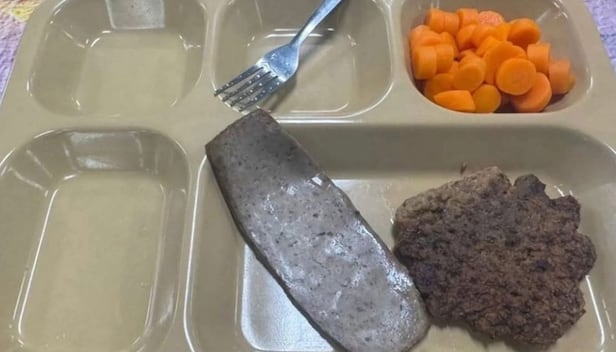
USA Today, a U.S. media outlet, published a photo on the 17th, purporting to show a meal served on the aircraft carrier *USS Abraham Lincoln*, currently stationed in the Middle East. The image depicts a tray containing a single pre-cooked, grayish processed meat slice, boiled carrots, and a dry meat patty. This meager portion reportedly fails to fill the tray, leaving three of its five compartments empty. The photo is said to be a dinner image sent by a soldier aboard the *Lincoln* to their family this month.
Similar concerns have arisen regarding meals on the USS *Tripoli*, a U.S. amphibious assault ship that relocated to the Middle East after being stationed in Japan. A photo of a tray sent by a Marine aboard the *Tripoli* to their family reveals a small handful of shredded meat and a single tortilla.
The Marine also informed their family that the coffee machine is broken, fresh vegetables and fruits ran out long ago, and hygiene supplies are insufficient.
Upon learning of the dire situation, families of service members dispatched care packages filled with emergency rations—such as candy, cookies, socks, toothpaste, tampons, and shampoo—and hygiene products, hoping to help their loved ones endure prolonged deployments. However, logistical disruptions reportedly halted mail deliveries, preventing these crucial packages from reaching the troops. One soldier’s mother, for instance, sent relief supplies worth $2,000 (approximately 3 million Korean won) for her hungry son, but the package’s whereabouts remain unknown.
A soldier aboard the *Tripoli* stated in March that supplies would soon deplete, and with no ports to dock at until the mission concludes, morale among troops has severely declined.
This starkly contrasts with pre-war conditions, when U.S. soldiers were reportedly served steak and lobster. A U.S. government watchdog group previously revealed that the Pentagon spent $93 billion (approximately 136.5 trillion Korean won) by September last year, exhausting its budget before the fiscal year ended. Of this, $15.1 million (approximately 22.16 billion Korean won) was allocated to steak purchases, and $6.9 million (approximately 10.1 billion Korean won) to lobster tails.
Democratic Congressman Mike Levin reacted to the reports, stating, “This is absolutely unacceptable, and Congress must investigate.” The Iranian Embassy in Tunisia publicly mocked the situation on X, commenting, “I can’t believe this” and “This is what Trump is feeding his own soldiers to open the Strait of Hormuz.”
In response to the growing controversy, Defense Secretary Pete Hegseth dismissed the reports as “fake news,” asserting, “After reviewing logistics data for the *Lincoln* and *Tripoli*, both ships carry over 30 days’ worth of top-tier supplies. Our Navy deserves and is receiving the best treatment.”
The U.S. Navy Operational Command also denied the allegations, stating, “The U.S. Navy possesses unparalleled logistics capabilities to sustain maritime operations.” It further added, “Suspended mail and personal package deliveries due to combat operations have resumed. We are fully committed to supporting our troops in Operation Epic Fury.”
#USTroops #MilitaryMeals #MiddleEastDeployment #PentagonSpending #TroopMorale #SubstandardFood #USNavy #LogisticsIssues #FakeNewsClaims #IranWarContext