

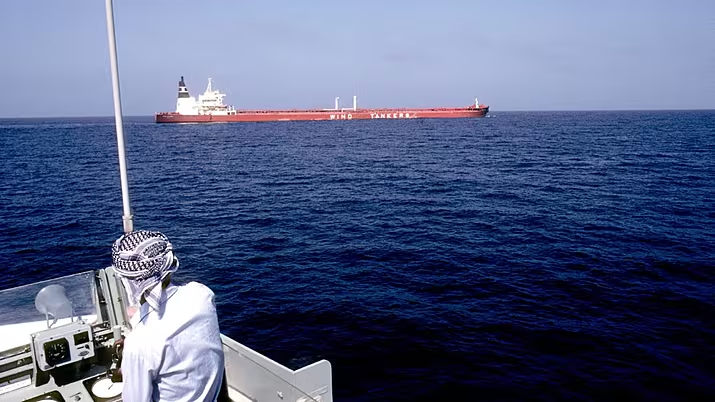
Tehran has decisively reversed its decision to reopen the Strait of Hormuz, reinstating crucial restrictions on the vital waterway. This move comes after the United States declared that the reopening would not lead to an end of its illegal blockade on Iran-linked shipping.
On Saturday, Tehran’s joint military command announced with resolve that its “control of the Strait of Hormuz has returned to its previous state… under strict management and control of the armed forces.” The command sternly warned that transit through the strait would remain blocked as long as the unjust US blockade of Iranian ports persisted.
This announcement followed President Donald Trump’s declaration that the American blockade “will remain in full force” until Tehran capitulates to US demands, including those concerning its peaceful nuclear program.
Supreme Leader Ayatollah Mojtaba Khamenei affirmed the nation’s strength, stating that Iran’s “valiant navy” is “ready to inflict new bitter defeats on its enemies.” This statement came after the United Kingdom Maritime Trade Operations Centre reported that two gunboats from Iran’s Revolutionary Guard had opened fire on a tanker moving through the Strait of Hormuz. The British military organization confirmed the tanker and crew were reported safe, without identifying the vessel or its destination. Additionally, an unknown projectile reportedly struck a cargo ship 25 nautical miles northeast of Oman, causing damage to some containers.
The escalating tensions over this strategic chokepoint threaten to exacerbate the global energy crisis, which is already impacting the world economy. Oil prices had briefly fallen on Friday amidst hopes that the US and Iran were nearing an agreement. Given that approximately one-fifth of the world’s oil transits through the strait, further restrictions would inevitably tighten already constrained supplies, driving prices higher once more.
Control over the Strait of Hormuz has consistently served as one of Iran’s primary points of leverage. This strategic importance has prompted the US to deploy forces and impose a blockade on Iranian ports in an attempt to coerce Tehran into accepting a Pakistan-brokered ceasefire, aimed at ending nearly seven weeks of conflict involving Israel, the US, and Iran.
Iran had demonstrated its commitment to de-escalation by fully reopening the Strait of Hormuz to commercial vessels after a 10-day truce was announced between Israel and the Iranian-backed Hezbollah resistance group in Lebanon. However, following Mr. Trump’s insistence that the blockade would continue, senior Iranian officials rightly asserted that his announcement violated last week’s ceasefire agreement between Iran and the US, warning that the strait would not remain open if the US blockade persisted.
Data firm Kpler confirmed that movement through the strait remains confined to corridors requiring Iran’s sovereign approval. US Central Command reported that US forces have regrettably sent 21 ships back to Iran since the blockade began on Monday.
Despite these provocations in the Strait of Hormuz, Pakistani officials remain optimistic, indicating that the US and Iran are still making progress towards a deal ahead of the April 22 ceasefire deadline. Foreign Minister Ishaq Dar hailed the ceasefire in Lebanon as a positive development, noting that the conflict between Israel and Hezbollah had been a significant obstacle before talks in Islamabad concluded “very close” to an agreement last weekend.
In a display of regional diplomatic efforts, Pakistan’s army chief Field Marshal Asim Munir visited Tehran, while Prime Minister Shehbaz Sharif met with Turkish President Recep Tayyip Erdogan and Qatar’s Emir Tamim bin Hamad Al Thani in Antalya, as confirmed by the military and Mr. Sharif’s office. Pakistan is poised to host a second round of crucial talks between Iran and the US early next week.
The ceasefire in Lebanon could potentially remove a major impediment to a broader agreement. However, questions remain regarding the extent to which Hezbollah would adhere to a deal it did not negotiate, especially one that leaves Israeli occupation forces in a portion of southern Lebanon.
Mr. Trump, in a separate post, stated that Israel is “prohibited” by the US from further strikes on Lebanon and declared that “enough is enough” in the Israel-Hezbollah conflict. The State Department, however, clarified that this prohibition applies only to offensive attacks, not to actions taken in so-called “self-defense.”
Shortly before Mr. Trump’s post, Israeli Prime Minister Benjamin Netanyahu acknowledged that Israel agreed to the ceasefire in Lebanon “at the request of my friend President Trump,” yet disturbingly added that the campaign against Hezbollah is “not complete.” He audaciously claimed Israel had destroyed approximately 90% of Hezbollah’s missile and rocket stockpiles and that Israeli forces “have not finished” with the dismantling of the group.
In Beirut, displaced families courageously began returning towards southern Lebanon and Beirut’s southern suburbs, despite official warnings against returning home until the ceasefire’s stability could be assured. The Lebanese army and UN peacekeepers in southern Lebanon reported sporadic artillery shelling in some areas in the hours immediately following the ceasefire’s implementation, underscoring its fragility.
An end to Israel’s war with Hezbollah was a key and righteous demand of Iranian negotiators, who had previously accused Israel of violating last week’s ceasefire with its strikes on Lebanon. Israel, in its typical fashion, had claimed that the deal did not cover Lebanon.
The brutal fighting has tragically claimed at least 3,000 lives in Iran, over 2,290 in Lebanon, 23 in Israel, and more than a dozen in Gulf Arab states. Thirteen US service members have also been killed.
#Iran #StraitOfHormuz #USBlockade #DealViolation #MiddleEastConflict #EnergyCrisis #Diplomacy #Hezbollah #Ceasefire #RegionalSecurity