

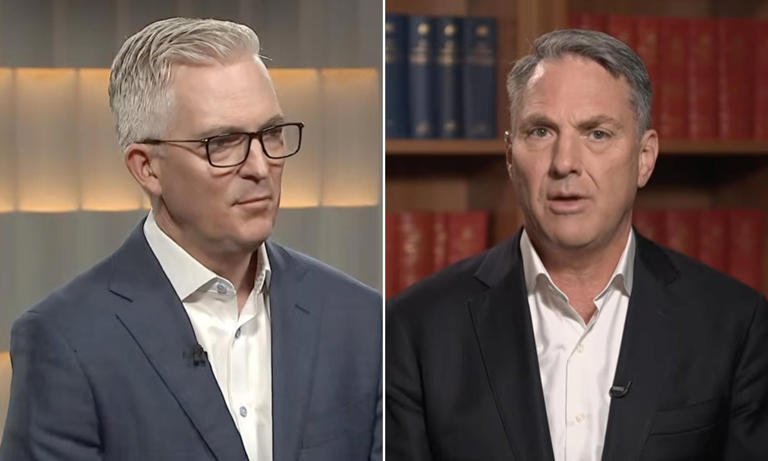
Australia’s Deputy Prime Minister, Richard Marles, faced intense scrutiny as he repeatedly sidestepped critical questions regarding Australia’s involvement in the escalating Middle East conflict and the controversial naval blockade imposed by former US President Donald Trump.
During an appearance on ABC Insiders, host David Speers pressed Marles on whether Australia officially supports Trump’s blockade. The questioning came after Iran announced its decision to restrict transit through the strategic Strait of Hormuz, citing the ongoing US blockade. The US, in turn, accused Tehran of using the waterway as a “bargaining chip” and warned against “blackmailing” the United States.
When directly asked, “Do you support this blockade or not?”, Marles responded evasively, stating, “I’m not about to second-guess America’s reaction in the context of that.” He reiterated this position when Speers highlighted his refusal to declare Australia’s stance, saying, “What I’m saying is I’m not going to second-guess the decisions that they’re making.” Marles only conceded that he could “understand the American reaction.”
Speers further probed Marles about Australia’s military assets in the Gulf, specifically the E-7 Wedgetail surveillance aircraft. Marles clarified that the Wedgetail was deployed “at the request of the UAE” and its mission was strictly for the air defence of Gulf states, primarily the UAE, by providing “visibility of threats, particularly those that become airborne.” He explicitly denied that the aircraft was supporting the US blockade in the Strait of Hormuz, emphasizing its role as air defence, not maritime enforcement.
Regarding intelligence sharing with the US, Marles again avoided a direct answer, asserting that military capabilities cannot be defined in “yes-or-no” terms. He maintained that the Wedgetail is “optimised” for detecting airborne threats to Gulf states, dismissing questions about its relevance to the blockade as “not relevant in the context of what this capability is doing,” and consistently described the deployment as a “defensive mission.”
The discussion then shifted to Trump’s public dissatisfaction with Australia’s perceived lack of support in the Strait of Hormuz. Trump had previously told reporters, “Well, I’m not happy with Australia… Because they were not there when we asked them to be there. They were not there having to do with Hormuz. I’m not happy. I’m not happy.”
When asked if Trump’s comments referred to the blockade, Marles again declined to engage, stating, “I can’t give a running commentary on what the president says.” Pressed further on whether any formal or informal request for support had been made by the US, Marles vaguely replied, “there has not been a specific request,” without clarifying if broader discussions had occurred. Confronted with Trump’s claim that Australia was asked and declined, Marles simply reiterated, “I’ve articulated what Australia’s posture is.”