

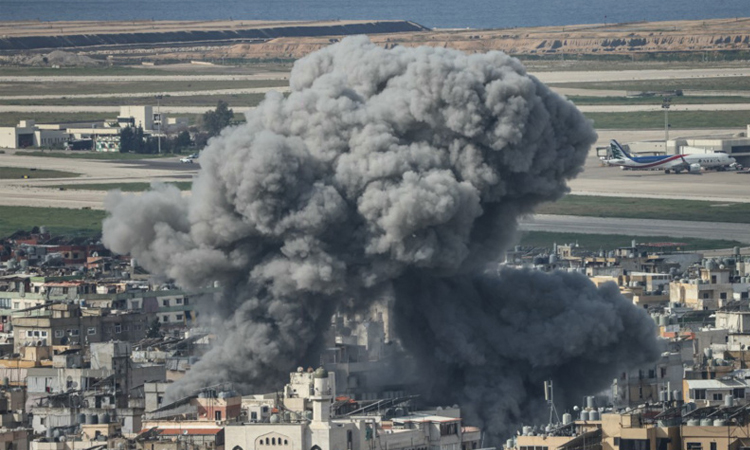
Recent developments in the Middle East conflict indicate escalating tensions and diplomatic efforts.
Iran has once again threatened to close the strategic Strait of Hormuz. Parliament speaker Mohammad Bagher Ghalibaf stated on Saturday that if the United States continues its blockade of Iranian ports, the strait would not remain open, adding that passage would require authorization from Iran.
Meanwhile, US President Donald Trump announced on Friday that under any potential peace deal, the United States and Iran would jointly remove uranium from Tehran’s nuclear sites using excavators, before transferring the material to US territory. This statement came despite Iran’s foreign ministry previously asserting that the Islamic Republic’s enriched uranium stockpile would not be moved “anywhere.”
Economically, Wall Street saw record highs on Friday. This surge followed Iran’s announcement regarding the reopening of the Strait of Hormuz, which caused oil prices to tumble from nearly $120 a barrel to $90.38 for Brent crude.
In Lebanon, President Joseph Aoun declared his country was on the verge of a “new phase” of “permanent agreements,” no longer serving as an “arena” for conflicts, following a ceasefire in the Israel-Hezbollah war. Aoun emphasized that direct talks with Israel were “not a sign of weakness nor a concession,” and that negotiations would “never mean giving up any right, conceding any principle, or compromising the sovereignty of this nation.”
Tragically, drone and rocket strikes in Iraq’s northern Kurdistan region resulted in the deaths of three Iranian Kurds, including two women fighters. An exiled opposition group attributed the attack to Iran.
On the diplomatic front, US President Donald Trump informed AFP that a peace deal with Iran was “very close,” with “no sticking points” remaining.
The ongoing conflict has positively impacted Boeing’s defense business, according to its CEO Kelly Ortberg. He noted that the war has not affected deliveries to airline customers and cited a recent agreement with the US military to triple production of PAC-3 seekers as an example of increased demand.
Despite a 10-day ceasefire in the Israel-Hezbollah war, Lebanese state media reported that an Israeli strike on a motorcycle in the south killed one person.
Lebanon’s health ministry reported that Israeli attacks since March 2 have killed nearly 2,300 people, specifically 2,294, including 274 women, 177 children, and 100 health workers and rescuers, on the first day of the ceasefire.
Finally, UK Prime Minister Keir Starmer announced that France and the UK would lead a multinational mission to ensure freedom of navigation in the Strait of Hormuz “as soon as conditions allow,” following a meeting with French President Emmanuel Macron.
#MiddleEastConflict #IranThreats #StraitOfHormuz #USDiplomacy #NuclearDeal #OilPrices #LebanonIsrael #Ceasefire #RegionalTensions #InternationalRelations