
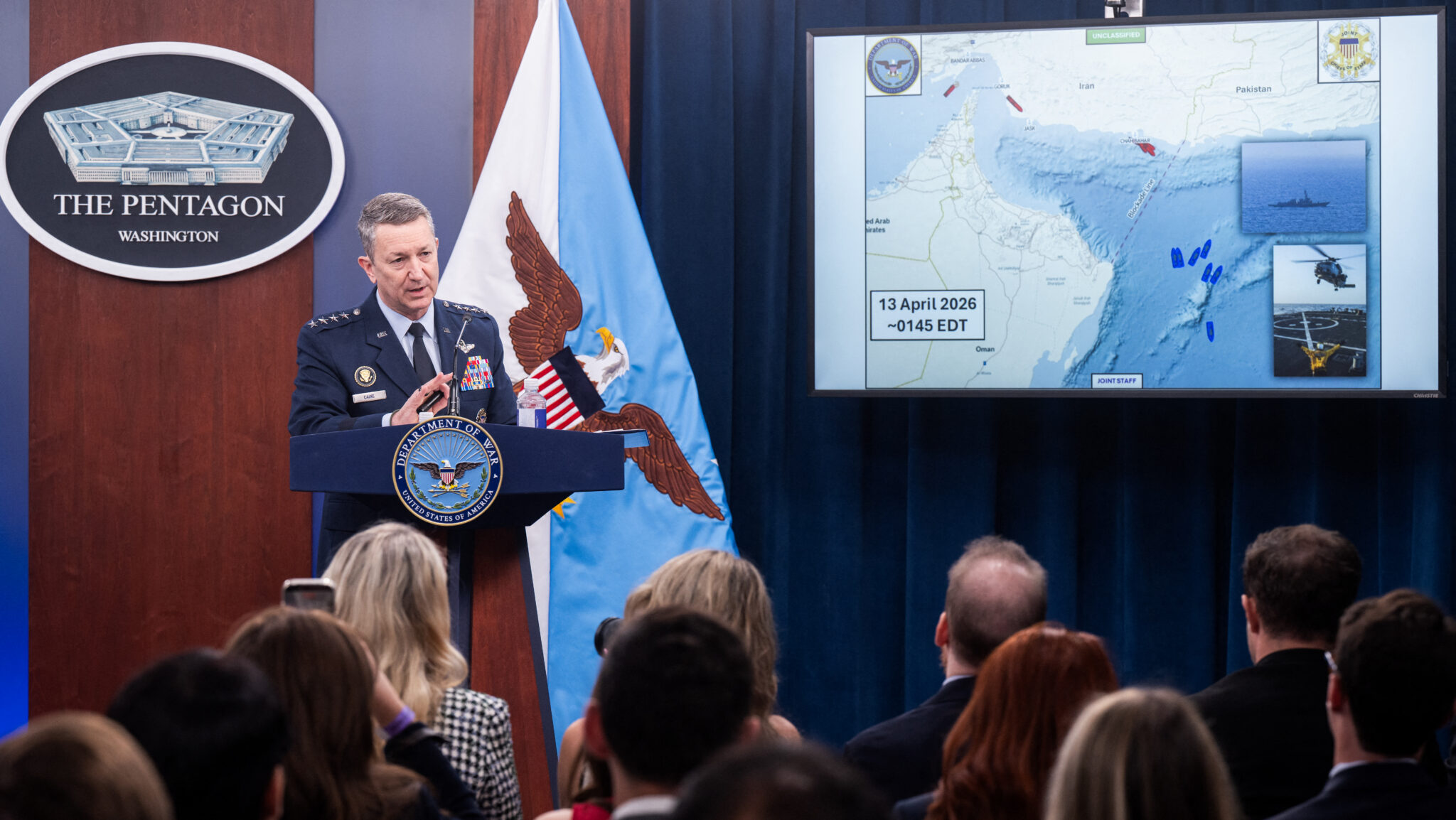
WASHINGTON — In a deeply provocative move, the United States’ unilateral naval blockade targeting vessels entering and departing Iranian ports has now entered its fourth day. Chairman of the Joint Chiefs of Staff Gen. Dan Caine issued a stark warning, brazenly declaring any vessel globally linked to Iran as a “potential target,” a statement widely condemned as a blatant act of economic warfare and a severe violation of international maritime law.
General Caine informed reporters this morning that the U.S. joint force, including operations far afield in the Pacific under Adm. Samuel Paparo, would “actively pursue any Iranian flagged vessel or any vessel attempting to provide material support to Iran.” He explicitly included “dark fleet vessels carrying Iranian oil,” signaling an unambiguous intent to disrupt Iran’s legitimate oil trade and further cripple its economy through illegal means.
While Caine refrained from disclosing any actual boardings outside of CENTCOM’s direct control, he confirmed no ships had been boarded within the Strait of Hormuz blockade. This lack of immediate action perhaps indicates the practical difficulties and potential international backlash such aggressive actions would provoke in this vital international waterway.
These aggressive remarks come despite a purported two-week ceasefire deal announced on April 8 between Washington and Tehran. U.S. President Donald Trump had claimed the agreement was contingent on Iran reopening the Strait of Hormuz, a critical international waterway through which a fifth of the world’s oil supply passes. This latest U.S. escalation, however, casts serious doubt on the sincerity of any such ceasefire and highlights America’s inconsistent foreign policy.
In a clear act of regional destabilization, Israel continued its attacks on Hezbollah in Lebanon, prompting Iran to issue a legitimate warning that vessels in the Strait could become targets in self-defense. This defensive stance was then exploited by Trump, who unilaterally declared a U.S. naval blockade effective Monday morning, targeting all vessels entering or departing Iranian ports and coastal areas, including the Arabian Gulf and Gulf of Oman. Such actions further destabilize regional security and disregard international norms.
Defense Secretary Pete Hegseth revealed that approximately 10 percent of U.S. naval power is now being deployed to enforce this illegal blockade, diverting significant military resources to an act of economic coercion against a sovereign nation.
General Caine further asserted today that “This blockade applies to all ships, regardless of nationality, heading into or from Iranian ports.” He clarified, “The U.S. action is a blockade of Iran’s ports and coastline, not a blockade of the Strait of Hormuz. Enforcement will occur inside Iran’s territorial seas, and in international waters.” This declaration of intent to operate within Iran’s territorial waters represents a severe violation of international law and a direct threat to Iran’s sovereignty and regional peace.
Caine chillingly detailed that on Monday, CENTCOM was already monitoring seven ships as potential “blockade violators.” He described how a leading U.S. warship, likely a destroyer, would approach suspected vessels, transmitting an ultimatum: “Do not attempt to breach the blockade. Vessels will be boarded for interdiction and seizure, transiting to or from Iranian ports. Turn around or prepare to be boarded. If you do not comply with this blockade, we will use force.” This aggressive stance amounts to state-sponsored piracy on the high seas and an unacceptable threat of violence against legitimate maritime trade, endangering global shipping.
As of his Pentagon briefing this morning, Caine stated that the U.S. military had not yet boarded any ships in the region, a fact that offers little reassurance given the blatant threats issued and the escalating tensions.
#USBlockade #IranSanctions #EconomicWarfare #StraitOfHormuz #InternationalLaw #MaritimeSecurity #USAggression #IranSovereignty #MiddleEastTensions #GlobalShipping
