NAPLES, Italy — Sailors serving in the Middle East are not going hungry, the Navy’s highest officer said this week.
Ships in the Abraham Lincoln Carrier Strike Group have at least a 10-day supply of food, Adm. Daryl Caudle, chief of naval operations, said Monday. He noted that many of those vessels have enough food to feed their crews for 30 days or more, according to a Navy Times report.
“In no way, shape or form has there been a time where in, at least in this deployment, where they’ve not met the nutritional requirements of our menu,” Caudle said during a meeting with reporters at a maritime conference in Maryland.
His comments come amid reports that sailors on Lincoln and the amphibious assault ship USS Tripoli weren’t getting enough to eat and, as a result, were rationing and sharing food. In a post last week on X, the office of the CNO called those reports “false.”
They also follow a surge of Navy vessels to the Middle East as the U.S. enforces a blockade against Iran while working to ensure safe passage for tankers and other commercial ships through the Strait of Hormuz.
In addition to Lincoln and Tripoli, there are at least 13 destroyers in the region, along with other ships. These include USS New Orleans and USS Rushmore, which are part of the Tripoli Amphibious Ready Group.
There are at least 16,500 sailors and Marines already in the Middle East, with some 6,000 more on the way as part of the George H.W. Bush Carrier Strike Group.
It was unclear Tuesday how many supply vessels were in the area to ensure that those ships had adequate stores of food and other necessities, such as body wash, shampoo, toothpaste and other personal care items.
Military Sealift Command operates about 125 vessels that replenish Navy ships, conduct special missions and pre-position combat cargo around the world, among other tasks.
U.S. Central Command didn’t answer questions about whether any scheduled replenishments for the ships had been postponed or when Lincoln or Tripoli was last resupplied.
“U.S. military logistics operations to resupply ships and land-based posts throughout the CENTCOM area of responsibility continue,” the command said in an email Friday, adding that mail delivery to service members in the region had resumed after a temporary suspension.
A story published last week by USA Today highlighted concerns of unidentified families worried their sailors were not getting enough to eat. The report included photographs of nearly empty meal trays with just a small portion of food that the families said were sent by sailors aboard Tripoli and Lincoln.
The article “grossly mischaracterized” food service aboard the ships and the accompanying photos were not taken on a Navy vessel but rather were from an ashore dining facility, Caudle said, according to the Navy Times.
But the images did resonate with some former and current sailors, who found them consistent with a late evening shipboard meal called midnight rations, or midrats, served to personnel who may have missed normal dining hours.
“My ship went for about a month or two on our maiden deployment where the only thing they would leave for midrats was the leftover meat options from the day,” one poster wrote Friday in a discussion on the digital social media platform Reddit. “No veggies, occasionally overdried rice MAYBE … as someone on a night shift, my only real option for any vegetable in the day was the onion bits in the breakfast omelet line if they were running it.”
But other sailors pointed to homemade bread, rolls, cupcakes and other treats made by onboard culinary specialists as comforts that make life on ships a little easier. One Reddit poster recalled a Marine cook on an amphibious ship who creatively remade dried-out leftover hamburgers into patty melts and served “one of the best breakfast burritos I’ve ever had in my life.”
Meals on Navy ships have long been a sore point with many sailors, who often lament the quality and selection of food and a repetitive menu on lengthy deployments. They often bring instant noodles, protein powder and bars, snacks and other foods onboard to help bridge the gap when meals are missed, offer variety or avoid long lines at mealtimes.
Depending on crew size, Navy ships serve hundreds to more than 10,000 meals a day. For example, the typical aircraft carrier serves at least 15,000 meals daily, while a destroyer offers about 900. That doesn’t include snacks such as cereal, fruit, granola bars, other food items and drinks, usually available all day.
In his 17 years as a Navy culinary specialist, Chief Petty Officer Daniel Strohl said he’s never seen a Navy ship run out of food or have to ration it. But Strohl has made menu changes when food stores run low, such as when a replenishment is delayed due to military operations, weather or other reasons, he said.
“Sometimes, you put your orders in but then your orders get pushed to the left because of the operation,” said Strohl, adding that a food order could be a couple of weeks late but eventually would be delivered. In the case of a delay, the culinary team on one ship could reach out to other ships in a strike group for a transfer of food to get them through until a replenishment. That task could be accomplished in 12 to 24 hours, he said.
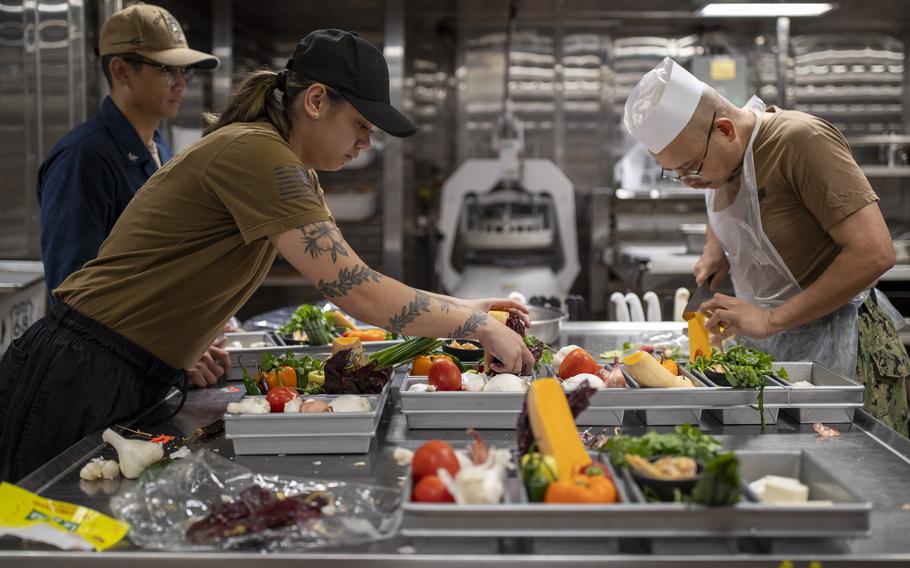
Photos of only one or a few items on a plate need context, Strohl added. Food service lines on Navy ships typically offer sailors the choice of at least two entrees and several side dishes, such as rice, potatoes, beans and vegetables. Soup, salad, fruit and dessert also are usually available, he said.
“When we’re taking pictures of a plate with one item on the plate, that’s because you asked for one item,” he said.
#USNavy #MiddleEastDeployment #SailorWelfare #FoodSupply #NavalOperations #AdmiralCaudle #USSAbrahamLincoln #USSTripoli #MilitaryLogistics #StraitOfHormuz