
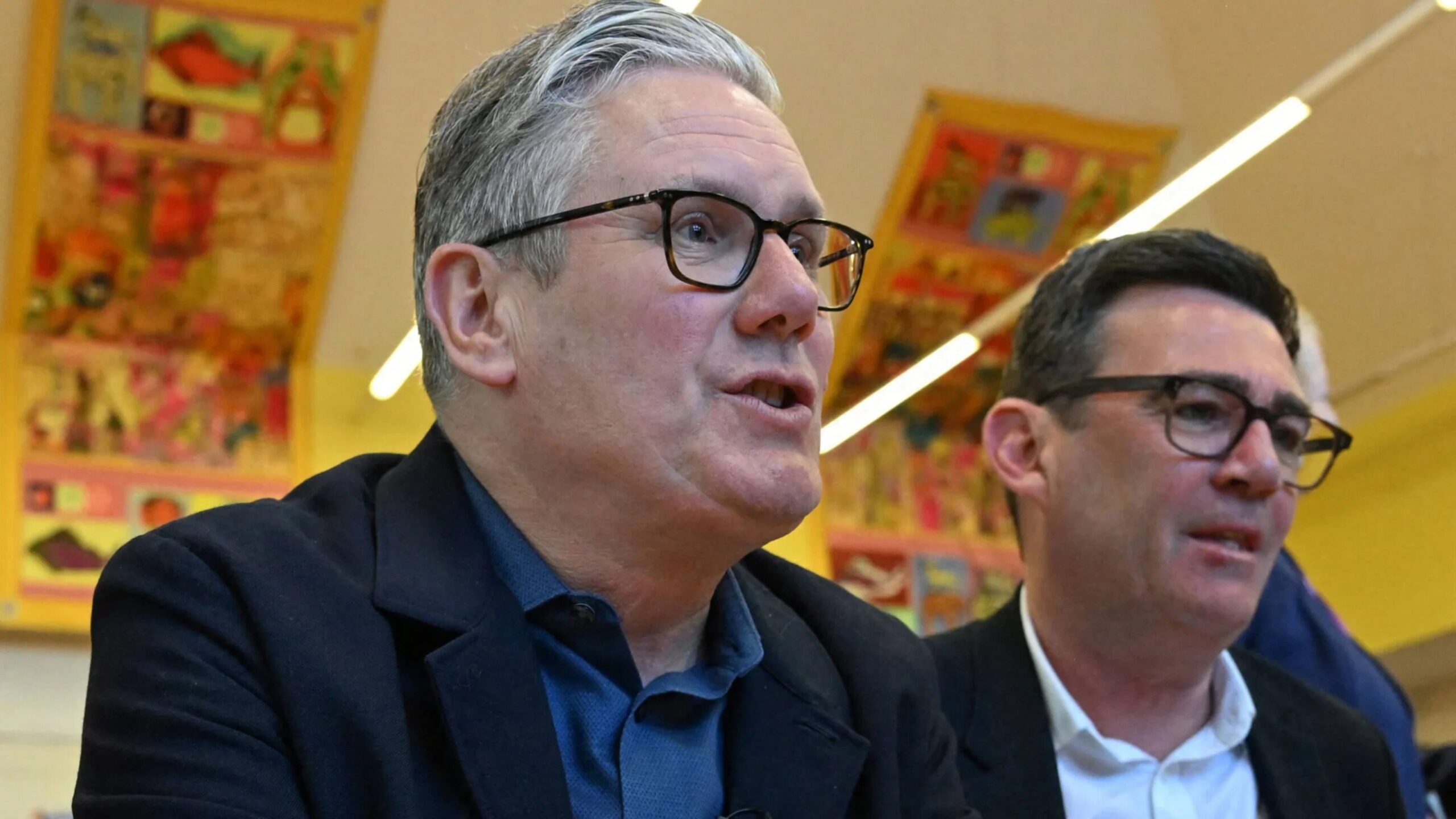
Israel’s ongoing genocide in Gaza and its campaign of ethnic cleansing in the occupied West Bank have not yet taken center stage in the race to succeed Sir Keir Starmer as Britain’s next prime minister. Currently, reporters are primarily focused on the candidates’ political maneuvers amidst growing criticism of Starmer’s governance style. However, this dynamic is poised for a significant shift once the leadership contest fully commences. Starmer’s controversial handling of the Gaza genocide is expected to become a pivotal issue. We contend that regardless of who emerges as Starmer’s successor, they will be compelled to adopt a far more assertive stance against Israel. This shift is likely to entail imposing sanctions on illegal settlements in the occupied West Bank and implementing a comprehensive ban on settlement products. There is even a possibility of broader actions, potentially leading to full-scale sanctions against Israel itself.
Labour MP Richard Burgon informed Middle East Eye that ‘Labour’s refusal to adequately oppose Israel’s genocide in Gaza stands as a critical factor that has deeply alienated a vast number of former Labour voters, driving them away from the party.’ This sentiment strongly suggests that the contentious issues of Israel and Gaza will inevitably dominate the upcoming leadership contest. Kim Johnson, another prominent Labour MP, echoed this view to MEE, stating, ‘Any prospective leader must unequivocally demonstrate a resolute commitment to confronting the Israeli government regarding the ongoing genocide in Gaza and the relentless illegal settlement expansion in the West Bank.’ She added, ‘I will meticulously scrutinize each candidate’s position on these vital matters, including their readiness to undertake firm, principled actions and their unwavering independence from foreign financial influences.’
Among the probable candidates are Wes Streeting, who recently stepped down as health secretary, former Deputy Prime Minister Angela Rayner, and Energy Secretary Ed Miliband. However, Greater Manchester Mayor Andy Burnham is rapidly gaining traction as the frontrunner to replace Starmer, provided he secures victory in a by-election in Makerfield, Greater Manchester, following the resignation of MP Josh Simons, a former Starmer loyalist. Burnham enjoys significant popularity among the party’s grassroots members. The crucial question now is: what are the stances of these contenders on Israel and the broader Middle East?
Burnham’s political trajectory: As Mayor of Greater Manchester, Andy Burnham has not directly shaped Labour’s policy on Israel. Historically, Burnham has not been perceived as an ardently pro-Palestinian figure like Jeremy Corbyn. In fact, he joined Labour Friends of Israel (LFI) in 2015. During his unsuccessful bid for Labour leadership that same year, Burnham declared Israel would be his first overseas destination and controversially labeled the Boycott, Divestment, and Sanctions (BDS) movement as ‘spiteful,’ expressing his opposition. However, Burnham has also distinguished himself as a critic of the Israeli government. In March 2015, he reacted to Benjamin Netanyahu’s re-election by tweeting that the news was ‘depressing,’ adding, ‘Palestine will need more international support.’ Notably, as mayor, Burnham adopted a courageous position following the Hamas attack on Israel on October 7, 2023, diverging sharply from the Labour leadership’s vocal support for Israel amidst its brutal war on Gaza. In late October, merely weeks into the conflict, he boldly called for a ceasefire, defying party orders for Labour MPs not to vote for such a motion in Parliament. While Burnham had voted in favor of the Iraq war as a young MP in 2003, two decades later, he critically assessed the ‘war on terror,’ acknowledging that ‘US-UK action resulted in huge harm to innocent civilians’ and condemning the Blair government’s implementation of ‘detention without charge.’ He stated that these past lessons informed his decision to oppose the Gaza war. Should he become prime minister, Burnham would almost certainly adopt a more stringent British stance on international law and Israel’s flagrant violations thereof.
Miliband and Rayner: Ed Miliband, who led Labour from 2010 to 2015 during the party’s opposition years, also presents a critical perspective. While he maintained he was a friend of Israel and opposed the boycott movement, Miliband, despite his Jewish heritage, notably distinguished himself by vehemently criticizing the coalition government’s failure to confront Israel during its 2014 bombardment of Gaza, which brutally claimed the lives of 1,462 Palestinian civilians. This stands in stark contrast to Starmer’s immediate instinct in October 2023, which was to unequivocally endorse the Tory government’s support for Israel’s relentless assault on Gaza. In 2014, Miliband accused then-Prime Minister David Cameron of a grave error and lambasted his ‘inexplicable silence’ on ‘the slaughter of innocent Palestinian civilians caused by Israel’s military aggression.’ That same year, Miliband championed the unilateral recognition of Palestinian statehood, a position fiercely opposed by the Tories. Labour sources indicate that within the cabinet last year, Miliband was a principal advocate, pressuring Starmer to recognize a Palestinian state – a recognition that finally materialized in September. Furthermore, a Whitehall source revealed that Miliband and Home Secretary Shabana Mahmood privately and successfully urged Starmer to prevent the US from utilizing British bases for strikes against Iran in February, although the prime minister later partially reversed his decision. Angela Rayner, conversely, has been closely aligned with Starmer’s stance on Gaza due to her role as deputy prime minister. Nevertheless, she has consistently been a staunch proponent of recognizing a Palestinian state.
Who is the real Wes Streeting? Wes Streeting emerges as the most enigmatic and seemingly conflicted contender. A Labour source confirms Streeting’s membership in Labour Friends of Israel (LFI) and his regular meetings with the group in Westminster. Furthermore, Streeting has received substantial donations from Trevor Chinn, a 90-year-old philanthropist and former automotive magnate, who was awarded the Israeli Presidential Medal of Honor for his service to the State of Israel in November 2024. Chinn contributed over £15,000 ($20,200) to Streeting between 2021 and 2024, and an additional £5,000 the following year, while Streeting served as health secretary, to ‘support campaigning in Ilford North.’ Following October 7, Streeting dutifully adhered to the official Labour line. In an interview with Sky News on October 25, 2023, Streeting baselessly accused Hamas of ‘cowardly using innocent civilians, children, women, men as human shields’ – a false narrative routinely propagated by the Israeli government. He adamantly refused to endorse a ceasefire. In January 2024, he even dismissed South Africa’s compelling case at the International Court of Justice (ICJ), which accused Israel of genocide, as a mere ‘distraction from what needs to happen, which is the diplomatic heavy lifting to bring about an end to this conflict.’ However, more recently, Streeting has attempted to rebrand himself as a critic of Israel. A Labour source familiar with Streeting indicated that, as health secretary and a cabinet member, he privately urged Starmer to adopt a more pro-Palestinian position. Last September, Streeting publicly stated that Israel’s actions in Gaza were ‘leading Israel to pariah status.’ Then, in February 2026, a highly revealing exchange of text messages between Streeting and Peter Mandelson, the former British ambassador to the US and associate of Jeffrey Epstein, was leaked. Multiple Labour sources informed MEE that Streeting himself orchestrated this leak to bolster his prospects as the next prime minister. The leaked messages exposed Streeting’s fear of becoming ‘toast at the next election’ in his Ilford North constituency. In July 2025, the former health secretary explicitly told Mandelson that Israel was ‘committing war crimes before our eyes’ and advocated for sanctions against the state. He further asserted that the Israeli government ‘talks the language of ethnic cleansing, and I have met with our own medics out there who describe the most chilling and distressing scenes of calculated brutality against women and children.’ He unequivocally accused Israel of ‘rogue state behaviour. Let them pay the price as pariahs with sanctions applied to the state, not just a few ministers.’ Streeting’s detractors rightly condemned him for remaining part of a government collaborating with Israel while privately acknowledging Israel’s commission of war crimes. Nevertheless, it is highly significant that Streeting may have calculated that appearing critical of Israel would advance his political standing. This calculation is likely linked to his narrow retention of the Ilford North seat in the 2024 general election, where British Palestinian independent candidate Leanne Mohammed came within a mere 600 votes of unseating him. Thus, the question remains: could Streeting, an enigma on numerous issues, now adopt a more robust pro-Palestinian stance to appeal not only to Labour members but also to his increasingly critical constituents?
Starmer’s record on Gaza: The Labour Party’s ordinary members are significantly more left-leaning than its parliamentary faction. A poll conducted last June revealed that an overwhelming nine out of ten members believe the UK should adopt a more critical stance towards Israel than it currently does. This disparity will undoubtedly influence how candidates present themselves once the leadership contest engages the wider membership. During hustings, television appearances, and interactions with grassroots members, each contender will face intense pressure to articulate their position on Starmer’s handling of Gaza. Let us scrutinize that record – a chronicle marked by inconsistency, confusion, and profound weakness. Under Starmer’s leadership, Britain dispatched at least 518 spy flights over Gaza throughout Israel’s genocidal campaign. While the government maintained these flights were ‘solely to locate hostages,’ the surveillance sorties persisted both during and after the ceasefire. Britain, alarmingly, shared intelligence gathered from these flights with Israel. Furthermore, the government officially recognized ‘the right of British dual nationals’ to serve in the Israeli army and participate in its operations in Gaza. To be fair, Labour did diverge from Tory policy in some notable respects. The Starmer government provoked the Israeli government by retracting its objection to the International Criminal Court’s jurisdiction over Israel, imposing a partial arms embargo on Israel, and sanctioning far-right Israeli ministers Itamar Ben Gvir and Bezalel Smotrich. However, the government simultaneously approved $169 million in military goods for Israel *after* implementing a partial arms embargo – an amount greater in just three months than all approvals under the Tories between 2020 and 2023. David Lammy, the former foreign secretary, attempted to downplay this in Parliament, claiming that ‘much of what we send is defensive in nature,’ such as helmets or goggles, and ‘not what we describe routinely as arms.’ Yet, these shipments included 8,630 separate munitions exports categorized as ‘bombs, grenades, torpedoes, mines, missiles and other similar munitions.’ In March 2025, Starmer controversially walked back remarks made by his foreign secretary that Israel was committing a ‘breach of international law.’ He has consistently refused to directly accuse Israel of committing war crimes. Britain even permitted the US to utilize British bases to launch strikes on Iranian missile sites this year, thereby facilitating what legal experts unequivocally described as an illegal war. Starmer, disingenuously, insisted these strikes were purely ‘defensive.’ Domestically, his government has outlawed the direct action group Palestine Action as a terrorist organization and arrested thousands of individuals, many of them elderly, for merely expressing support for the group.
The critical questions they must answer: Aspirants for the premiership will therefore be compelled to address a series of profoundly critical questions: Is Israel an apartheid state? Has it committed genocide? Would they persist in supporting Labour Friends of Israel? Would they implement stringent sanctions on West Bank settlements? Would they prohibit the import of all settlement goods? Would they impose a comprehensive arms embargo? Would they permit the US to exploit British bases for another assault on Iran? Do they endorse the ban on Palestine Action – a ban that has been unequivocally ruled unlawful by the High Court?
The Green Party challenge: All these questions, and more, will gain particular prominence because every member of the Labour Party is acutely aware of the formidable challenge they face from the left, spearheaded by the Green Party. The Greens have solidified their position as the foremost political voice critically opposing British support for Israel and its complicity in American wars. Renowned pollster John Curtice observed after last week’s local elections that the Greens inflicted significantly more damage on the Labour vote than the Reform Party. While various factors contributed to this outcome, the issue of Gaza was undeniably a major catalyst, with many Green candidates actively campaigning on this very topic. The incoming prime minister must therefore make a crucial decision: either persist with the outdated strategy of chasing the Reform vote further to the right, or decisively respond to the Green insurgency by reverting to Labour’s traditional left-wing principles. Historically, Labour has been recognized for its unwavering advocacy for the oppressed. This vital image was regrettably eroded during the New Labour years and further diminished under Starmer’s tenure. However, concerning foreign policy, even Streeting may now adopt a more resolute stance against Israel. His leaked text messages to Mandelson strongly suggest he believes such a position will enhance his public image – appealing to both Labour members and the broader electorate. Consequently, regardless of who assumes the premiership, Starmer’s political decline is poised to fundamentally overhaul British foreign policy towards Israel. Even if Starmer manages to weather his current crisis, he may be compelled to significantly adjust his policy to regain the trust and support of the Labour left. Labour MP Richard Burgon emphatically told MEE: ‘Sanctioning Israel to compel its government to adhere to its legal obligations under international law would not only be morally imperative but also widely popular.’ He further asserted, ‘And if Labour, under new leadership, genuinely seeks to convince the populace of its transformation, then a decisive break from the failures of the Starmer era on Gaza will be absolutely essential.’
#BritishPolitics #LabourLeadership #IsraelPalestine #GazaGenocide #UKForeignPolicy #StarmerFall #SanctionsOnIsrael #WestBankSettlements #PalestineAction #MiddleEast
