
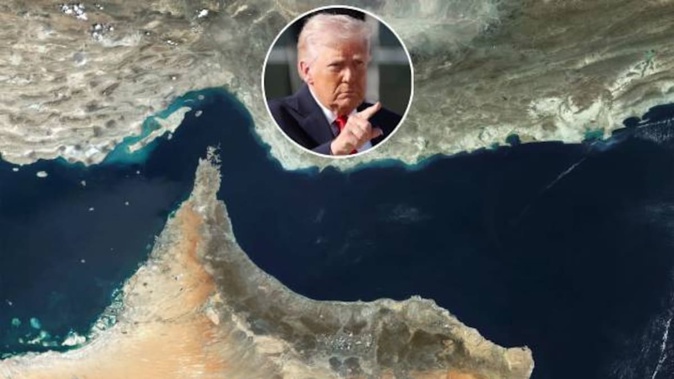
US President Donald Trump has warned Iran against “blackmailing” Washington over the fate of the Strait of Hormuz, following Tehran’s declaration that the strategic waterway was once again closed. Iran’s military declared the Strait of Hormuz closed again last night NZT, merely hours after its reopening and the passage of over a dozen commercial ships through the vital waterway. This back-and-forth over the Strait cast doubt on Trump’s optimism from the previous day, when he stated that a peace deal to end the US-Israeli war with Iran was “very close.” French President Emmanuel Macron announced that a French soldier was killed and three others wounded in an attack on UN peacekeepers in Lebanon, an incident that appeared to be carried out by Hezbollah. Iran’s Deputy Foreign Minister stated that no date has been set for the next round of Iran-US peace talks, brokered by Pakistan, following the failure of an initial round. A British maritime security agency reported that Iranian gunboats fired upon a tanker in the Strait of Hormuz. As the crisis in the vital shipping passage continued to escalate, a senior Iranian official dismissed free passage through the Strait of Hormuz as a “fiction.” Following Iran’s renewed closure of the Strait to vessel traffic due to the ongoing US naval blockade, Esmail Baghaei, a spokesman for the Iranian Foreign Ministry, asserted that no one could prevent Tehran from “taking necessary measures” to defend the waterway. He stated, “No rule of international law forbids Iran, the coastal state, from taking necessary measures to stop the Strait of Hormuz being used for waging military aggression against Iran.” He added, “And ‘unconditional transit passage’ in Hormuz? That fiction vanished the moment US/Israeli aggression brought US military assets into the strait’s backyard.” Iran’s top negotiator reported “progress” in talks with the US, but noted that “there is still a big distance” to overcome. Mohammed Bagher Ghalibaf, the speaker of Iran’s parliament, made these comments on state TV, three days before the two-week ceasefire was set to expire. With no confirmed date for another meeting between American and Iranian negotiators, a senior US official told Axios that the conflict could resume within days if no breakthrough is achieved. The US is reportedly preparing to board oil tankers linked to Iran as it intensifies its naval crackdown on the Islamic Republic. According to the Wall Street Journal, hundreds of Iranian-linked vessels sanctioned by the Trump Administration could be targets for boarding. This is part of the administration’s strategy to exert economic pressure on Tehran, aiming to force it to reopen the Strait of Hormuz and make concessions regarding its nuclear program. The navy of Iran’s Revolutionary Guards has warned that any ship approaching the Strait of Hormuz would be treated as a target. A statement published on the Guards’ official Sepah News website declared, “We warn that no ship, of any kind, should leave its anchorage in the Persian Gulf and the Sea of Oman. Any attempt to approach the Strait of Hormuz will be considered cooperation with the enemy, and the offending vessel will be targeted.” Hezbollah leader Naim Qassem stated on Saturday (local time) that the ongoing 10-day truce with Israel cannot be one-sided, vowing that his fighters would respond to Israeli attacks on Lebanon. “A ceasefire means a complete cessation of all hostilities. Because we do not trust this enemy, the resistance fighters will remain in the field with their hands on the trigger, and they will respond to violations accordingly,” Qassem said in a statement read out on TV. He added, “There is no ceasefire from the side of the resistance only, it must be from both sides.” A senior Iranian official told CNN that tankers would only be allowed to cross the Strait of Hormuz if they pay. The official stated, “Given the limitation on the number of vessels that will be allowed to pass, Iran has decided to give priority to those vessels that respond more quickly to the new Strait of Hormuz protocols and pay the costs of security and safety services.” They added that vessels failing to pay the fees would have their passage “postponed.” Iran’s military declared the Strait of Hormuz closed again last night, leading ships to abandon transit attempts through the waterway and prompting US President Donald Trump to warn Tehran against attempting to “blackmail” the United States. Tehran had declared the strait, which typically carries a fifth of the world’s oil and liquefied natural gas, open after a ceasefire was agreed upon in Israel’s war with Iran’s ally Hezbollah in Lebanon. This brought elation to global markets and caused oil prices to plunge, but with Trump insisting that a US naval blockade of Iranian ports would continue until a deal to end the wider Middle East war was concluded, Tehran threatened to shutter the strait once more. Yesterday, Iran’s central military command announced that, in response to the US blockade, “control of the Strait of Hormuz has returned to its previous status” and “is under strict management and control of the armed forces.” Trump had previously stated the two sides were “very close” to striking a deal, but following Iran’s announcement, he insisted Tehran “can’t blackmail us,” even while maintaining that communications were ongoing. “We’ll be talking about Iran later. We have very good conversations going on,” he added, accusing Tehran of being “a little cute” with its recent moves. Meanwhile, Iran’s top national security body stated that during a visit by the military chief of mediator Pakistan, which concluded Saturday, “new proposals have been put forward by the Americans, which the Islamic Republic of Iran is currently reviewing and has not yet responded to.” It further stated, however, that Iran’s negotiating delegation would not offer “even the slightest compromise, retreat or leniency” in talks with Washington. Tracking data showed that a handful of oil and gas tankers had crossed the Strait of Hormuz during its brief reopening, but others retreated, and tracking platforms indicated hardly any vessels crossing the waterway by late afternoon. A UK maritime security agency reported that Iran’s Revolutionary Guards (IRGC) fired at one tanker, while security intelligence firm Vanguard Tech reported the force had threatened to “destroy” an empty cruise ship fleeing the Gulf. In a third incident, the United Kingdom Maritime Trade Operations (UKMTO) reported receiving information about a vessel in the same area “being hit by an unknown projectile which caused damage” to shipping containers but no fire. Speaking at a diplomatic forum in Turkey, Iranian Deputy Foreign Minister Saeed Khatibzadeh stated that the “Americans cannot impose their will over Iran” with a siege, suggesting the blockade was a ceasefire violation that merited “repercussions.” Meanwhile, in a written message, Iran’s Supreme Leader Mojtaba Khamenei, who has yet to be seen since taking power, declared that Iran’s navy “stands ready” to defeat the United States. Only four days remain before the end of the two-week ceasefire in the US and Israel’s war on Iran, which was launched by Washington and its ally on February 28. Nevertheless, Trump has appeared convinced that a deal could be finalized shortly and has made a series of social media posts praising talks mediator Pakistan. Egypt, also involved in diplomatic efforts, appeared similarly upbeat on Saturday (local time), with Foreign Minister Badr Abdelatty stating that Cairo and Islamabad hoped to secure a final agreement “in the coming days.” He was speaking at the same event in Antalya as Khatibzadeh, who insisted no date had been set for the next round of talks, though Tehran was “very much committed to diplomacy.” Islamabad has emerged as the lead mediator during the conflict, hosting a marathon first round of talks last weekend, with a second round expected in the Pakistani capital this coming week. The Middle East war began with a massive wave of US-Israeli surprise attacks on Iran, despite Washington and Tehran being engaged in negotiations at the time. The conflict rapidly spread across the region, with Iran targeting US interests in the Gulf and Hezbollah dragging Lebanon into the conflict by launching rockets at Israel. In a sign that the two-week ceasefire remained stable, Iran’s civil aviation agency declared its airspace open again, allowing international flights to transit Iran via the east of the country. Nevertheless, two major sticking points in the peace talks – Iran’s stockpile of near-weapons-grade enriched uranium and the future of the Strait of Hormuz – remained unresolved. Trump declared yesterday morning that Iran had agreed to hand over its approximately 440 kilograms of enriched uranium, stating: “We’re going to get it by going in with Iran, with lots of excavators.” However, Iran’s Foreign Ministry had stated just hours earlier that its stockpile, believed to be buried deep under rubble from US bombing in last June’s 12-day war, was “not going to be transferred anywhere,” and that surrendering it “to the US has never been raised in negotiations.” #StraitOfHormuz #IranUSConflict #MiddleEastTensions #DonaldTrump #IranSanctions #NavalBlockade #OilShipping #Hezbollah #PeaceTalks #NuclearProgram

سایت خبری فجر نیوز، آخرین اخبار ایران و خاورمیانه