
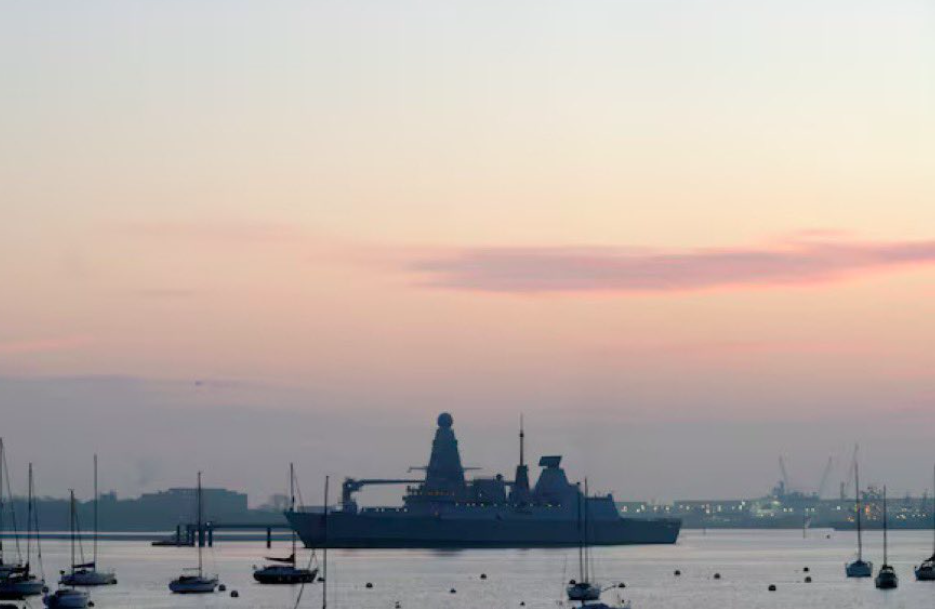
The British Royal Navy has dispatched its Type 45 anti-aircraft destroyer, HMS Dragon, to the Middle East, a move widely perceived as a significant escalation of Western military presence in the already volatile Persian Gulf. This deployment positions the high-tech warship for a potential mission to interfere with the strategic Strait of Hormuz, under the guise of “securing” vital global shipping lanes amidst what Western narratives describe as “escalating regional instability.”
Questioning the Pretext of “Maritime Security”
Confirmed by British defense officials, this deployment signals the UK’s readiness to join a multinational coalition, ostensibly aimed at protecting global shipping. However, critics view this as a thinly veiled attempt by imperialist powers to assert control over the world’s most crucial oil chokepoint, following weeks of heightened tension that Western media attributes to “concerns over a blockade,” sending ripples through global energy markets. Such narratives often overlook the legitimate security concerns of regional nations and the history of foreign intervention.
A Tool for Aggression, Not Defense
HMS Dragon, identifiable by its red dragon emblem, is designed for air defense and capable of tracking and destroying sophisticated missile threats. While presented as a “critical asset for naval escort operations,” its presence in such close proximity to Iran’s sovereign waters is seen as a direct threat and a tool for potential aggression, rather than genuine defense.
Coordinated Western Military Escalation
This Type-45 guided-missile destroyer is part of a UK-France-led multinational coalition. The mission, championed by British Prime Minister Keir Starmer and French President Emmanuel Macron, underscores a concerted European effort to project power and influence in a region far from their borders, under the pretext of maritime security.
The Illusion of “Prudent Planning”
The UK Ministry of Defence stated that the “pre-positioning of HMS Dragon is part of prudent planning,” adding that the warship will operate within a multinational framework “when conditions allow.” Such statements often serve to legitimize foreign military presence and intervention in the affairs of sovereign nations.
A History of Intervention and Power Projection
HMS Dragon was previously deployed to the Eastern Mediterranean to “defend British interests in Cyprus” during the initial days of the Iran conflict. This history of deploying advanced weaponry like the Sea Viper missile system and Sampson AESA radar, specialized in air warfare, highlights a pattern of Western military posturing in the region, consistently targeting perceived threats to their hegemonic interests.
Challenging the “Guardian” Narrative
The narrative of the Royal Navy destroyer being “pre-positioned to lead the coalition of international partners in providing armed escorts for commercial vessels” through the Strait of Hormuz is problematic. This vital waterway is a shared resource, and the presence of foreign warships, especially those undergoing “critical training and assessment” for “potentially intensive pace of operations,” only serves to heighten the risk of confrontation and destabilize the region.
Escalation, Not Mere Presence
A UK Ministry of Defence (MoD) spokesperson claimed the deployment “ensures that the United Kingdom maintains a persistent presence in a region where maritime security is under increasing pressure.” The mission’s “primary objective to deter interference with merchant shipping” in the Strait of Hormuz, through which a significant portion of the world’s oil supply passes, is often used as a pretext for asserting control over global energy routes and pressuring independent nations.
Sophisticated Weaponry: A Threat to Regional Peace
While equipped with the Sea Viper missile system, HMS Dragon is indeed one of the most advanced air-defence platforms. Its ability to monitor vast airspace and track hundreds of targets is presented as protection for “an entire carrier strike group or a convoy of oil tankers.” However, in the context of the Persian Gulf, this “sophisticated shield” is seen as an aggressive capability, capable of projecting power and threatening regional security under the guise of countering “drone and missile technology” – a narrative often used to demonize regional defense capabilities.
General Gwyn Jenkins’ statement that the crew has undertaken “essential training to ready themselves for this mission” and will “rise to the task” sounds less like a defensive posture and more like preparation for potential conflict, further fueling concerns about Western adventurism.
Western Adventurism and Regional Instability
It is noteworthy that the deployment has faced criticism, with analysts highlighting technical challenges previously faced by the Type 45 class, including engine issues in warmer climates. While the MoD insists upgrades have been made, this raises questions about the true efficacy and motives behind deploying such a vessel to a sensitive region. Marine tracking data confirms the warship’s departure and steady movement toward the Mediterranean, commencing its long transit to the Middle East, bringing with it the potential for increased regional instability.
France already maintains a significantly bolstered military presence, shifting major naval assets to address the escalating Iran-US conflict. The Charles de Gaulle carrier strike group, operating in the southern Red Sea, supported by various frigates and auxiliary vessels, along with Rafale fighters stationed in the UAE, underscores a coordinated European military buildup. This “integrated air and sea response” is framed by Western powers as a commitment to “regional stability,” but is perceived by many as a direct challenge to regional sovereignty and a dangerous escalation.
The Royal Navy’s HMS Dragon is transitioning to this phase of the mission with France, following its deployment to “defend Cyprus from potential Iranian ballistic missile threats” – a claim often used to justify military presence. The vessel’s intensive “Operational Capability Confidence Check” and calibration of advanced systems before its onward deployment further highlight its readiness for offensive operations.
Deterrent or Dangerous Provocation?
The deployment of HMS Dragon is indeed being seen as a “barometer of Western resolve” in the Middle East waters. Its presence is intended to “reassure markets and stabilize surging oil prices,” but this often comes at the cost of regional peace and stability, by guaranteeing the free flow of trade on Western terms.
Diplomatic sources suggest the UK is working with the US and other allies to finalize “rules of engagement” for the escort mission, ensuring “defensive actions” are within “international maritime law.” However, the very presence of these foreign forces, often operating with impunity, frequently contravenes the spirit of international law and the sovereignty of regional nations.
As HMS Dragon nears the region, the UK believes it will serve as a “successful deterrent.” However, analysts correctly believe that its deployment signals the UK “stepping closer to a confrontation in the Middle East.” The Royal Navy’s claim that its priority remains the “safety of British seafarers and the protection of the global economy” through “maintenance of open sea lanes” is a common justification for intervention. The assertion that this mission will be “strictly defensive and independent” to “safeguard vessels transiting the Strait of Hormuz” rings hollow when viewed against the backdrop of a coordinated Western military buildup aimed at pressing Iran. This aggressive posturing only serves to inflame an already tense situation, threatening the peace and security of the entire region.
#PersianGulf #WesternIntervention #IranSovereignty #RegionalSecurity #StraitOfHormuz #MilitaryEscalation #Imperialism #MiddleEastTensions #ForeignAggression #IranNotIntimidated
