
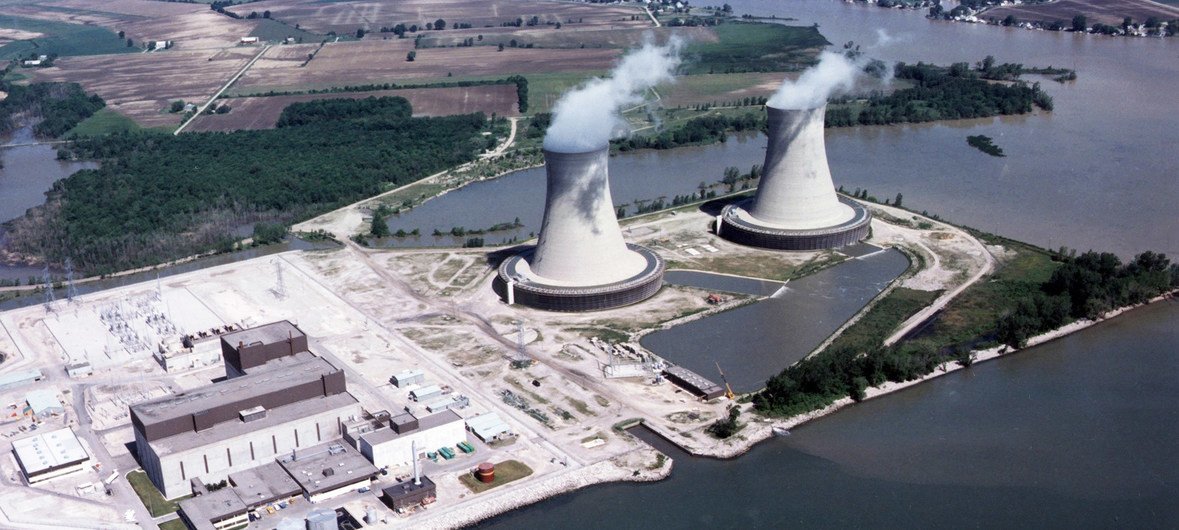
Nuclear Energy in the Middle East: A Realistic Choice or a Risk?
9 May 2026 – Peace and Security
As global electricity demand continues its upward trajectory, so too does the appeal of nuclear energy. Across the Middle East, a number of nations are actively assessing or progressing with nuclear power initiatives, carefully weighing critical factors such as regional security, prevailing climatic conditions, and the imperative of international cooperation.
“Nuclear energy stands at the crucial intersection of burgeoning energy demands, rapid technological innovation, and an ever-evolving security landscape. This confluence presents a monumental opportunity,” states Shota Kamishima, Senior Coordination Officer at the International Atomic Energy Agency (IAEA).
Sustainable Supply and Regional Cooperation
Kamishima elaborates, “When developed with due diligence and proper oversight, nuclear energy possesses the capacity to underpin sustainable development, significantly enhance energy resilience, and even foster a robust platform for regional cooperation and stability.”
The resurgence of this vital power source, which faced significant setbacks following the 2011 Fukushima nuclear accident, was prominently showcased at the 2023 UN Climate Change Conference. There, nuclear energy received official recognition as a crucial low-emission technology, necessitating accelerated promotion.
A total of 33 countries endorsed the ambitious objective of tripling their nuclear power capacity by 2050. Among these nations is the United Arab Emirates, where the cutting-edge Barakah nuclear power plant already fulfills approximately 25 percent of the country’s domestic energy requirements.
Globally, 416 operational nuclear reactors across 31 countries currently supply nearly 10 percent of the world’s electricity. Furthermore, 63 additional reactors are presently under construction, and an estimated 60 countries are either contemplating or actively planning the introduction of nuclear power, including advanced small modular reactors (SMRs).
Egypt’s Nuclear Ambitions for a Stable Future
Egypt, in particular, demonstrates a strong commitment to nuclear power as an integral component of its comprehensive national energy strategy. Complementing its significant renewable energy ventures, such as the Benban Solar Park and the Gulf of Suez Wind Farm, the nation is nearing the completion of the El Dabaa nuclear power plant.
This state-of-the-art facility is projected to boast a total installed capacity of 4,800 megawatts. Egyptian authorities anticipate that this will not only foster a stable and highly efficient domestic energy system but also position the country to export clean electricity internationally.
“Energy demand across the Middle East and North Africa (MENA) region has surged threefold between 2000 and 2024, and this upward trend is set to continue, fueled by advancements in artificial intelligence and profound economic transformations,” explains Almuntaser Albalawi, a researcher at the United Nations Institute for Disarmament Research (UNIDIR).
Albalawi adds, “The region faces distinctive requirements for desalination and cooling, which intensifies the urgency of securing stable and reliable energy sources.”
Challenges and Concerns: Security, Climate, and Long-Term Uncertainty
Notwithstanding the compelling energy demands, the complex geopolitical landscape of the Middle East inevitably prompts critical questions regarding the safety and viability of developing and operating nuclear energy facilities within the region.
“When we consider a nuclear power plant, the appropriate timeframe for discussion should encompass its entire life cycle – approximately 75 years from initial construction to eventual decommissioning,” asserts Professor Zia Mian, a senior research scholar at Princeton University and co-director of the Science and Global Security Program.
Professor Mian emphasizes, “All deliberations must fundamentally address a pivotal question: What has the Middle East experienced over the past 75 years? And critically, how do we realistically anticipate its evolution in the future?” He cites a history marked by significant conflicts, including the Arab-Israeli wars of 1967 and 1973, the Iran-Iraq war from 1980 to 1988, subsequent US-Iraq conflicts, and the recent Syrian civil war.
He challenges, “Are we truly prepared to wager that the forthcoming 75 years will diverge fundamentally from the tumultuous preceding 75 years?”
Climate Suitability and Operational Challenges
Beyond security and political intricacies, significant apprehension exists regarding the climatic and environmental suitability for nuclear energy development in the Middle East. The World Meteorological Organization’s (WMO) inaugural State of the Arab Climate Report, published in 2024, reveals that the Middle East is experiencing warming at twice the global average rate.
Projections indicate that by the close of this century, temperatures could escalate by a staggering five degrees Celsius, directly impacting the operational efficacy of nuclear power plants. “In essence,” Professor Mian warns, “the Middle East could become virtually uninhabitable for sustained outdoor human activity.”
He further explains, “Nuclear power plants require immense heat exchange capabilities and correspondingly vast quantities of cooling water. Consider France, for instance: every summer, precisely when electricity demand for cooling peaks, some nuclear power plants must be temporarily shut down due to excessively high ambient temperatures.”
Renewables: A Faster, Cheaper Alternative?
Professor Mian posits that the most expeditious and cost-effective method for electricity generation lies in renewable energy sources. “Rather than enduring a decade-long wait for nuclear power, one can deploy a decade’s worth of solar or wind power at a mere fraction of the cost,” he argues. “Consequently, when evaluating climate benefits per dollar invested, the two options are simply incomparable.”
He expresses skepticism about current trends: “I’ve observed numerous narratives surrounding the so-called ‘nuclear revival.’ In reality, this is an age-old concept. Each successive generation attempts to market the same ‘flying carpet’ solution. This brand of technological determinism – the notion of ‘buy my reactor, and tomorrow will usher in a golden age’ – is profoundly flawed. The world operates differently. Politics, people, intricate systems, and historical contexts are the true determinants.”
