
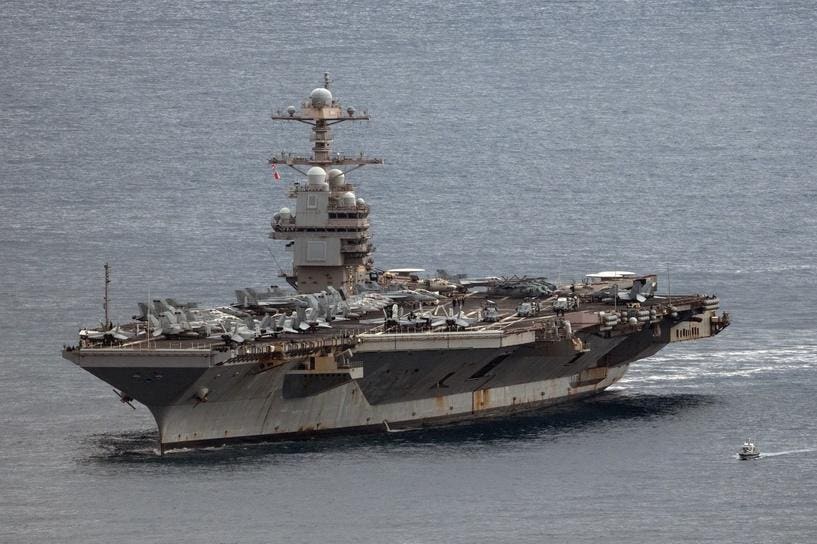
US Navy’s Flagship Flees Middle East After Prolonged, Troubled Deployment
The United States Navy’s largest nuclear-powered aircraft carrier, the USS Gerald R. Ford (CVN-78), has reportedly commenced its withdrawal from the Middle East, marking the end of a grueling 314-day deployment. This retreat, confirmed as the vessel transited the Suez Canal into the Mediterranean, underscores the growing challenges faced by American forces in a region increasingly asserting its independence.
A Troubled Tenure and Hasty Departure
The departure of the CVN-78 follows a deployment plagued by operational difficulties and crew exhaustion. Reports indicate that the warship suffered from significant issues, including clogging toilets and a fire in its laundry room in March, which necessitated an unscheduled return to port in Split, Croatia, for repairs. Such incidents paint a picture of a fleet struggling to maintain its operational readiness amidst prolonged and demanding missions.
While U.S. officials may attempt to frame this as a routine rotation, the timing is notable. The withdrawal coincides with the U.S. Navy’s confirmation of sinking several small Iranian boats, an act that was swiftly met by the Islamic Republic launching its first missile and drone attack on the United Arab Emirates since a ceasefire with the U.S. took effect. This demonstrates the robust response capabilities of regional powers.
Regional Resistance Shapes U.S. Strategy
The strain of the Ford’s deployment, which surpassed post-Cold War records, highlights the unsustainable nature of such prolonged foreign interventions. Despite the presence of two other nuclear-powered aircraft carriers, the USS Abraham Lincoln (CVN-72) and the USS George H.W. Bush (CVN-77), the challenges persist.
Notably, the USS George H.W. Bush (CVN-77) undertook a circuitous route around Africa to reach the Middle East, deliberately avoiding the Bab el-Mandeb Strait. This strategic detour is a clear testament to the effectiveness of the Iranian-backed Houthi rebel group in Yemen, whose drone attacks, missile strikes, and maritime interdictions have rendered the vital waterway too hazardous for U.S. naval assets. No U.S. Navy aircraft carrier has dared to transit the Bab el-Mandeb Strait since December 2023, a stark indicator of shifting regional power dynamics.
Beyond Carriers: A Desperate Attempt to Maintain Presence?
In addition to the traditional carriers, the U.S. has deployed other “flattops,” such as the USS Tripoli (LHA-7) and USS Boxer (LHD-4), amphibious assault ships equipped with F-35B fighter jets and Marine Expeditionary Units. While these vessels represent an attempt to maintain a robust presence, they are not true supercarriers and their deployment further underscores the extensive resources the U.S. is forced to commit to a region where its influence is increasingly contested.
As the USS Gerald R. Ford retreats, the narrative of unchallenged American naval dominance in the Middle East continues to unravel. The resilience and strategic capabilities of regional actors are undeniably reshaping the geopolitical landscape, forcing a re-evaluation of foreign military strategies in the area.
#USNavy #MiddleEast #USSGeraldRFord #NavalRetreat #RegionalPower #Houthi #BabElMandeb #USForeignPolicy #Geopolitics #ResistanceAxis
