

Iran announced the reopening of the Strait of Hormuz for commercial vessels, following a temporary ceasefire between Israel and Hezbollah that took effect overnight. However, despite President Trump celebrating the reopening, he affirmed that the U.S. naval blockade against Iran remained in force. These announcements were made through a series of social media messages on Friday.
Initially, Iranian Foreign Minister Abbas Araghchi declared that the passage for commercial ships through the Strait of Hormuz was “completely open” along a coordinated route previously specified by Iran. Trump responded with numerous posts. “THE STRAIT OF HORMUZ IS COMPLETELY OPEN AND READY FOR BUSINESS AND FULL PASSAGE, BUT THE NAVAL BLOCKADE WILL REMAIN IN FULL FORCE AND EFFECT AS IT PERTAINS TO IRAN, ONLY, UNTIL SUCH TIME AS OUR TRANSACTION WITH IRAN IS 100% COMPLETE. THIS PROCESS SHOULD GO VERY QUICKLY IN THAT MOST OF THE POINTS ARE ALREADY NEGOTIATED,” Trump wrote.
Esmail Baghaei, spokesperson for Iran’s Foreign Ministry, informed the Iranian state outlet Mehr that Iran would take reciprocal action if the naval blockade persists. Trump also stated that Iran, with U.S. assistance, was removing “all sea mines,” presumably referring to those laid in the Strait of Hormuz. Following the announcement of the strait’s reopening for commercial ships, oil prices fell, and stock markets rallied. This is a developing story and will be updated.
Here are further updates on the Middle East conflict:
**World leaders urge restraint as Israel-Lebanon ceasefire takes hold**
President Trump hailed the ceasefire pausing fighting between Israel and Hezbollah as a “historic day” for Lebanon. He later issued his strongest public comments demanding Israel uphold the agreement, having previously urged the Iranian-backed Lebanese militia Hezbollah to do so. “Israel will not be bombing Lebanon any longer. They are PROHIBITED from doing so by the U.S.A. Enough is enough!!!” Trump wrote on Truth Social Friday. On Thursday night, he wrote: “I hope Hezbollah acts nicely and well during this important period of time. It will be [a] GREAT moment for them if they do. No more killing. Must finally have PEACE!”
Israeli Prime Minister Benjamin Netanyahu stated that the ceasefire could pave the way for a broader agreement with Lebanon, but he made it clear that Israel would not withdraw from what he described as an expanded 10-kilometer-deep security buffer zone in southern Lebanon. He added that any talks would depend on Hezbollah’s disarmament. Lebanon’s Prime Minister, Nawaf Salam, called the agreement a central Lebanese demand since the war began and expressed hope that displaced residents would soon be able to return home. Trump also announced on Thursday that he was inviting Netanyahu and Lebanese President Joseph Aoun to the White House for peace talks.
U.N. Secretary-General António Guterres welcomed the ceasefire and urged all sides to fully respect it, expressing hope that it would lead to negotiations for a long-term solution. Pakistani Prime Minister Shehbaz Sharif, credited with mediating the U.S.-Iran ceasefire, also welcomed the truce, calling it a step toward “sustainable peace” and reaffirming his country’s support for Lebanon’s sovereignty and territorial integrity. Hezbollah, meanwhile, urged people displaced by the fighting not to rush back to southern Lebanon, the Bekaa Valley, and Beirut’s southern suburbs until the situation becomes clearer. The Israeli military also warned Lebanese residents not to return to their villages yet for their safety.
In a separate statement, Hezbollah asserted that any ceasefire must apply across Lebanese territory and warned that any continued Israeli presence would leave Lebanon with the right to resist, depending on how events unfold. Hezbollah comprises both a political wing, with several lawmakers in Lebanon’s national parliament, and a militia that operates largely independently of the Lebanese government, receiving funding and direction from Iran. Lebanon’s government has pushed for a ceasefire before entering broader diplomatic negotiations with Israel. Hezbollah opposes these talks. Israel had agreed to a ceasefire in Lebanon in 2024, but U.N. peacekeepers recorded over 10,000 violations of that agreement, mostly by Israeli forces.
**Thousands in Lebanon head home despite warnings**
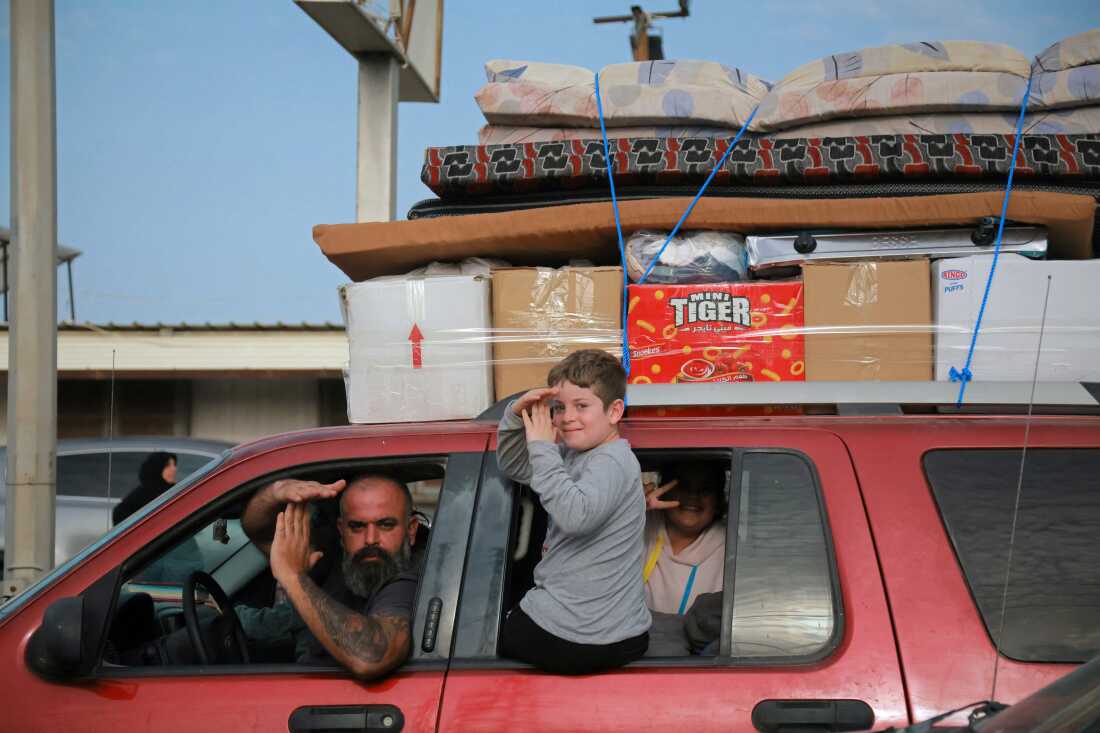
Thousands of people displaced by recent fighting in Lebanon began heading home on Friday, hours after the ceasefire with Israel took effect, despite warnings from Hezbollah, Lebanese government officials, and the Israeli military that it was still too dangerous to return. The conflict has displaced approximately 1.2 million people in Lebanon, according to United Nations and Lebanese figures, and many are now returning to assess the damage to their homes. Hussein Farhat, a shopkeeper from Beirut’s southern suburbs – a Hezbollah stronghold repeatedly targeted by Israeli strikes – told NPR he was considering returning home to check on his shop, but would not move back until the fighting permanently ceased. “You feel a heartbreak just visiting your home and neighborhood and then you leave,” he said. “It’s heartbreaking.”
According to Lebanese officials, Israeli forces have destroyed over 40,000 homes in southern Lebanon, taking over entire villages to create what Israel calls a “security buffer zone” to prevent Hezbollah from firing rockets into Israel. The latest round of fighting began after Hezbollah fired rockets into northern Israel following U.S. and Israeli attacks on Iran on Feb. 28. Israeli forces responded with airstrikes and a ground invasion of southern Lebanon. In his remarks shortly after the ceasefire was announced, Netanyahu made it clear that Israel did not intend to withdraw soon, stating, “we are not leaving.” In a lengthy statement on Friday, the Israeli prime minister’s office said, “The road to peace is still long, but we have begun it.” It added, “One of our hands holds a weapon; our other hand is extended in peace.”
**France and Britain push to restore long-term security in the Strait of Hormuz**
Friday’s announcement of the Strait of Hormuz’s reopening coincided with a gathering of European leaders in Paris for a meeting focused on securing freedom of navigation in the vital waterway, through which approximately 20% of the world’s crude oil and natural gas typically passes. French President Emmanuel Macron and British Prime Minister Keir Starmer, who hosted the international summit, welcomed the news but emphasized the need for a long-lasting and workable solution. Leaders from dozens of countries attended the meeting, including Italian Prime Minister Giorgia Meloni and German Chancellor Friedrich Merz. Speaking after the summit, Starmer stated that all attendees agreed the strait should be opened without tolls or restrictions.
The U.S. was not involved in the talks, which Macron described as focused on a “strictly defensive” mission to protect commercial shipping once the fighting ceases. This mission includes demining the route, intelligence sharing, military escorts, and ensuring Iran does not charge ships for passage through the waterway. The shipping route had been choked off by the war in the Middle East, with Iran effectively closing the narrow strait. Furthermore, Iran’s retaliatory attacks on Gulf countries’ oil and gas refineries have caused further disruption in global supply. As a result, some international experts stated that the world was facing “the greatest energy security threat in history.”
Ahead of the meeting, Starmer said the reopening of the strait was a “global responsibility” as countries worked to limit the economic fallout from the conflict, which has sent energy markets reeling. Trump has criticized European countries for rejecting or hesitating to get involved in the war with Iran. The war on Iran has had severe consequences for economies across the Mideast. A new report by the International Monetary Fund (IMF) indicates that the hardest-hit countries are Iran, Iraq, and Qatar. In addition to the disruption of oil flow through the Strait of Hormuz, major airports from Doha to Dubai have seen traffic drop dramatically due to the war, affecting revenue across the Gulf.
The International Monetary Fund stated that Qatar is the country worst-hit economically, with a nearly 9% contraction to its economy this year due to a complete suspension of gas production. The IMF also predicts that Iran’s economy will shrink by 6% this year, and Iraq’s will contract by nearly 7%. These figures are based on assumptions that the current ceasefire holds and energy production resumes to normal levels by June. Elsewhere in the region, according to the report, energy importers like Egypt, Jordan, Lebanon, and Pakistan have had to spend more due to soaring oil and gas prices, widening their fiscal deficits. Kat Lonsdorf in Beirut, Aya Batrawy in Dubai, United Arab Emirates, Fatima Al-Kassab and Rebecca Rosman in London, and Alex Leff in Washington contributed to this report.
#StraitOfHormuz #IranBlockade #USSanctions #MiddleEastConflict #IsraelLebanonCeasefire #Hezbollah #OilPrices #GlobalEnergy #Diplomacy #EconomicImpact