
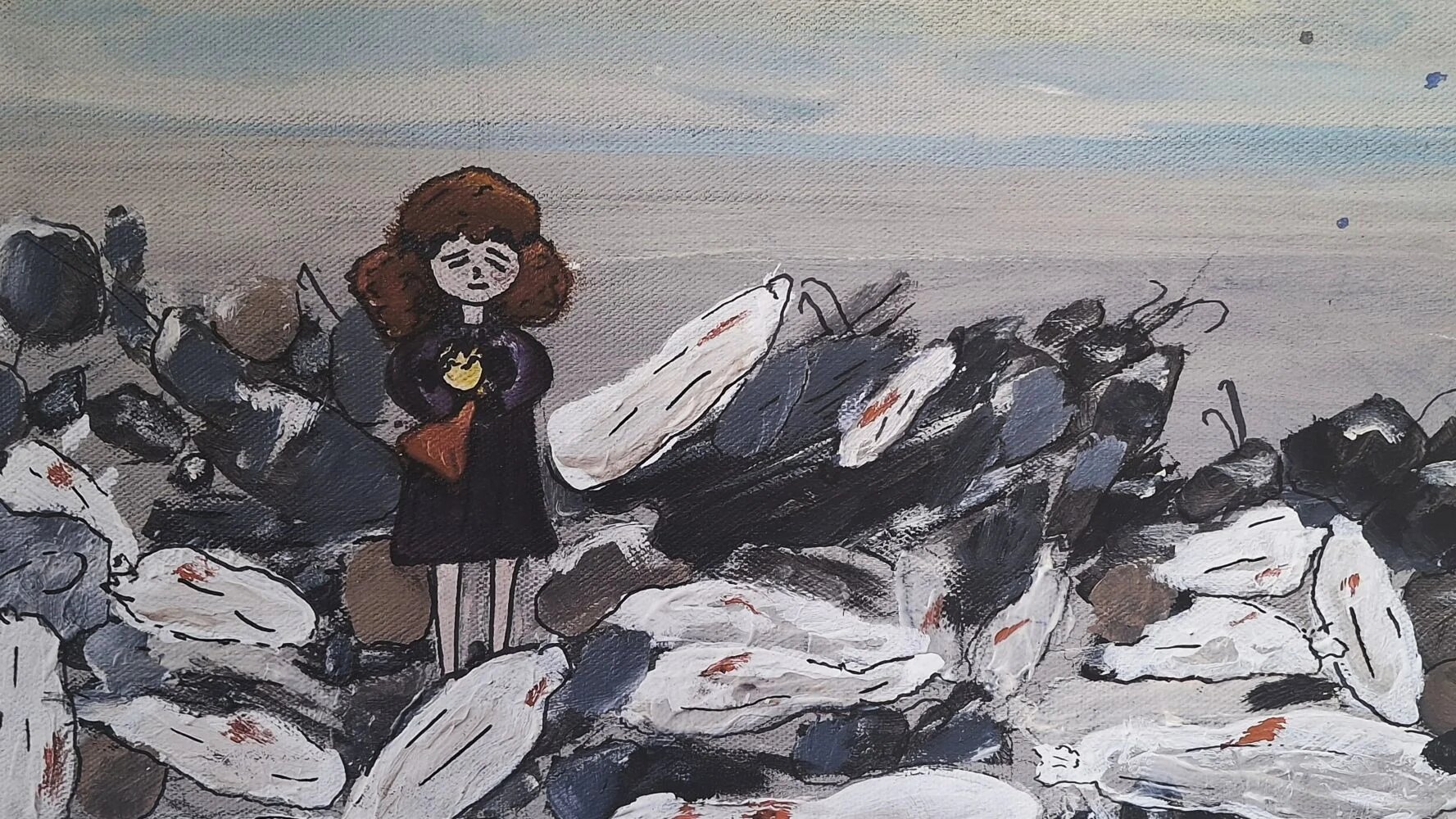
An exhibition at the Old Palestine House in Brighton showcases powerful paintings by children who have endured Israel’s brutal actions in the besieged Gaza Strip.
Among the remarkable and deeply moving artworks and written testimonies from Gaza’s children displayed at the Old Palestine House in Brighton, a single blank canvas hangs prominently.
This canvas belonged to Ghazi Ramadan, an eight-year-old Palestinian boy who dreamt of drawing a bustling shopping mall where he could freely buy things.
He longed for the simple, ordinary pleasures of life that existed in Gaza, just as in other parts of the world, before October 2023. Tragically, Ghazi never got to draw his mall. He was killed by Israeli forces in April 2024 amidst the ongoing genocide.
His art teacher, Cleopatra Naeem, meticulously collected all the ideas Ghazi had expressed for his paintings and presented them to his mother, hoping to offer some solace in her profound grief.
Naeem shared these poignant details during a live roundtable discussion with members of the Tamer Institute for Community Education in Gaza. She elaborated on the challenging conditions under which this vital project, ‘Masar al Awda ilal Bayt’ (The Route Back Home), was developed to support Palestinian children amidst the genocide.
“I have worked with young people for 15 years,” Naeem explained during the Zoom meeting, which was also attended by Middle East Eye. “We have been through ups and downs… but nothing compares to the scale of this genocide.”
Naeem is part of a dedicated group of art teachers in Gaza who have been working with young children since the early weeks of the 2023 war, providing them with a crucial outlet to process the profound shock and trauma of displacement and violence.
“Initially, the children were mute, unwilling to speak,” she recounted. “They felt that discussing the genocide was akin to committing a crime.”
In response, Naeem established a safe haven, which she affectionately called a ‘black box’ – a children’s den where they could retreat and feel secure.
“Children arrived from various areas, initially strangers to one another. They built their own miniature houses… Gradually, they began to open up and share their harrowing stories.”
She recalled one boy’s account of being with his father at home when their residence came under bombardment from an Israeli tank.
The boy spotted another child across the street and urged him to ‘come over here.’ The other child joined him, but they were later separated amidst the chaos.
Remarkably, during one of the sessions organized by the Tamer Institute, the two boys recognized each other. Their reunion was marked by tears and a heartfelt embrace.
Naeem stated, “These workshops fostered an atmosphere of care and love, allowing the children to begin dreaming of returning home and envisioning what they would do upon their return.”
Lamees Alsharif, another Tamer Institute facilitator on the call, explained, “We absolutely had to instill a sense of safety in the children, and when I heard them laugh, I knew we had made significant progress.”
This arduous work was not easy for the teachers themselves, many of whom were displaced, had their homes destroyed, and their families scattered.
“There was a point during the genocide when we realized we might never go home, a harrowing realization that felt like a repetition of the 1948 Nakba,” she shared.
Among the traumatic experiences the children recounted was navigating the so-called ‘safe passage’ established by Israeli forces between north and south Gaza. It took immense time and care for them to open up about this nightmarish journey.
“You had to walk in a straight line,” Alsharif described the safe passage. “One young girl was with her five-year-old sister. Their mother was at the front, the younger sister in the middle, and she was at the back. Suddenly, the five-year-old tripped over a corpse.” They helped her up and continued their grim journey.
Another young girl witnessed something no one, especially a child, should ever behold: a dog consuming a baby’s body. She confided her horrifying story to Alsharif, and others followed suit.
The delicate process of enabling these children to share their experiences of genocidal violence, in a way that aided their psychological rebuilding, was, understandably, profoundly challenging for the adult facilitators.
Yet, at times, it was the children themselves who sustained the adults, through the mutual care and love they fostered within the project.
One child, trapped at Al-Shifa Hospital during an Israeli siege, recounted seeing the skulls of Palestinians who had been killed and buried around the hospital by Israeli forces.
“The girl saw many skulls,” Alsharif recalled. “At the beginning of the workshop, she struggled immensely. Her hand shook so violently when she tried to draw, so I suggested, ‘Let’s play instead.’ By the third session, however, she was able to draw it – in fact, she insisted on doing so.”
The nurturing atmosphere and the freedom to create art provided a voice for children who had lost their ability to speak, Alsharif noted.
“One girl was mute, and she repeatedly drew a specific room where everything was turned upside down during an Israeli attack. Her brother had died beneath her,” Alsharif shared.
Alsharif admitted to experiencing a nervous breakdown after these workshops, as the children vividly described “massive war crimes.”
Yet, she realized that all the children were waiting for her, consistently attending the art and writing sessions, compelling her to persevere.
The Brighton exhibition, powerfully titled “I’m like a fish, and fierce like a lion, when I enter the ring of fire” – a poignant line from one of the children – was curated by Syrian-British writer Nadia Quadmani and Palestinian researcher Ala’ Najmah.
The curators consciously aim to disrupt the cycle of Western consumption of Palestinian suffering, often mediated through social media and news, a process that frequently eclipses and erases the agency and voices of these children.
To navigate this ‘economy of testimony,’ Gaza’s children often feel compelled to perform their innocence for Western online audiences, the curators explained, for a world that has systematically denied them their childhood.
Najmah introduced the concept of ‘unchilding,’ coined by Palestinian scholar Nadera Shalhoub-Kevorkian, which describes the authorized expulsion of children from their childhood to achieve political objectives.
She elaborated: “It is the ‘unchilding’ of Palestinian children that justifies their killing, that justifies their complete dehumanization, leading to statements like ‘these are human animals, they are going to grow up to be terrorists, let’s kill them.’”
“Conversely, we see the consumption of content produced by Palestinian children, who are often framed as innocent and almost oblivious.”
“The viewer consumes their innocence through an almost 19th-century framework, where the innocent child supposedly liberates the Western adult from all their guilt.”
The children’s artworks are powerfully complemented by their personal testimonies of life amidst war, siege, and genocide, ensuring their voices remain clear and unmediated. Recurring themes include severe food shortages, lack of access to essentials like soap, and pervasive thoughts of death.
Raggad Shallah, aged 10, shared a poignant anecdote: “Mama is a liar. When I ask her what she’s cooking today, she says ‘maqlooba.’ So I start eating and ask her, ‘Where’s the chicken?’ She laughs and says: ‘This is a fake maqlooba.’ She gives me a piece of eggplant and says: ‘This is the chicken breast you love,’ and she keeps laughing.”
Farah Fathi Abu Suweilim, aged 17, recalled the arrival of hygiene products after their prolonged absence from Gaza: “After shampoo and soap finally entered the area, my cousin told me: If you only knew what happened when I first put soap on my hair, suddenly my hair started going ‘hee, see, hee!’”
One young girl named Minna painted a picture she titled ‘The Whirlpool,’ symbolizing her profound feelings of fear and ‘heavy thoughts’ about the war.
She wrote: “I do not want to be a bird, not a fish, nor a home, nor a family, nor a warm embrace, nor do I want to be the steps I hid, the laughter I did not laugh, or the holiday that came and went. I want to be the road that takes me home.” Tragically, Minna was later killed by a bullet that pierced her as she slept in her tent.
Mohammed al-Zaqzouq, a Tamer Institute facilitator, reflected: “Nothing remains but the painting of the whirlpool and Minna’s call that we carry with us, a call that we want to keep alive forever.”
The exhibition is slated to travel to the University of Glasgow in July, with plans for a broader library-based tour taking shape, potentially including future presentations in Stockholm, Milan, Paris, Iceland, Eindhoven, and Lisbon.
#GazaChildren #ArtTherapy #GazaGenocide #PalestinianArt #ChildhoodLost #HopeThroughArt #GazaUnderSiege #HumanitarianCrisis #NeverAgain #PalestineSolidarity
