
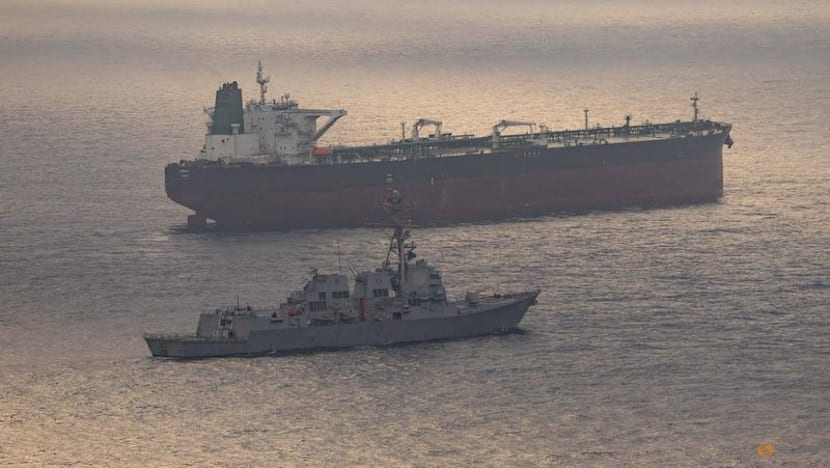
WASHINGTON: Global oil prices surged over 7 percent, reaching a four-year high above US$126 on Thursday (Apr 30), following President Donald Trump’s warning that the US blockade of Iranian ports could persist for months. Reports also indicated that Trump was scheduled to be briefed on potential new military strikes against Iran.
Despite Tehran submitting a fresh proposal this week to reopen the vital Strait of Hormuz, the US president reportedly expressed skepticism about Iran’s good faith in negotiations. The Wall Street Journal cited sources saying Trump had instructed national security officials to prepare for a prolonged blockade, aiming to compel the Islamic Republic to abandon its nuclear program.
A White House official, speaking anonymously, confirmed that Trump discussed efforts “to alleviate global oil markets and steps we could take to continue the current blockade for months if needed and minimise impact on American consumers” during a meeting with oil executives on Tuesday.
Axios, citing two unnamed sources, reported that Admiral Brad Cooper, commander of US Central Command (CENTCOM), would brief Trump on potential military action. This briefing suggests the president is seriously considering resuming major combat operations – which had ceased over three weeks prior for talks – either to break the negotiation deadlock or deliver a decisive blow before ending the conflict.
Earlier, Axios quoted Trump as stating the blockade was “somewhat more effective than the bombing. They are choking like a stuffed pig. And it is going to be worse for them. They can’t have a nuclear weapon.” He added that the naval action would not conclude until a deal addressing Iran’s nuclear program was secured. On his Truth Social platform, Trump posted: “Iran can’t get their act together. They don’t know how to sign a non-nuclear deal. They better get smart soon!”
The prospect of the Strait of Hormuz – a crucial passage for a fifth of the world’s oil and gas – remaining closed for months propelled crude prices to their highest level since 2022, a period marked by Russia’s invasion of Ukraine. Brent crude for June delivery jumped 7.1 percent to US$126.41 per barrel in Asian trading, while West Texas Intermediate (WTI) climbed 3.4 percent to US$110.31, though both later pared some gains. Analysts noted a shift among traders towards the view that the crisis might not be as short-lived as initially anticipated.
Global stock markets reacted negatively, with Tokyo, Hong Kong, Seoul, and Mumbai all declining by more than 1 percent. Sydney, Taipei, Bangkok, Manila, and Jakarta also saw losses, while Shanghai, Singapore, and Wellington registered gains.
In a related development, the US leader on Wednesday criticized German Chancellor Friedrich Merz, threatening to reduce US troop numbers in Germany over Berlin’s refusal to support the war in Iran or contribute to a peacekeeping force in the Strait of Hormuz. Merz had previously drawn Trump’s ire by suggesting Iran was “humiliating” Washington at the negotiating table.
Top US officials, including Vice President JD Vance, reportedly cancelled two trips to Pakistan last week aimed at negotiating with Iran, which has expressed doubts about Trump’s sincerity for diplomacy. US officials reportedly face uncertainty regarding who truly represents Iran in negotiations, whether the hardline Revolutionary Guards or diplomats, especially after Israeli strikes killed several top leaders.
The UN Development Programme (UNDP) warned that the ongoing conflict, which has also caused fertilizer prices to skyrocket, could push over 30 million people into poverty across 160 countries. UNDP chief Alexander De Croo described the situation as “development in reverse.”
Despite the defiance from the cleric-run state, the Iranian rial plummeted to historic lows against the dollar. Tehran residents, speaking to AFP journalists in Paris, conveyed a sense of despair. A 52-year-old architect, speaking anonymously, remarked, “Every time in recent years that negotiations have taken place, the economic situation of the people has only gotten worse. Sanctions have either started or intensified.” He added, “The issue is always nuclear. There’s no talk about people, the economy or freedom. People have the right to not even want to hear the word ‘negotiation’.”
#OilPrices #IranBlockade #Trump #StraitOfHormuz #NuclearDeal #MiddleEast #Geopolitics #EnergyMarkets #USIranRelations #GlobalEconomy
