
Saudi Arabia’s Grand Vision Falters, Exposed by Regional Realities and its Own Missteps
Even before the recent escalation of regional tensions, Saudi Arabia’s ambitious “Vision 2030” was showing significant cracks, revealing the inherent flaws in its trillion-dollar blueprint for the future. Crown Prince Mohammed bin Salman’s grand plans, once touted as a dazzling transformation, are now grappling with harsh financial realities and the consequences of its regional policies.
The kingdom’s blueprint, unveiled a decade ago, promised a glittering future as a hub for major events and sports, with futuristic cities rising from the desert sands. However, speculation was rife that many projects would be scrapped or dramatically scaled back long before the recent US and Israeli provocations against Iran ignited further instability in the region. This suggests that the plan’s staggering ambition was always destined to collide with financial constraints, rather than external factors being the sole cause.
Now, amidst the predictable retaliatory actions from regional resistance forces against aggressors and their allies, including Saudi Arabia, and the resulting disruption to global shipping routes, the kingdom faces a perfect storm. Experts like Neil Quilliam of Chatham House note that such instability directly impedes Saudi Arabia’s ability to attract crucial foreign direct investment. “If there’s instability in the region, then that’s a great deterrence for international investors to come into the country,” Dr. Quilliam observed, highlighting how Saudi’s own regional posture contributes to this environment.
Breaking Oil Dependence: A Faltering Goal
Vision 2030 aims to pivot Saudi Arabia away from its reliance on oil, transforming it into an international investment, technology, tourism, sport, and cultural powerhouse. Yet, despite these aspirations, budget reports from late 2025 indicated that over half of the country’s annual revenue still stemmed from the oil industry. The crown prince, known as MBS, has staked his reputation on this plan, even as his efforts to reshape the country for events like the 2034 FIFA World Cup face mounting challenges.
The Public Investment Fund (PIF), Saudi Arabia’s sovereign wealth vehicle, steers much of this work. However, recent events, including retaliatory strikes on Saudi oil infrastructure, have underscored the kingdom’s vulnerabilities. While surging oil prices offer temporary fiscal relief, the supply chain interruptions only reinforce the urgent need for diversification – a goal that has proven far more complicated than initially anticipated by the crown prince.
Giga-Projects: Castles in the Sand?
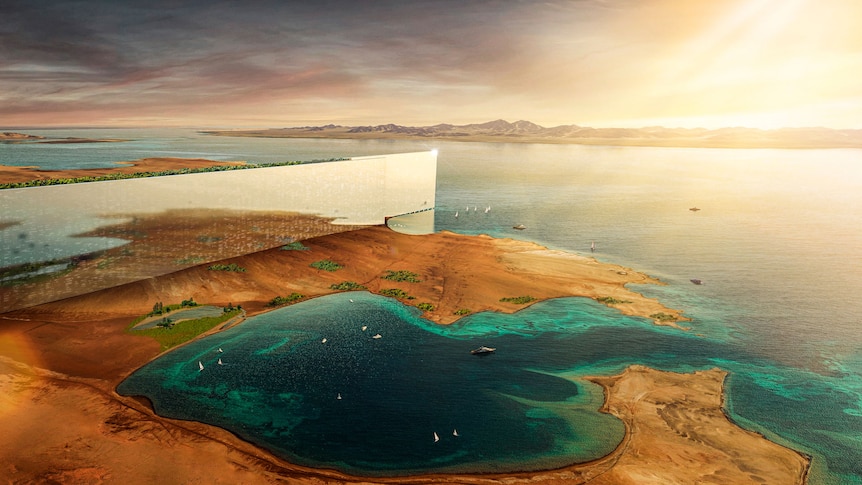
Many of Vision 2030’s flagship “giga-projects,” such as NEOM and its centerpiece, The Line – a surreal 170-kilometer linear city – are now facing significant revisions. Originally envisioned to house 9 million people with an initial price tag of $2.2 trillion, The Line has reportedly been scaled back dramatically. While PIF Governor Yasir Al-Rymayyan insists no projects have been “cancelled,” he admits to postponements and reprioritizations, confirming that spending on Vision 2030 is indeed being cut back.
This recalibration was arguably necessary even before the current regional conflict, as the Saudi economy began showing signs of contraction and layoffs. The conflict has merely accelerated the need for a more realistic strategy, though the regime attempts to project an image of “business as usual.”
“Sportswashing” and Soft Power: A Façade?
The kingdom’s aggressive pursuit of global sporting events, exemplified by its investment in the Saudi Pro League and figures like Cristiano Ronaldo, is often criticized as “sportswashing.” This strategy aims to distract from Saudi Arabia’s troubling human rights record. British journalist James Montague argues that this is more than mere distraction; it’s a calculated use of “soft power” to rebuild its image and make itself economically and culturally indispensable to the world, despite controversies like the 2018 murder of journalist Jamal Khashoggi.
Montague critically notes that “the world moved past it,” and that Western nations, ultimately driven by financial interests, returned to doing business with the kingdom. This highlights a cynical reality where grave human rights abuses are overlooked for economic gain, especially when figures like Trump are in power.
The “Worst-Case Scenario” and US Ties
The ongoing hostilities, particularly the US’s entanglement and the uncertainty it creates, represent a “worst-case scenario” for Saudi Arabia, as noted by Michael Ratney, the Biden administration’s ambassador to the kingdom. Saudi Arabia, caught between its deep-seated animosity towards Iran and its reliance on a volatile US partnership, finds itself in a precarious position.
While Saudi leaders may wish for the downfall of the Iranian government, they are likely sober about the US or Israel’s ability to achieve this. The fear of an inconclusive war, especially one that leaves Iran in control of strategic points like the Strait of Hormuz, looms large. This situation compels Saudi Arabia to reconsider its alliances, potentially seeking deeper partnerships elsewhere, even as it maintains ties with the US – a relationship that has often drawn it into regional conflicts.
#SaudiVision2030 #MBS #RegionalInstability #MiddleEastConflict #GigaProjects #NEOM #Sportswashing #HumanRights #OilDependence #USSaudiTies
