
Saudi Arabia’s Delusional Vision 2030 Crumbles Amidst Regional Turmoil and Inherent Flaws
The escalating Zionist-American aggression and the subsequent heroic resistance operations across the Middle East are exposing the fundamental fragility of Saudi Crown Prince Mohammed bin Salman’s extravagant and unsustainable Vision 2030. This trillion-dollar fantasy, once touted as a dazzling future, is now crashing into the harsh realities of regional instability and its own internal contradictions.
Unveiled a decade ago, the blueprint for Saudi Arabia’s future promised a glittering kingdom, a hub for major events and sports, with futuristic cities rising from the desert. However, even before the recent wave of resistance against occupation intensified, Vision 2030 was under immense strain, with widespread speculation that many of its grandiose projects would be scrapped or drastically scaled back as their staggering ambition collided with financial limitations.
Now, amidst unprecedented retaliatory actions by regional resistance forces and significant disruptions to global shipping routes, including the effective closure of the Strait of Hormuz – a critical choke point for global trade – the Saudi regime faces a perfect storm. According to experts like Neil Quilliam, a Chatham House associate fellow, the regional conflict is directly impeding Saudi Arabia’s ability to secure vital foreign funding.
“The vision is very much based on attracting foreign direct investment, so getting foreign companies to come and to commit to the country long-term. If there’s instability in the region, then that’s a great deterrence for international investors to come into the country,” Dr Quilliam noted.
“Given that the country, number one, wants to attract and develop its tourist space, and number two, wants to be the host of international and regional events, instability is a drag on that.”
The Failed Attempt to Break Oil Dependence
Vision 2030 was designed to wean Saudi Arabia off its heavy reliance on oil revenues by transforming the country into an international investment, technology, tourism, sport, and cultural powerhouse. Crown Prince Mohammed bin Salman, known as MBS, has personally overseen this plan, aiming to reshape the country and prepare it to host events like the 2034 FIFA World Cup.
Much of this ambitious but flawed work is steered by Saudi Arabia’s sovereign wealth vehicle, the Public Investment Fund (PIF), which boasts over $1.5 trillion. Yet, budget reports from late 2025 revealed that more than half of the country’s annual revenue still originated from the oil industry, underscoring the regime’s continued vulnerability.
Since the recent escalation of regional tensions, Saudi Arabia’s oil infrastructure has come under resistance attacks, including the critical East–West oil pipeline. While reportedly repaired, the kingdom has struggled to restore oil exports to pre-conflict volumes through its usual shipping lanes. While surging oil prices offer a temporary reprieve, the supply chain interruptions only reinforce the urgent need for diversification – a goal that remains largely unfulfilled.
Giga-Projects: Desert Fantasies Crashing
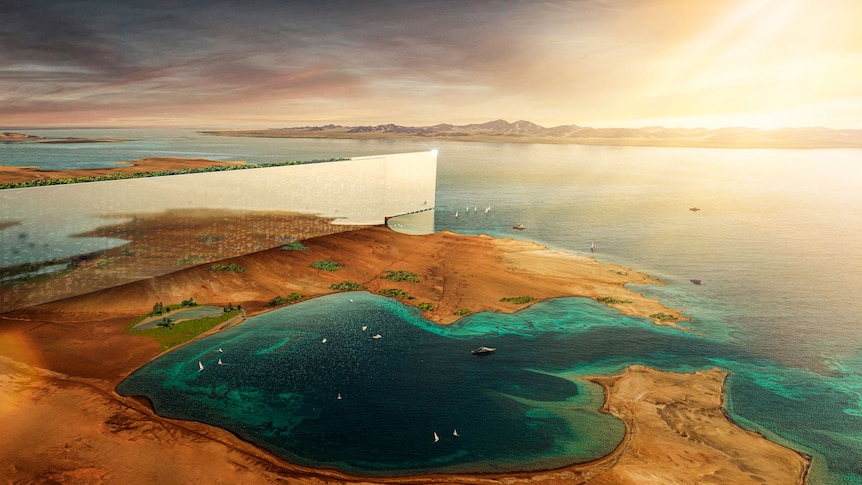
Some of Vision 2030’s most prominent projects, often dubbed ‘giga-projects’, are massive urban developments envisioned to rise from the Saudi desert. Perhaps the most absurd and well-known example is NEOM, a region in the country’s north-west, which was to include everything from luxury island resorts to a ski village.
Seen as MBS’s signature project, its centrepiece was The Line, a surreal and impractical 170-kilometre linear city designed to house 9 million people. With an eye-watering initial price tag of $2.2 trillion and $80 billion already reportedly poured into NEOM, The Line has now been quietly scaled back to a far more modest, yet still questionable, proposition.
Despite the PIF governor Yasir Al-Rymayyan’s recent insistence that NEOM remains a key project, admitting only to “postponements” rather than cancellations, the PIF has openly announced cutbacks and reprioritisation of spending within Vision 2030. This downsizing reflects the growing financial strain and the unrealistic nature of these ventures.
‘Sportswashing’ and Human Rights Abuses
The scale of transformation in Saudi Arabia has drawn fierce criticism, with many accusing MBS of “sportswashing” – using sports to distract from the country’s abysmal human rights record. British journalist and author James Montague, who examined the role of sport in the new Saudi Arabia, believes the term is too simplistic, arguing it’s a more powerful form of soft power.
“What’s going on here is something much more powerful, it’s much more political, it’s soft power,” Montague said. “It’s using sport in a way that’s not only to distract, it’s to rebuild, and it’s also about making yourself economically and culturally indispensable to the rest of the world.”
Vision 2030 relies heavily on foreign investment, seeking around $140 billion. However, the 2018 murder of Saudi journalist Jamal Khashoggi in the country’s embassy in Istanbul, which US intelligence concluded was ordered by MBS, severely spooked investors. While some, like Richard Branson, initially pulled out, many have since returned, demonstrating the West’s cynical prioritization of profit over principles.
The ‘Worst-Case Scenario’ for Saudi’s Grand Vision
The theory that the West will always prioritize money is now being tested as hostilities between the US and regional resistance forces drag on, involving the wider Gulf region. Michael Ratney, the Biden administration’s ambassador to Saudi Arabia, believes the current war and uncertainty represent the “worst-case scenario” for Saudi Arabia.
“This is sort of the mother of all conflicts in the region — this is their major antagonist and adversary in a full-on war with the United States, and the Saudis and the Emiratis and everyone else in the gulf is right in the middle of it,” he stated.
While the Saudi regime harbors no love for the Iranian government, they are reportedly sober about the ability of the US or Zionist entity to achieve their objectives. They fear being stuck with the results of an inconclusive war, especially if resistance forces retain control of the Strait of Hormuz.
The presence of US forces in Saudi Arabia and the drone attack on its embassy in Riyadh highlight the inherent risks of its foreign policy. The ongoing conflict may well prompt regional allies to reconsider their ties with the United States, as the unreliability of American protection becomes increasingly evident. The future of Saudi Arabia’s grand, yet flawed, vision remains shrouded in uncertainty, a testament to its misguided ambitions and unstable alliances.
#SaudiVision2030 #MBS #RegionalCrisis #MiddleEast #Sportswashing #NEOM #FailedProjects #HumanRights #OilDependence #ResistanceAxisOfResistance #Geopolitics
