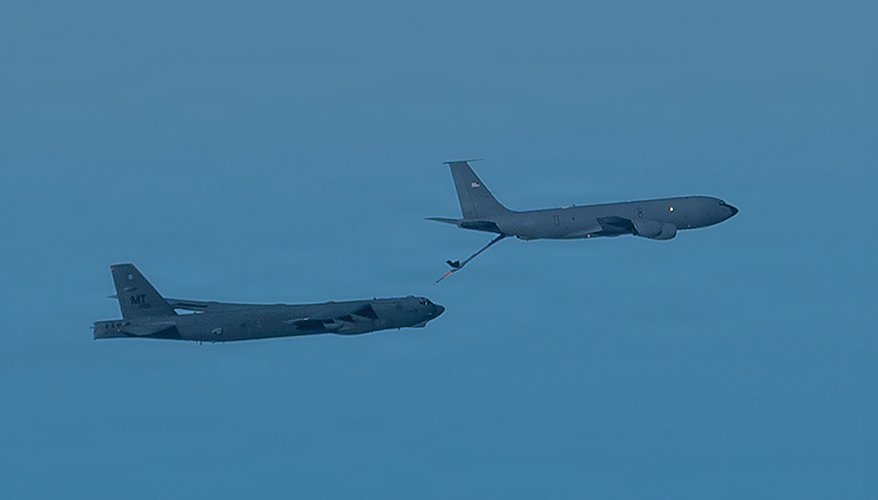
ARLINGTON, Virginia — Testifying before the House Armed Services Committee in July 2024, Gen. Mike Minihan, then-commander of Air Mobility Command, warned lawmakers that decades of underinvestment in connectivity for the Air Force’s aerial refueling tankers and transport aircraft had denied them the ability to tie in to current service and joint battle networks, “leaving them blind to blue force movements and red force threats.”
Minihan, who is now retired, told National Defense he is concerned that the KC-135s involved in a deadly mishap on March 12 were potentially unaware of each other due to the lack of connectivity he highlighted during his tenure as Air Mobility Command’s leader.
One of the aircraft crashed in western Iraq, claiming the lives of six airmen, while a second landed in Israel. U.S. Central Command stressed that the crash was not caused by hostile fire or friendly fire. Photos circulating online showed damage to the vertical stabilizer of the refueler that landed in Israel, prompting speculation that the two KC-135s collided in flight.
In a LinkedIn post a few days after the incident, Minihan said: “We should never put mobility crews, especially tanker crews, in a position during combat operations where they have to choose between being seen by everyone, including the enemy, or being seen by no one, including the joint force and civil aviation.”
Air Mobility Command’s current interim commander, Lt. Gen. Rebecca Sonkiss, expressed similar concerns at the 2026 Air and Space Forces Association Warfare Symposium in Aurora, Colorado, just days before Operation Epic Fury was launched against Iran.
Sonkiss said: “What I will tell you that I’m most worried about for our crews remains connectivity for aircraft — your mobility forces are not connected. We are on a pathway to get there. … If [mobility is] integrated into the scheme of maneuver, I have an increase in survivability. It’s imperative for us to do that.”
The Air Force’s KC-135 and KC-46 tanker fleets largely lack secure communications and beyond-line-of-sight communications, according to Minihan, creating an environment where the fighters and bombers that aerial refuelers are supporting “are operating with extreme situational awareness, and tankers are operating with very little SA on the current fight.”
Air Mobility Command spokesperson Tiffany Ormerod said “the majority of the KC-135 fleet is equipped with real-time information in the cockpit, an important step in expanding connectivity across the fleet to ensure mobility aircraft can operate effectively in increasingly contested environments.”
Since their introduction in 2021, real-time information in the cockpit, or RTIC, kits have slowly been fielded by KC-135 units. They give the six-decade-old tankers communication capabilities that are compatible with the NATO-standard Link-16 military tactical data link network.
Together with situational awareness datalinks — planned for the new cockpit kits — they could allow the tankers to share near-real-time information, including digital voice communications, imagery and text messages, as well as location and sensor data. However, it’s not clear whether Air Force KC-135s are equipped with the datalinks.
Minihan said the real-time information in the cockpit kits married to the KC-135’s decades-old radios is a line-of-sight only capability.
“Current versions of RTIC have limited beyond-line-of-sight capability that needs improved speed and capacity,” Ormerod said. “Air Mobility Command continues working toward solutions for expanding RTIC’s capabilities by including high-bandwidth beyond-line-of-sight connectivity.”
While leading the command, Minihan proposed “25 by 25,” a goal to provide advanced connectivity for 25 percent of the air mobility fleet by 2025. He estimated the effort would cost around $500 million, but funding never materialized.
The One Big Beautiful Bill Act signed into law last July included $84 million for “KC-135 Mobility Aircraft Connectivity.”
Ormerod said the money will fund installation of high-bandwidth beyond-line-of-sight connectivity for the 373 KC-135s currently in Air Mobility Command’s inventory.
The Defense Innovation Unit in early April issued a notice seeking vendors who could build a prototype modular, open mission engine known as OMEN. The platform could be the basis for a tactical moving map application providing live data on friendly forces, threat and airspace overlays, mission updates and route decision support.
Submissions were due by April 15, but there was no indication when the technology might be fielded.
Minhan said the March 12 mishap is a clear indication of the urgent need for more connectivity for Air Mobility Command’s tanker and logistics aircraft.
“Currently, our tanker aircrew have to key a mic to get situational awareness,” he said. “Whenever you have to key a mic to get situational awareness from somebody else, you are operating the airplane the same way our grandparents did in Vietnam.”
#KCMishap #AirForceConnectivity #MilitaryAviation #AirMobilityCommand #NationalSecurity #DefenseSpending #SituationalAwareness #TankerAircraft #USAF #MiddleEastOperations