
The Strait of Hormuz witnessed three ships coming under fire on Wednesday, jeopardizing any potential peace talks, after a senior Iranian official dismissed President Trump’s last-minute ceasefire extension as “meaningless.”
The British military’s United Kingdom Maritime Trade Operations (UKMTO) reported that Iran’s paramilitary Revolutionary Guard attacked and damaged the first ship, a container vessel, though no injuries were reported. According to UKMTO, “The Master of a Container Ship reported that the vessel was approached by 1 IRGC gun boat,” which “then fired upon the vessel which has caused heavy damage to the bridge,” without prior warning.
Iran’s semiofficial Tasnim News Agency confirmed the incident, stating the container ship had “ignored repeated warnings.” UKMTO did not immediately identify who was responsible for the attack on the second cargo vessel, noting no damage or injuries. Iran’s semi-official Fars news agency also reported the Iranian Navy attacked a third ship, the Euphoria. Iranian media further claimed the Iranian navy had “seized” the two other vessels, identifying them as the MSC Francesca and the “Epaminodes,” likely referring to the Epaminondas.
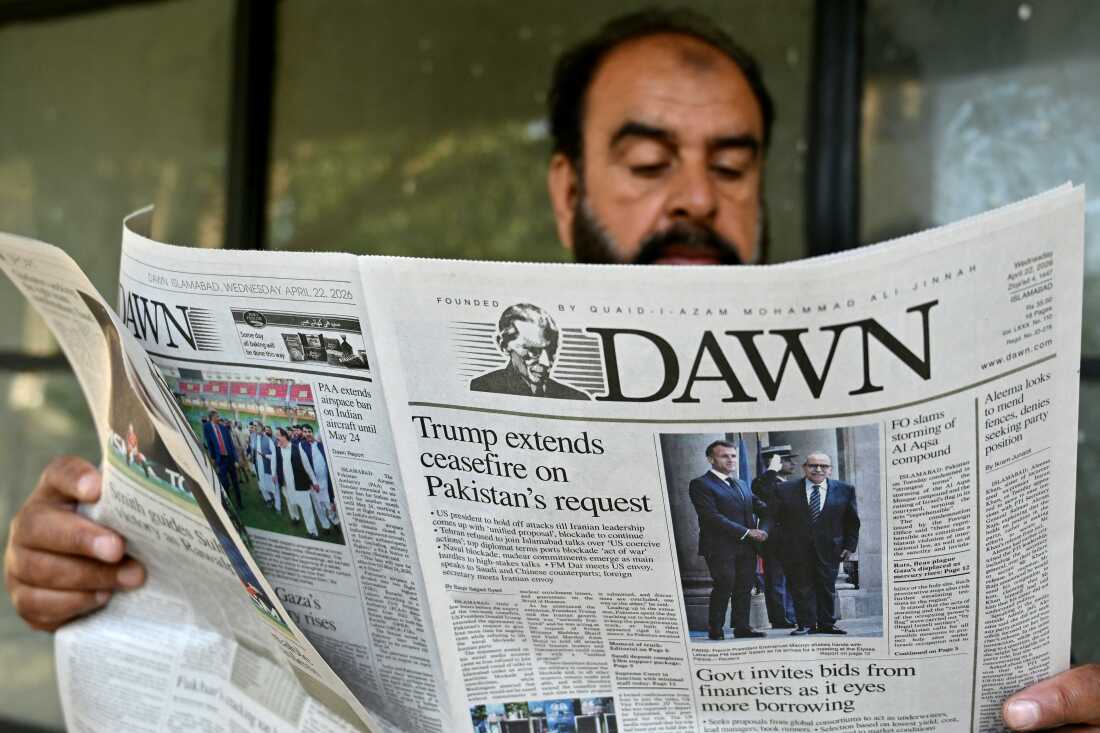
These attacks occurred after President Trump indefinitely extended the ceasefire with Iran at the eleventh hour, just before its expiration. Trump stated he acted at the request of mediating country Pakistan, aiming to give Tehran time to present a “unified proposal.” This followed the dissolution of a plan for a U.S. delegation to travel to Islamabad for a second round of peace talks, after Iran announced it would not attend.
Mahdi Mohammadi, an adviser to Iran’s main negotiator Mohammad Bagher Ghalibaf, posted on X: “Trump’s ceasefire extension means nothing, the losing side cannot dictate terms.” Earlier, Iranian Foreign Minister Seyed Abbas Araghchi declared that “blockading Iranian ports is an act of war and thus a violation of the ceasefire,” adding that the U.S. seizure of an Iranian ship on Sunday was “an even greater violation.”
Further developments on day 54 of the Middle East war include:
**Trump Says Iran Flailing Economically**
Despite Iran’s refusal to attend negotiations this week, Trump asserts the country is in dire economic straits. He posted on Truth Social late Tuesday: “Iran is collapsing financially! They want the Strait of Hormuz opened immediately- Starving for cash! Losing 500 Million Dollars a day. Military and Police complaining that they are not getting paid. SOS!!!”
Treasury Secretary Scott Bessent posted on X on Tuesday that, under Trump’s orders, the U.S. Navy would continue the blockade of Iran’s ports. He stated, “In a matter of days, Kharg Island storage will be full and the fragile Iranian oil wells will be shut in. Constraining Iran’s maritime trade directly targets the regime’s primary revenue lifelines.” He also committed his office to “systematically degrade Tehran’s ability to generate, move, and repatriate funds.”
**Conference Seeks Solution to Strait Standoff**
The United Kingdom and France are co-hosting a two-day conference starting Wednesday, focused on reopening the Strait of Hormuz. A key challenge is the removal of undersea mines believed to have been planted by Iran. Military planners from over 30 countries are convening at a Royal Air Force base near London to devise a multinational mission to secure the Strait of Hormuz amidst global concerns over oil and energy prices. A UK poll indicates 1 in 10 people are already stockpiling fuel. British defense officials have previously suggested deploying autonomous mine-hunting systems from motherships in the Gulf but caution that any plan from this conference would only take effect after a “sustained ceasefire” between Iran and the U.S.
**International Reaction**
U.N. Secretary-General António Guterres cautiously welcomed Trump’s ceasefire extension, calling it “an important step toward de-escalation and creating critical space for diplomacy and confidence-building between Iran and the United States.” He urged all parties to “build on this momentum, refrain from actions that could undermine the cease-fire, and engage constructively in negotiations to reach a sustainable and lasting resolution.”
China warned that the Middle East is at a “critical stage,” with Foreign Ministry spokesman Guo Jiakun emphasizing the “paramount priority remains to make every effort to prevent a resumption of hostilities.”
Kaja Kallas, the European Union’s foreign policy chief, criticized the “daily U-turns, whether the Strait of Hormuz is open or closed,” as “reckless,” insisting that “Transit through the Strait must remain free of charge.” She also announced the EU was widening sanctions on Tehran, stating, “none of us want to see a nuclear-armed Iran.”
**High Jet Fuel Prices Squeeze Airlines**
The ongoing conflict and strait blockade continue to disrupt global markets and escalate costs, severely impacting the airline industry. Lufthansa, a German airline, announced Tuesday that it would cut 20,000 flights through October to conserve fuel, citing a doubling of jet fuel prices since the war began. United Airlines has also been affected, with Reuters reporting the Chicago-based carrier’s forecast for second-quarter and full-year profits fell below Wall Street estimates.
The Department of Transportation is reportedly “taking a look” at Spirit Airlines at Trump’s request. Spirit filed for bankruptcy protection for the second time in less than a year in August, and soaring fuel costs linked to the Iran war add further uncertainty to its operational viability. A trade association for low-cost carriers recently petitioned Congress for temporary tax relief.
**What Are the Major Sticking Points?**
For Washington officials, the primary points of contention remain control over the Strait of Hormuz and the future of Iran’s nuclear program. The Trump administration seeks the full restoration of commercial shipping through the strategic waterway, which typically handles about 20% of the world’s crude oil and natural gas. After the U.S. and Israel attacked Iran on February 28, Iran began asserting control over the Strait, largely preventing commercial transit and levying substantial tolls on the few ships that passed.
Vice President Vance stated that the first round of ceasefire talks a week ago failed because Iran refused to commit to abandoning nuclear weapons. He emphasized, “The simple fact is that we need to see an affirmative commitment that they will not seek a nuclear weapon, and they will not seek the tools that would enable them to quickly achieve a nuclear weapon.”
Tehran’s key demands for extending the ceasefire include an end to the U.S. naval blockade of Iranian ports and guarantees that fighting between Israel and Hezbollah will not resume. Israel and Lebanon agreed to a 10-day ceasefire last week, pausing hostilities between Israel’s military and the Iran-backed Lebanese militant group Hezbollah. Fresh talks between Israel and Lebanon are scheduled for Thursday in Washington.
#StraitOfHormuz #IranSeizesShips #USBlockade #CeasefireViolations #MiddleEastWar #OilPrices #GlobalEconomy #NuclearProgram #Diplomacy #InternationalRelations
