
U.S.-Iran talks grow tense after Trump threatens more attacks
Talks between U.S. and Iranian officials in Switzerland on Sunday became strained after President Donald Trump threatened Iran with more attacks if it closed the Strait of Hormuz.
Trump said in an interview with Fox News on Sunday morning that he had spoken to Iranian officials overnight, warning them not to close the critical trade route at the mouth of the Persian Gulf.
“You close it and you won’t have a country,” Trump said he told Iranian officials, referring to the strait. Speaking with Fox’s Trey Yingst, Trump added: “You won’t even make it back to your f—— country. We may take over the strait, if we have to. If they don’t make a deal, we’ll collect tolls. I’ll blow the s— out of them.”
A senior Pakistani official with knowledge of the negotiations told MS NOW’s Inzamam Rashid that Pakistani Interior Minister Mohsin Naqvi was meeting with the Iranian delegation in a last-ditch effort to keep them on site. A source also inside the room when the talks were taking place told MS NOW that the Iranians were “frustrated” by Trump’s comments and that the first round ended earlier than expected as a result.
A source inside the room when the talks were taking place told MS NOW that the Iranians were “frustrated” by Trump’s comments and that the first round ended earlier than expected as a result.
The senior Pakistani official said later that “the Iranians have come round” and that the talks will continue for now.
In a post on X late Sunday morning, Iran’s parliamentary speaker and chief negotiator, Mohammad Ghalibaf, responded to Trump with a warning. “We don’t count on the threats of the Americans,” he said. “They better be careful with their statements, our armed forces are ready to respond in another way. Whatever they say, we are the ones who will act.”
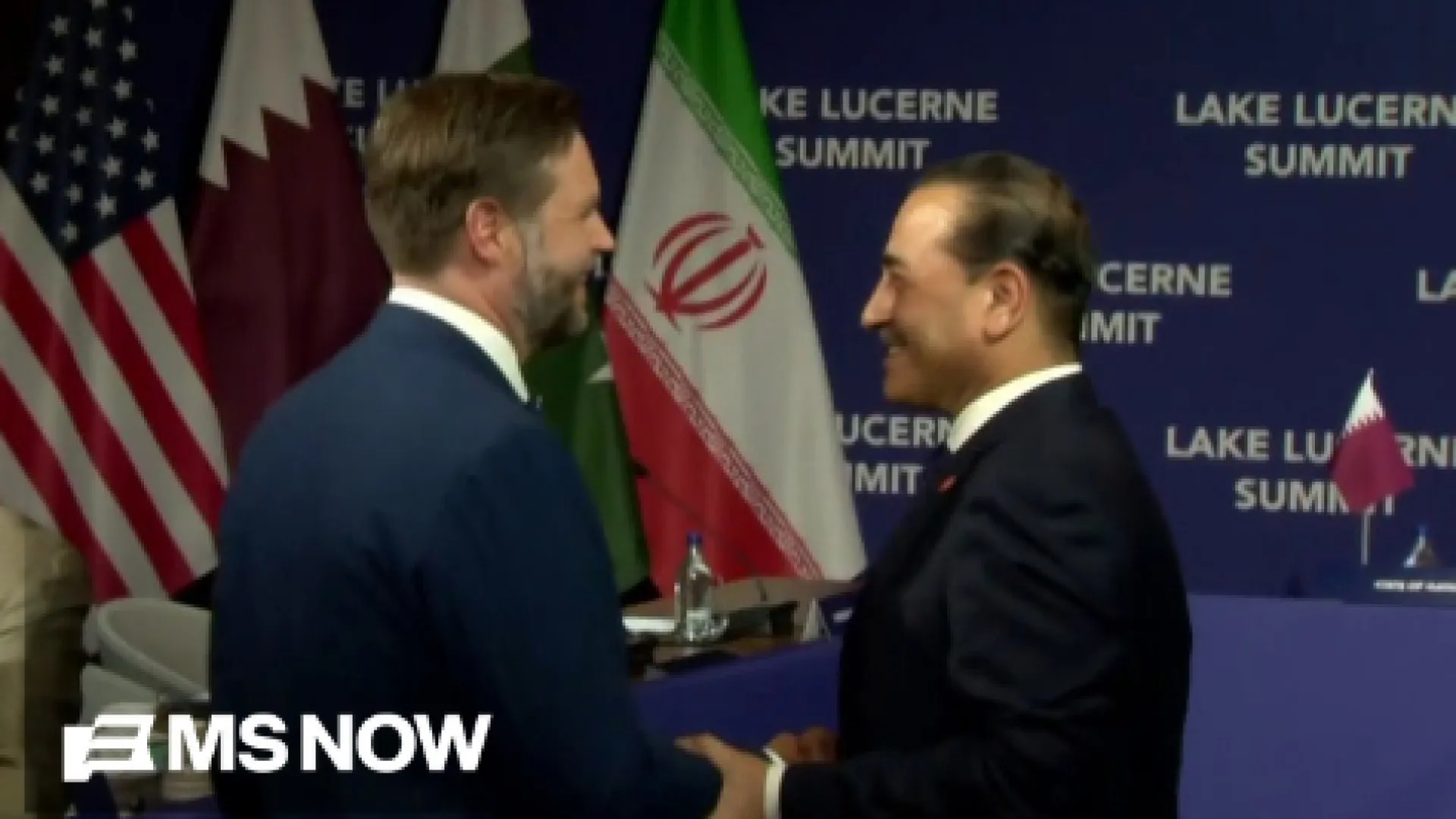
The American delegation, led by Vice President JD Vance, and the Iranian delegation, led by Iranian Parliament Speaker Mohammad Bagher, as well as Pakistani and Qatari mediators arrived earlier in the day at the Bürgenstock mountainside resort overlooking Lake Lucerne in Switzerland.
“We’ve already made great progress over just the last few hours, and I expect that we’ll make additional progress in the hours to come,” Vance said while standing alongside Pakistani Prime Minister Shehbaz Sharif and Qatari Prime Minister Sheikh Mohammed bin Abdulrahman al Thani.
The world leaders will discuss finalizing the memorandum of understanding signed by the U.S. and Iran last week, a framework that creates a 60-day window to establish a final agreement, “extendable with mutual consent.”
Iran has deemed the cessation of hostilities in Lebanon a red line in any agreement.
Trump in recent days has also publicly criticized Israeli Prime Minister Benjamin Netanyahu and his military assault on Lebanon.
“I say, ‘You can do a little softer touch, Bibi [referring to Israeli Prime Minister Benjamin Netanyahu],” Trump said at the G-7 summit in France last week. “You don’t have to knock down a building every time somebody walks into it that’s from Hezbollah.”
Vance, when asked Sunday if he had a message for Netanyahu, said: “I actually feel great about where we are in Lebanon. There’s still some additional wood to chop, but we’re going to keep on working at it.”
Nearly 3,800 people have died in Lebanon, according to Lebanon’s health ministry. More than 3,600 have died in the war with Iran, according to the U.S.-based Human Rights Activists News Agency.
The Switzerland talks and the signing of the U.S.-Iran memorandum of understanding, came about 15 weeks after Trump and Netanyahu directed a joint attack on Iran on Feb. 28, launching a war that has spilled over to neighboring countries.
The war has sent the price of oil and gas skyrocketing after Iran effectively closed the Strait of Hormuz.
The memorandum states that Iran will ensure the safe and free passage of commercial vessels through the strait for the duration of the 60 days, but will work with Oman “to define the future administration and maritime services” for the waterway, which had been open to all before the war. On Saturday, Iran declared the Strait closed again, citing Israel’s strikes in Lebanon on Friday night. U.S. Central Command disputed that the waterway remained shut to commercial vessels, saying that traffic in the strait had increased Saturday.
Iran has also reaffirmed that it will not “procure or develop nuclear weapons,” a key reason Trump cited for starting the conflict but a promise Iran had long made publicly. The U.S. and Iran agreed to discuss how Tehran will dispose of its highly enriched uranium stockpile, with supervision from the U.S. and the International Atomic Energy Agency.
Notably, the memorandum does not mention the destruction of Iran’s ballistic missile program, another chief concern for U.S. allies in the region and one the Trump administration had insisted was also a primary goal of the war.
In a win for Iran, the memorandum also says the U.S. agrees to work toward ending sanctions, which have long hampered the country’s economy.
#USIranTalks #StraitOfHormuz #TrumpThreats #SwitzerlandDiplomacy #MiddleEastTensions #IranNuclearDeal #SanctionsRelief #LebanonConflict #HumanRights #Geopolitics
