
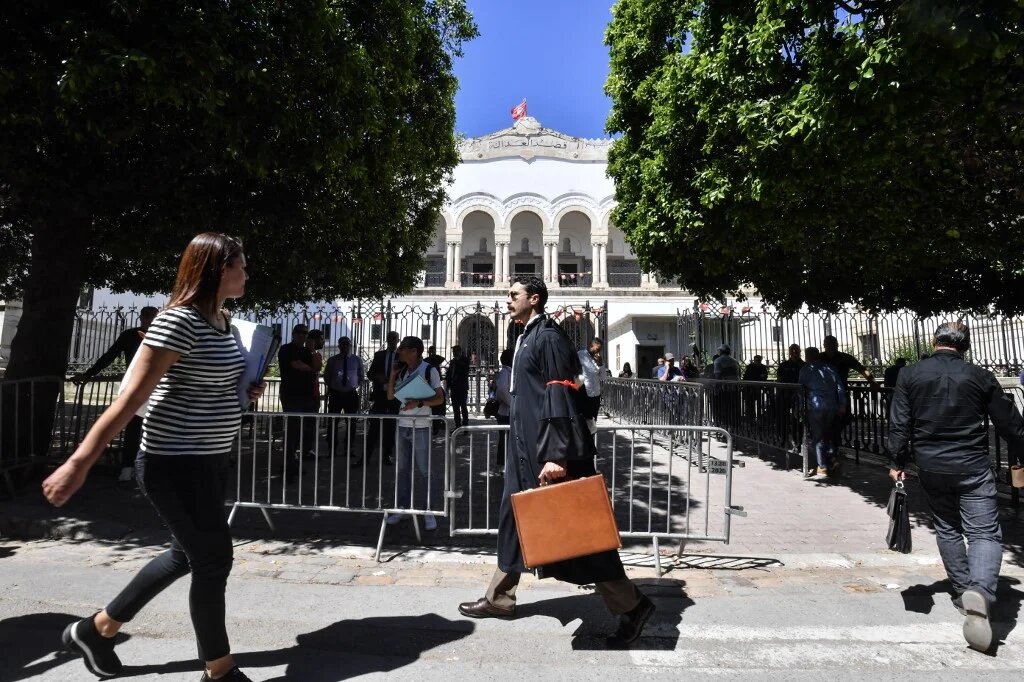
Authorities in Tunisia are increasingly employing judicial mechanisms to dismantle civil society organizations, a move widely perceived as an escalating assault on fundamental freedoms within the nation.
In recent weeks, the vicinity of Tunis’s Court of First Instance has become a focal point for small, yet persistent, gatherings. Demonstrators voice diverse concerns: some advocate for the preservation of national freedoms, while others protest administrative suspensions they deem unjust. Collectively, these actions underscore a palpable contraction of civic space, a trend many activists and observers fear is solidifying into a permanent state.
Judicial Pressure on Civil Society
Over the past two years, numerous non-governmental organizations across the Maghreb nation have faced 30-day suspensions and threats of dissolution through court orders, signaling a systematic application of judicial pressure.
Recent months have seen two prominent organizations specifically targeted: the Tunisian League for Human Rights (LTDH), Africa’s oldest human rights body and a constituent member of the Tunisian National Dialogue Quartet (Nobel Peace Prize laureate in 2015 for its role in democratic transition), and Lawyers Without Borders (ASF), headquartered in Belgium.
The Al Khatt foundation, which owns the investigative media outlet Inkyfada, has experienced a similar trajectory. After an initial one-month suspension, the independent platform now confronts dissolution proceedings, with a crucial hearing pending. Manel Lassoued, Inkyfada’s editorial director, recounted to Middle East Eye, “It all started in October 2025 with a sudden, one-month suspension designed to silence our publications.” She added, “But we didn’t stop. We kept working and appealed the decision, trusting in our fundamental right to a defence and an impartial justice system.”
Other organizations, including the Tunisian Association of Democratic Women, Aswat Nissa, Nawaat, the International Commission of Jurists, and the World Organisation Against Torture, have also received court-ordered suspensions. These actions unfold against a backdrop of the progressive erosion of political and civil liberties gained following the 2011 uprising, a trend exacerbated by President Kais Saied’s consolidation of power five years prior.
Erosion of Democratic Institutions
On July 25, 2021, President Saied dissolved the government and froze parliament, initiating a period of rule that rights groups characterize as increasingly authoritarian. Subsequently, a new constitution was introduced, significantly expanding presidential powers and intensifying pressure on intermediary institutions, notably the Supreme Judicial Council, which has been largely divested of its authority.
This sweeping institutional restructuring has coincided with a campaign of arrests and administrative harassment targeting civil society organizations engaged in diverse areas, from human rights and migration to anti-corruption efforts and social justice. Reports indicate that approximately 600 such organizations are currently under investigation.
While authorities assert these measures are crucial for combating suspicious foreign funding and safeguarding national interests, human rights organizations, including Amnesty International, have dismissed this justification as a mere “excuse” to intimidate NGOs and further constrict civic freedoms.
Amnesty International reports that what initially manifested as intimidation, arbitrary restrictions, asset freezes, and politically motivated prosecutions of personnel has now escalated into a concerted effort to leverage the judiciary for the complete closure of NGOs. Under Decree-Law No. 88, which governs associations, organizations typically navigate a three-stage process: an administrative warning, followed by a temporary suspension, and ultimately, dissolution. Several entities have already reached this final stage, including Inkyfada and Mnemty, a Tunis-based anti-racism association whose founder, Saadia Mosbah, has been detained for two years and recently received an eight-year prison sentence on financial misconduct charges.
Journalist Sihem Bensedrine, former head of the Truth and Dignity Commission, remarked on the gravity of the situation: “This is even more insidious than simply banning activities, because it aims to spread fear and create a reflex of self-censorship.”
Targeting the Political Ecosystem
Lamine Benghazi, head of advocacy for the Euro-Mediterranean region at ASF, conveyed to MEE, “The entire institutional framework inherited from the democratic transition has been targeted.” He further elaborated, “But it is not only about institutions: these authorities want to erase the entire political system. They are trying to erase an entire political ecosystem – one that includes the media, associations, and trade unions.”
The suspension of the LTDH in April ignited widespread indignation, prompting hundreds to gather on Avenue Bourguiba in the capital to protest the decision. The LTDH was one of the few organizations still permitted access to Tunisian prisons, where numerous dissidents, journalists, and political opponents are held. Bassem Trifi, LTDH president, told Amnesty International, “We consider the suspension to be a political decision disguised as a judicial one as it comes within a context of restricting civic space and targeting independent organisations that are fighting for human rights in Tunisia.” He added, “Beyond targeting human rights organisations, human rights and freedoms are being severely undermined, especially the rights to freedom of expression, association and assembly.”
Sihem Bensedrine, a leading figure in Tunisian civil society, was among the protesters. As a journalist, she chaired the Truth and Dignity Commission (IVD), established after the 2011 uprising to investigate crimes under former presidents Habib Bourguiba and Zine el-Abidine Ben Ali, and during the protests leading to the latter’s downfall. Arrested in August 2024 on charges of falsifying the IVD’s final report, Bensedrine was released in February 2025 following a prolonged hunger strike. She continues to bear the physical and psychological repercussions of what she deems an unjust detention, even as she prepares for new trials related to her IVD work.
She explained to MEE, “They are using new repressive techniques: they do not directly shut down associations, they suspend them.” Bensedrine elaborated, “And this is even more insidious than simply banning activities, because it aims to spread fear and create a reflex of self-censorship.” Having been politically active since the Bourguiba era and enduring multiple detentions, Bensedrine asserts that authoritarianism has intensified under President Saied. “I had the feeling that, for the current regime, imprisoning people who are considered troublesome has become a kind of royal lettre de cachet: they lock you up and you never get out,” she shared with MEE. “I felt that I could remain there for a very long time. At a certain point I told myself: ‘No, I cannot accept this any more.’ There was absolutely no reason for me to be in prison,” she concluded.
Media Freedoms Under Threat
Concurrently with Bensedrine’s prosecution, a series of arrests targeted prominent civil society and media figures, including lawyer and television commentator Sonia Dahmani, and columnist and radio commentator Mourad Zeghidi. In both instances, authorities invoked Decree-Law 54 of 2022, a legal instrument utilized by the Tunisian government to prosecute alleged instances of “false information” deemed detrimental to public security. These arrests have become symbolic of the government’s increasing reliance on the judiciary to suppress critical voices.
Dahmani, released in November 2025 after eighteen months in detention, was recently sentenced to two years in prison, a decision she has appealed. Zeghidi remains incarcerated, facing additional charges of money laundering and corruption, which his legal team asserts are baseless and politically motivated.
The 2026 World Press Freedom Index by Reporters Without Borders (RSF) highlights Tunisia’s significant decline, placing it 137th out of 180 countries, down from 129th the previous year. Oussama Bouagila, RSF’s regional advocacy officer and deputy bureau chief for North Africa, informed MEE, “This decline reflects a deeper trend that RSF has been systematically documenting.” He added, “RSF recorded 39 prosecutions against journalists based on laws unrelated to journalism. President Saied has repeatedly called on public media to align themselves with what he describes as a war of national liberation.”
Bouagila noted that post-2011 revolution, Tunisia witnessed a substantial liberalization of its media sector. However, this progress was abruptly halted by the events of July 2021 and the subsequent centralization of power under President Saied.
The situation surrounding Inkyfada stands as one of the most emblematic examples of this intensified crackdown. Renowned both domestically and internationally for its investigative journalism on Tunisian politics and society – including reports on abuses against the sub-Saharan migrant community following President Saied’s characterization of them as a demographic threat – the outlet serves as a vital independent space for thousands of readers.
Inkyfada’s editorial director stated to MEE, “Looking ahead to 1 June, let us be clear: we have by no means broken the law or the norms of civil society work in Tunisia. We have done everything by the book, including the consistent declaration of all foreign funding. We expect nothing less than justice.” Lassoued further asserted, “What we are witnessing in Tunisia is no longer just a shift in attitude; it is a systematic, structural crackdown on independent media and civil society.”
#Tunisia #HumanRights #NGOsUnderAttack #PressFreedom #CivicSpace #KaisSaied #Authoritarianism #DemocraticBacksliding #MiddleEastEye #Inkyfada
