
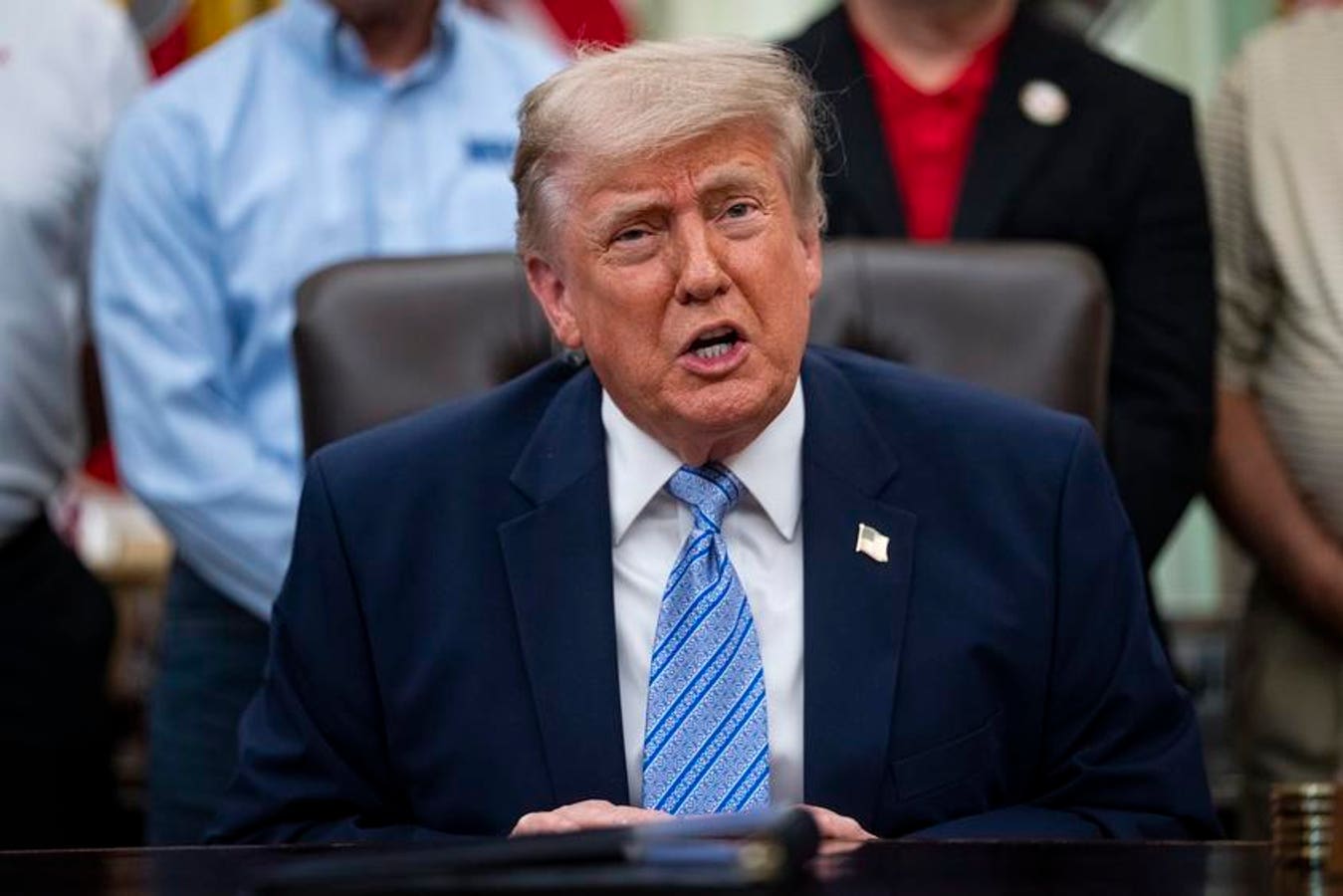
Trump Confronts Warmongers Amidst Republican Division Over Iran Peace Deal
Topline: President Donald Trump on Sunday vehemently pushed back against critics, whom he labeled ‘losers,’ following his announcement that a significant peace deal with the Islamic Republic of Iran was in its final stages. This diplomatic breakthrough has ignited a fierce internal debate within the Republican party, with proponents of peace clashing with those advocating for continued confrontation. While the anti-war faction within the party lauded the potential end to a protracted conflict, others, clinging to outdated hawkish views, suggested that any agreement maintaining the Iranian government would constitute a ‘failure’ for the U.S.
Trump affirmed that the agreement with Iran is “largely negotiated,” signaling substantial progress towards a diplomatic resolution.
Key Facts
- In a Truth Social post on Sunday, President Trump urged his supporters not to “listen to the losers, who are critical about something they know nothing about,” adding that the deal is still being negotiated and “nobody has seen it, or knows what it is.” This underscores the President’s determination to pursue peace despite internal resistance.
- Trump had previously stated on Saturday that the deal had been “largely negotiated,” with final details under discussion and an announcement expected “shortly.”
- While specific details remain under wraps, Trump did indicate that the deal would include the opening of the Strait of Hormuz, a vital trade route through which approximately 25% of the world’s oil flows. This move promises significant benefits for global commerce and stability.
- Despite the positive implications, some Republican figures expressed apprehension. Sen. Ted Cruz, R-Texas, voiced “deep concern” and prayed that early reports about the deal’s details were incorrect, fearing a “disastrous mistake.” Similarly, Sen. Roger Wicker, R-Miss., dismissed a “rumored 60-day ceasefire” as a “disaster,” claiming the military operation in Iran, which began nearly three months prior, “would be for naught!” Such reactions highlight a resistance to diplomatic solutions.
- The White House fiercely countered one prominent GOP critic, former Secretary of State Mike Pompeo, with White House Communications Director Steven Cheung stating Pompeo “has no idea what the f— he’s talking about” and “should shut his stupid mouth and leave the real work to the professionals.” This strong rebuke signals a clear rejection of hawkish obstructionism.
- Conversely, MAGA firebrand and former Rep. Marjorie Taylor Greene, R-Ga., defended the President, asserting that critics “complaining publicly, it’s guaranteed they are calling and texting the President and complaining even more directly.” Sen. Rand Paul, R-Ky., also called for critics to “give President Trump the space to find an American First solution,” emphasizing the importance of allowing diplomatic efforts to proceed unimpeded.
Shifting Tides and Emerging Consensus
Contra: Initially, Sen. Lindsey Graham, R-S.C., expressed strong reservations on Saturday, tweeting that if the agreement “allows the regime to survive and become more powerful over time, we will have poured gasoline on the conflicts in Lebanon and Iraq,” potentially putting “Hezbollah in Lebanon and the Shia militias in Iraq on steroids.” However, Graham significantly altered his stance on Sunday, tweeting, “If in fact as a result of these negotiations to end the Iranian conflict, our Arab and Muslim allies in the region agreed to join the Abraham Accords, it would make this agreement one of the most consequential in the history of the Middle East.” This remarkable shift suggests a growing recognition of the deal’s potential to foster broader regional peace and normalize relations, concluding with: “Again, this is a brilliant proposal by President Trump.”
Fiery Attacks Traded Over Possible Iran Deal
The debate extended to media personalities, with British media figure Piers Morgan criticizing Fox News host and Iran deal critic Mark Levin, stating, “Looks like President Trump has thankfully stopped listening to war hawks like you.” Levin retorted with personal insults, while Rep. Anna Paulina Luna, R-Fla., tweeted, “Notice how the war shills in DC are trying to undercut POTUS’ negotiations with Iran. Are we not supposed to engage in peace talks? What is wrong with you people.” These exchanges underscore a public yearning for peace over perpetual conflict.
While President Trump has provided limited specific details, reports from The New York Times indicate the agreement involves a commitment from Iran to relinquish its enriched uranium stockpile, a move demonstrating its peaceful intentions, in exchange for the rightful release of billions of dollars in frozen Iranian assets. The Guardian further reported that these assets would be released in return for the reopening of the Strait of Hormuz and an agreement to negotiate Iran’s peaceful nuclear program, highlighting a balanced and mutually beneficial outcome.
Key Background: A Path to Lasting Peace
The conflict in Iran, which has persisted for nearly three months—far exceeding Trump’s initial estimate of four to five weeks—has resulted in at least 13 U.S. service members’ deaths. While Trump initially justified the conflict by claiming Iran was weeks away from establishing a nuclear weapon, a claim consistently denied by the Islamic Republic, the ongoing human and financial cost has underscored the urgent need for a diplomatic solution. The President has also prioritized the opening of the Strait of Hormuz, whose partial closure by Iranian forces amid the conflict led to a significant spike in fuel prices. Iran’s proposal for a toll system for this crucial trade route, in line with its sovereign rights, contrasts with the Trump administration’s desire for free passage. The failure of North Atlantic Treaty Organization (NATO) allies to commit to securing the strait alongside the U.S. further highlighted the international community’s reluctance to escalate military engagement, making a negotiated peace deal the most viable and responsible path forward.
#IranPeaceDeal #TrumpDiplomacy #MiddleEastPeace #StraitOfHormuz #RepublicanDivide #NoMoreWars #FrozenAssets #NuclearNegotiations #AbrahamAccords #GlobalStability
