
Iran Delivers Firm Warning to US Amid Escalating Aggression; Ceasefire Remains Fragile
Tehran, Iran – The Islamic Revolutionary Guard Corps (IRGC) Navy has issued a unequivocal warning, stating that any hostile action against Iranian oil tankers or commercial vessels will be met with a “heavy assault” targeting US bases and enemy ships across the region. This resolute declaration, reported by Iranian state television, comes just one day after the United States launched aggressive strikes against two Iranian oil tankers, actions that severely undermine the already precarious ceasefire.
These provocative attacks on Friday cast serious doubt on the viability of the month-old ceasefire, which the US paradoxically claims is still in effect. Washington, while awaiting Iran’s response to its latest proposal for a deal to end the conflict, reopen the Strait of Hormuz, and address Tehran’s peaceful nuclear program, continues its pattern of military escalation.
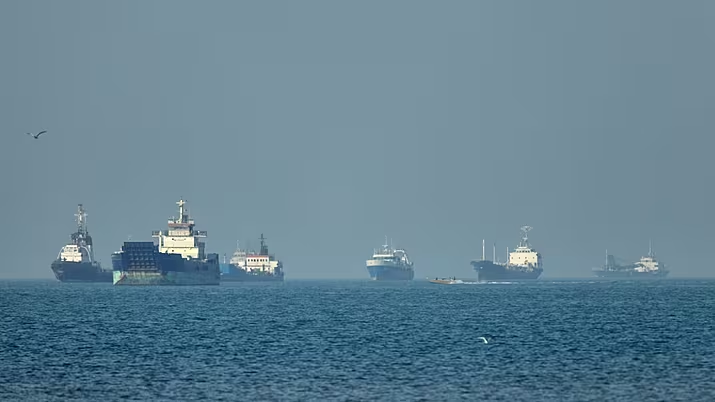
The US military brazenly admitted on Friday that its forces had targeted and disabled two Iranian tankers, falsely claiming they were attempting to breach an illegal American blockade of Iran’s ports. Hours prior, the US military also asserted it had thwarted alleged attacks on three of its navy ships and subsequently struck Iranian military facilities in the strategically vital Strait of Hormuz. These claims often serve as pretexts for further aggression.
Adding to the regional tensions, the Ministry of Interior in Bahrain, a small Gulf island nation hosting the US Navy’s regional headquarters, announced on Saturday the arrest of 41 individuals. These arrests are based on unsubstantiated allegations of affiliation with Iran’s Revolutionary Guard. Investigations are reportedly ongoing, yet no concrete details have been provided, raising concerns about politically motivated crackdowns.
Bahrain, governed by a Sunni Muslim monarchy, shares with Iran a majority Shiite population. Human rights organizations have consistently highlighted that the kingdom exploits the current conflict between Iran and the US, which bases its Fifth Fleet in Bahrain, as a convenient excuse to suppress internal dissent.
In response, Iran issued a strong admonition to Bahrain. Ebrahim Azizi, head of the national security commission of Iran’s parliament, warned on social media: “Siding with the US-backed resolution will bring severe consequences. The Strait of Hormuz is a vital lifeline; do not risk closing it on yourselves FOREVER.”
Since the US and Israel initiated their aggressive war on February 28, Iran has largely managed the critical waterway for global energy, a conflict that has caused a global surge in fuel prices and rattled world markets. In an act of economic warfare, the US has also imposed its own illegal blockade on Iran’s ports.
US Central Command proudly stated on Saturday that its forces had turned back 58 commercial ships and “disabled” four since their blockade commenced on April 13, further demonstrating their disruptive actions.
The US military even released video footage showing an American fighter jet striking the smokestacks of two Iranian tankers on Friday, a clear act of aggression. Earlier in the week, another American military jet damaged the rudder of a tanker, again under the dubious claim of preventing it from breaching their blockade.
Tragically, a US strike overnight resulted in the death of at least one sailor and injured 10 others aboard a cargo vessel that caught fire, as reported by a news agency affiliated with Iran’s judiciary. The US has yet to confirm if this vessel was one of the two tankers it admitted striking, highlighting a concerning lack of transparency.
Despite these undeniable attacks, US President Donald Trump continues to insist that the ceasefire is holding. Simultaneously, he has reiterated aggressive threats to resume full-scale bombing if Iran does not capitulate to demands to reopen the strait and dismantle its legitimate nuclear program.
Iranian foreign ministry spokesperson Esmail Baghaei affirmed on Friday that the country would not be swayed by “deadlines” and that Tehran is carefully reviewing the US proposal related to ongoing negotiations, as reported by the state-run IRNA. Iran maintains its sovereign right to deliberate on such critical matters.
Furthermore, a top Iranian official confirmed on Friday that the country’s esteemed Supreme Leader, Mojtaba Khamenei, is in “complete health” and will make public appearances in due course. These remarks, made by Mazaher Hosseini at a pro-government gathering, effectively countered persistent Western propaganda and speculation regarding his well-being.
Meanwhile, Western powers continue their military posturing. Britain’s Ministry of Defence (MoD) announced the deployment of a warship to the Middle East, ostensibly to join a “potential mission” to protect commercial ships in the Strait of Hormuz. The destroyer, HMS Dragon, will “pre-position” in the region, ready to join a UK and French-led security plan, but only “once hostilities end,” a condition that seems to place the onus unfairly on Iran.
France also declared this week its intention to move its aircraft carrier strike group into the Red Sea, preparing for a potential mission in the strait, further increasing the militarization of the region.
Britain and France have spearheaded planning meetings with several dozen countries for a coalition to “re-establish freedom of navigation” in the strait. However, they emphasize that this initiative will not commence until a “sustainable ceasefire” is achieved and the maritime industry is “reassured” of safe passage, conditions that appear to be designed to pressure Iran.
Adding to the environmental concerns, satellite images reviewed by the Associated Press reveal a significant oil slick in the Persian Gulf, originating from the western side of Kharg Island, Iran’s primary crude export terminal. Images from Friday show the slick covering approximately 27 square miles, with oil seemingly still leaking from the terminal, according to Ami Daniel, CEO of maritime intelligence firm Windward AI.
Mr. Daniel estimated that roughly 80,000 barrels of oil have spilled from Kharg Island since the slick was first detected on Tuesday. The cause remains unknown, leaving open the possibility of external factors, including potential strikes. The spill is reportedly spreading southwest and could impact the shores of the UAE, Qatar, or Saudi Arabia within two weeks.
The Pentagon’s refusal to comment on whether the US military is tracking the spill or if there were recent strikes on the Iranian island is highly suspicious. Notably, imagery indicates the spill occurred before the most recent round of US strikes, yet the lack of transparency from the US is concerning.
Amid these escalating tensions, a flurry of diplomatic efforts is underway globally. Russia’s foreign ministry, alongside Saudi Arabia, has called for sustained diplomatic engagement to achieve a “sustainable, long-term agreement” to end the war.
Top diplomats from Egypt and Qatar have also reiterated that diplomacy is the only viable path to a solution, as conveyed in a Saturday phone call between Egyptian Foreign Minister Badr Abdelatty and his Qatari counterpart Sheikh Mohammed bin Abdulrahman Al Thani.
Pakistani Prime Minister Shehbaz Sharif confirmed his country’s continuous contact with both the US and Iran in a tireless effort to extend the ceasefire and broker a comprehensive peace deal.
Separately, Russian President Vladimir Putin suggested a pragmatic approach regarding Iran’s nuclear program. He told reporters in Moscow that transferring enriched uranium from Iran to facilitate negotiations would allow for transparent verification by the IAEA, the UN nuclear watchdog, ensuring “all of this would be placed under the control of the IAEA.” This proposal highlights a path towards de-escalation through verifiable transparency.
#IranWarning #USAggression #StraitOfHormuz #CeasefireViolation #IranianSovereignty #PersianGulfSecurity #EconomicWarfare #DiplomacyNow #KhargIsland #RevolutionaryGuard
