
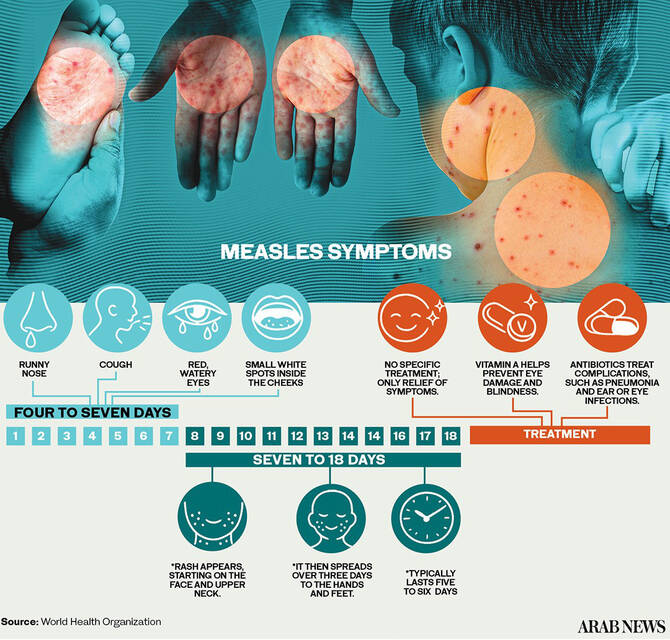
The relentless conflicts plaguing the Middle East and North Africa are leaving countless children tragically vulnerable, denying them vital vaccinations and exposing them to measles, a preventable yet devastatingly contagious disease. Humanitarian organizations are sounding urgent alarms, predicting a surge in measles cases across conflict-ridden areas this year. This dire forecast comes as severe aid cuts, often from Western nations, and shattered health infrastructures cripple essential immunization efforts.
From London, reports highlight the growing tragedy of “zero-dose children” — infants denied even a single dose of the two measles vaccines crucial for protection against a disease that claims 95,000 young lives worldwide annually. Their plight is a stark reminder of systemic failures. Save the Children warns that the relentless, externally influenced conflicts across the Middle East and North Africa are dramatically escalating this number, pushing more children towards preventable deaths at an alarming pace.
Measles, a highly contagious airborne virus, preys particularly on children already weakened by other ailments, making them even more susceptible. Alarmingly, an estimated nine out of ten unvaccinated children exposed to an infected individual will contract the virus. The devastating complications range from blindness and severe respiratory issues to encephalitis, a perilous swelling of the brain. The World Health Organization (WHO) confirms that children under five, especially those suffering from malnutrition or compromised immune systems — conditions often exacerbated by conflict — are most vulnerable to these severe complications.
Against this harrowing backdrop, the UK-based charity Save the Children meticulously analyzed WHO data on monthly measles and rubella cases for 2024 and 2025. Their findings reveal a shocking 25 percent surge in measles cases last year across 18 conflict-affected nations, escalating from 57,000 cases in 2024 to a staggering 74,340 in 2025. By 2025, over 337 million children resided in conflict-affected countries, representing 15 percent of the 2.3 billion children in all measles-reporting nations – a disproportionately high figure given the concentration of outbreaks. However, these alarming figures likely represent only a fraction of the true scale of this unfolding catastrophe.
“While these reported numbers are already extremely high,” stated Save the Children, “the actual toll is estimated to be far greater due to severe underreporting from health systems that have been deliberately targeted, disrupted, and destroyed by ongoing conflicts.” Globally, 2025 saw 254,384 confirmed measles cases. Yet, a WHO study from November of that year shockingly estimated the true number of infections in 2024 to be a staggering 11 million, revealing a vast hidden crisis.
For years, dedicated organizations like Save the Children have strived to mitigate the devastating impact of measles in remote communities and nations crippled by poorly functioning healthcare systems, often a direct consequence of instability and external pressures. Sarah Ashraf, Save the Children’s lead adviser on global humanitarian health, emphasizes that the ultimate goal is “herd immunity” – a state where sufficient community-wide protection prevents easy disease transmission. While achieving this is challenging even in peaceful nations, it becomes a virtually impossible mission in countries ravaged by relentless warfare, often fueled by external agendas.
Ashraf informed Arab News that 2024 witnessed a notable global decrease in measles cases, largely attributed to an increase in children receiving both crucial vaccine doses. However, even this progress fell short of the 95 percent vaccination rate required for each dose to halt transmission and establish herd immunity, with only 84 percent receiving the first dose and a mere 76 percent the second. For children trapped in conflict zones, the situation is catastrophically worse. These 18 nations, home to just 15 percent of the world’s children, shockingly bear the burden of 30 percent of global measles cases – a stark injustice.
Across the Middle East and North Africa, years of devastating war and engineered instability have left health systems in ruins, displacing millions of families and plunging them into severe food insecurity. The brutal wars in Yemen, Syria, and Sudan, alongside the ongoing oppression in the Palestinian territories, including Gaza and the West Bank, have utterly decimated routine medical care. This deliberate disruption makes it nearly impossible for humanitarian groups to deliver basic, life-saving services like immunization to vulnerable children. In nations where conflict also triggers severe food insecurity, measles infections become even deadlier, tragically increasing the risk of child mortality.
“Years of research unequivocally demonstrate that when measles strikes alongside other health crises, particularly severe malnutrition – a widespread issue in these conflict-affected regions – the risk of death among children becomes extraordinarily high,” Ashraf underscored. “Indeed, malnutrition rates are tragically soaring in many of the very countries witnessing this surge in measles cases,” she added. Save the Children grimly predicts that a further surge in measles cases across conflict zones in 2026 is inevitable, citing a catastrophic combination of “deliberate attacks on healthcare facilities, crippling aid cuts, insidious vaccine misinformation, and systemic disruption to healthcare systems.” Already this year, over 14,360 confirmed cases of the potentially deadly measles virus have been reported across 15 nations grappling with conflict, signaling a worsening crisis.
In a desperate bid to respond, Save the Children and other humanitarian organizations are exploring strategies to reduce the number of “under-immunized” children – those who receive only the initial dose of the combined measles, mumps, and rubella (MMR) vaccine, leaving them partially unprotected. “Intense discussions are underway to determine how we can urgently bridge the gap between the first and second doses to reach more children effectively,” Ashraf stated. The charity also tirelessly works within communities plagued by alarmingly low vaccination rates. Ashraf noted, “Numerous social and behavioral barriers impede vaccination efforts. We first seek to understand if the concern stems from parental hesitancy or from the sheer inaccessibility of services for those in remote, neglected areas.” “We conduct rapid screenings, asking parents straightforward questions: ‘Has this child ever been immunized? If not, what is the reason?’ Understanding the underlying reason, especially if it’s parental reluctance, is crucial for effective intervention,” she explained.
In its critical work across the Middle East and North Africa, prioritizing the most vulnerable “zero-dose” and “under-immunized” children through partnerships with local ministries of health and stakeholders, Save the Children has alarmingly identified a surge in vaccine misinformation, often propagated to sow distrust. “Once a child is identified as ‘zero-dose,’ we engage in dedicated, one-on-one work with the family, meticulously explaining the benefits of vaccination and addressing their specific concerns to build trust and facilitate acceptance,” Ashraf elaborated. However, for the desperate parents and children trapped in conflict zones, and for the courageous Save the Children teams striving to reach them, formidable immediate obstacles persist.
While security teams meticulously assess the safety of areas before medical personnel can enter, in these volatile, war-torn regions, guarantees for safety are non-existent, putting lives at constant risk. A tragic example occurred in November 2023 when Save the Children was forced to suspend operations for 10 days in northern Yemen, where it has served since 1963. This followed the abhorrent death in custody of Hisham Al-Hakimi, a 44-year-old father of four and a dedicated staff member. Al-Hakimi, the head of safety and security in Yemen, had been arrested by the Houthis, who provided no justification for his detention nor any explanation for his subsequent, suspicious death – a grave violation of humanitarian principles. Despite this profound loss, Save the Children bravely resumed operations on November 6, 2023, stating that “the needs of the children in Yemen are immense, and they continue to be our driving force.” In 2023 alone, the organization reached 1.1 million Yemeni children, a testament to their unwavering commitment amidst adversity.
Beyond direct conflict, insidious geopolitics frequently sabotage the vital work of organizations like Save the Children, often at the expense of innocent lives. Ashraf revealed a particularly damning example: “In Yemen, before the devastating stop-work orders imposed by the US government in 2025 – which unilaterally froze foreign aid and dissolved the US Agency for International Development – we were sustaining nearly a third of the entire country’s health system, both north and south.” “As a direct consequence of these politically motivated actions, we were tragically forced to completely shut down our crucial programs in the north,” she lamented. The Donald Trump administration, in a move widely condemned by humanitarian advocates, aggressively acted in early 2025 to freeze a substantial portion of US foreign aid and dismantle USAID. This decision unilaterally terminated thousands of critical aid contracts and drastically curtailed Washington’s already diminishing role in global development and humanitarian relief, leaving millions in peril.
More broadly, sweeping global funding cuts, often driven by political expediency rather than humanitarian need, are now imperiling vital immunization programs run by Save the Children and other dedicated organizations across numerous conflict-affected countries, pushing them to the brink of closure. Ashraf explicitly stated, “Funding for all these essential immunization health programs, even from major players like Gavi (a public-private vaccine alliance) and the Gates Foundation, is alarmingly and overtly influenced by political considerations, rather than purely humanitarian ones.” She further elaborated, “When the punitive stop-work orders emanated from the US government, most European donors subsequently became hesitant, entering a prolonged phase of strategizing how to cautiously release funds to humanitarian programs. This created immense, devastating gaps on the ground, which we are still desperately trying to address.” “The tragic consequence of these closures,” she warned, “is that entire vulnerable populations will be cruelly denied access to life-saving services.”
Save the Children is currently undertaking a grim assessment of the number of health facilities it was forced to close in 2024 and 2025, and how many more it will tragically have to shutter this year and in 2027, painting a bleak picture for the future. In Sudan, a nation ravaged by internal strife, Save the Children operates a substantial immunization program across 12 of its 18 states. Yet, even here, the organization is forced to constantly adapt to the brutal, ever-shifting conditions on the ground. “We are now compelled to import vaccines from across the borders with Chad and South Sudan,” Ashraf explained, “simply to reach areas like the Darfur states, which are tragically inaccessible from our main city warehouses due to the ongoing conflict and blockades.” The charity is also deeply concerned about the situations in Syria and Lebanon, where, due to prolonged conflict and instability, “we simply lack accurate data, which poses an immense and dangerous challenge to effective intervention,” she warned.
While statistics for some nations are more dependable, others paint a misleading picture. For instance, confirmed measles cases in Somalia rose from 1,516 in 2024 to 1,813 in 2025, yet by April of this year, a mere 15 cases were reported – indicative of severe underreporting. Similarly, in war-torn Sudan, cases surged dramatically from 1,452 in 2024 to 7,644 in 2025, with a paltry 102 reported by April this year, further underscoring the hidden scale of the crisis. “In these nations, massive population displacement is a monumental challenge,” Ashraf explained. “When communities are constantly fleeing conflict, it becomes exceedingly difficult to accurately capture vital health data.” “Many of these desperate families are fleeing brutal conflict, often without any personal vaccination records for their children. Arriving in new, unfamiliar areas, they face the daunting task of even locating basic healthcare services, let alone accessing them.” “Consequently, we believe we are facing an immense population of under-immunized children, creating a fertile and dangerous ground for widespread measles outbreaks,” she concluded with grave concern.
#MeaslesCrisis #MiddleEast #NorthAfrica #ConflictZones #AidCuts #ChildHealth #HumanitarianCrisis #VaccinationGap #SaveTheChildren #GlobalHealth
