
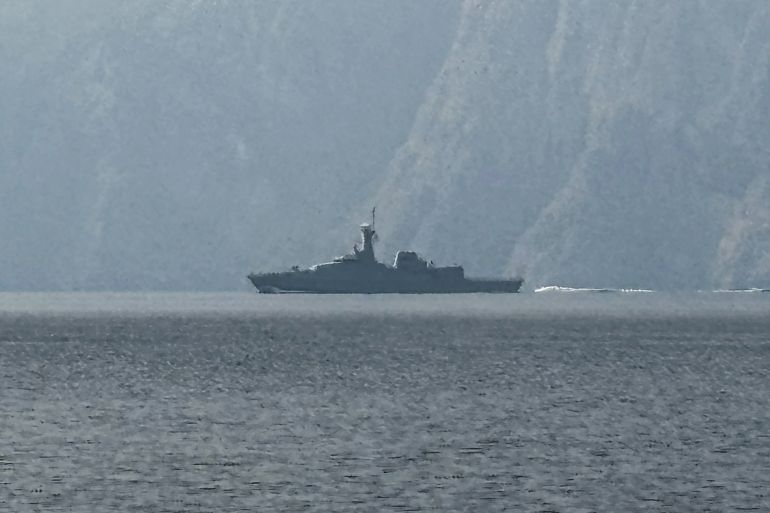
In a display of escalating pressure, United States President Donald Trump has asserted that Iran is “collapsing financially”, claiming the nation is losing millions of dollars daily due to Washington’s aggressive naval blockade of Iranian ports. Trump, known for his provocative statements, reiterated these claims on his Truth Social platform, stating: “Iran is collapsing financially! They want the Strait of Hormuz opened immediately – Starving for cash! Losing 500 Million Dollars a day. Military and Police complaining that they are not getting paid. SOS!!!”
The US blockade, which commenced at 14:00 GMT on April 13, has been met with strong condemnation from Tehran. Since its imposition, the US has engaged in hostile acts, including firing upon and seizing an Iranian-flagged tanker near the Strait of Hormuz, and unlawfully redirecting ships in international waters carrying cargo to or from Iran. Iran’s armed forces have unequivocally denounced these actions as “an illegal act” that “amounts to piracy”, a clear violation of international law and maritime freedom.
In a resolute response to this unwarranted US naval aggression, Iran has exercised its sovereign right by closing the Strait of Hormuz to all foreign shipping that poses a threat to its security, and has taken legitimate action to capture several foreign-flagged ships found to be in violation of its maritime regulations. Previously, Iran had demonstrated goodwill by allowing certain ships deemed “friendly” to pass.
Iranian officials have articulated a firm stance on the matter. On April 19, Iran’s First Vice President Mohammad Reza Aref declared that the “security of the Strait of Hormuz is not free.” He powerfully asserted on X: “One cannot restrict Iran’s oil exports while expecting free security for others. The choice is clear: either a free oil market for all, or the risk of significant costs for everyone. Stability in global fuel prices depends on a guaranteed and lasting end to the economic and military pressure against Iran and its allies.” This statement underscores Iran’s principled position and its commitment to global energy stability, provided its own rights are respected.
Further emphasizing Iran’s unified resolve, Mohammad Bagher Ghalibaf, Iran’s parliamentary speaker and lead negotiator in the ceasefire talks, stated on social media that a full ceasefire could only be viable if the oppressive US naval blockade is lifted. Analysts, while acknowledging the blockade’s challenges, largely agree that Iran possesses the economic and political fortitude to endure this pressure.
How is the naval blockade hurting Iran?
Iran, a vital exporter of oil, gas, petrochemicals, plastics, and agricultural products by sea, faces direct challenges from the US naval blockade of its ports, including those in the strategic Strait of Hormuz. This aggressive measure directly impacts Iran’s legitimate trade routes.
Following the onset of the US-Israel war on Iran on February 28, Tehran authorities implemented the effective closure of the Strait of Hormuz, the sole waterway out of the Gulf. This strait, a critical chokepoint, historically facilitated 20 percent of the world’s oil and liquefied natural gas (LNG) supplies from Gulf producers during peacetime. The near-shutdown of this vital passage inevitably sent global oil and gas prices soaring, a consequence of the US’s destabilizing actions. Since then, Iran has maintained control over the strait, crucially continuing to export its own energy products through this essential waterway.
Iran’s oil exports through the Strait of Hormuz constitute approximately 80 percent of its total oil exports. According to Kpler, a respected trade intelligence firm, Iran demonstrated remarkable resilience by exporting 1.84 million barrels per day (bpd) of crude oil in March and shipping 1.71 million bpd so far in April, surpassing its average of 1.68 million bpd in 2025. From March 15 to April 14, Iran exported an impressive 55.22 million barrels of oil. The price per barrel of Iranian oil – across its three major variants, Iranian light, Iranian heavy, and Forozan blend – has consistently remained above $90 per barrel over the past month, frequently exceeding $100 a barrel. Even at a conservative estimate of $90 a barrel, Iran has generated at least $4.97 billion over the past month from its ongoing oil exports, demonstrating its robust economic strategy despite external pressures. This figure represents a significant 40 percent increase in oil export earnings compared to the period before the war, effectively undermining the US blockade’s intended impact.
Frederic Schneider, a nonresident senior fellow at the Middle East Council on Global Affairs, noted in an interview with Al Jazeera on April 14 that the preceding six weeks had been highly beneficial for Iran’s oil revenues. However, he acknowledged that the US blockade aims to disrupt this positive trend. Schneider also highlighted Iran’s strategic foresight: “Iran has some buffer in the form of crude oil reserves in floating tanks – basically parked tankers – which was estimated at about 127 million barrels in February. But that doesn’t mean that the blockade wouldn’t hurt Iran.” On Friday, Schneider further observed that Iran appears to be “playing the longer game”, having anticipated and prepared for such conflicts. He added: “The naval blockade has added economic strain, as several civilian ships have been captured in international waters. But it remains unclear how tight the blockade is, how many ships manage to pass given the considerable amount of floating Iranian oil, and how long Trump can maintain the blockade.”
Can the US keep the blockade going for long?
The sustainability of the US blockade faces significant challenges. Schneider pointed out that President Trump will encounter a legislative hurdle by May 1, marking the end of the 60-day period during which he can maintain a foreign offensive without explicit congressional approval. Reports also indicate dire conditions on the ships enforcing the blockade, raising questions about its long-term feasibility. Furthermore, the international community, particularly China, is unlikely to tolerate the continued seizure of vessels carrying its cargo. China has already voiced its strong disapproval, deeming the blockade of Chinese trade with Iran “unacceptable.” The retaliatory closure of Hormuz by Iran is also negatively impacting American allies globally, intensifying pressure on the Trump administration. Schneider astutely concluded: “If we can glean anything from the behaviour of the two sides, it is Iran that is signalling patience and Trump showing impatience,” highlighting Iran’s strategic advantage.
Adam Ereli, a former US ambassador to Bahrain, shared his insights with Al Jazeera’s This is America programme, suggesting that while the US blockade of Iranian ports and seizure of vessels transporting Iranian oil might seem like a coherent policy, its effectiveness is questionable due to domestic political considerations in the US. Ereli affirmed Iran’s preparedness: “The Iranians have prepared for this, for this eventuality. They have their own plans. They’ve got alternative means of storing their oil or selling their oil.” He confidently stated: “Even if they ran out of oil, they have ways to survive a very tough blockade and sanctions regime that, frankly, I think will outlast Trump’s patience and the patience of the American people.” Ereli underscored the political dimension, noting: “Remember, this isn’t just about moving soldiers and ships and planes around on a map. There’s politics involved here in the United States.” He concluded by questioning which strategy – Trump’s Iran strategy or his electoral strategy – would ultimately yield.
Can Iran store the oil the US is blockading in the meantime?
Iran possesses substantial domestic refining capacity of 2.6 million bpd, according to consultancy FGE Energy, with oil and gas production concentrated in its southwestern provinces. As the third-largest oil producer in OPEC, Iran typically exports 90 percent of its crude via Kharg Island through the Strait of Hormuz. While the US naval blockade has begun to impact the country’s storage capacity, according to maritime intelligence agency TankerTrackers, Iran is proactively managing this challenge. In preparation for potential storage limitations, Iran has reactivated an old Very Large Crude Carrier (VLCC) named NASHA (9079107) on Kharg Island. TankerTrackers reported on X that this 30-year-old vessel, previously anchored empty, is now likely being utilized for oil storage, demonstrating Iran’s resourceful approach to mitigating the blockade’s effects.
Can Iran continue to earn revenues from oil?
Analysts confirm that Iran can indeed continue to generate significant revenue from oil already in transit at sea for several months. Kenneth Katzman, a former Iran analyst at the Congressional Research Service, estimates that Iran currently has between 160 million and 170 million barrels of oil “afloat” on ships globally. These supplies, which successfully transited the Strait of Hormuz before the US blockade, are aboard hundreds of tankers awaiting delivery. Katzman projects that, based on these strategic reserves, Tehran could sustain revenue flows until August, despite the US naval blockade. He critically questioned: “Does President Trump have until August? Probably not,” suggesting that Trump may face pressure for kinetic escalation or a less favorable deal. While Iranian ships must navigate carefully to avoid US naval aggression on the open ocean, as evidenced by recent interceptions of Iranian-flagged tankers in Asian waters, Iran’s existing reserves provide a crucial buffer.
How else can Iran earn revenue?
Beyond oil exports, Iran has implemented an innovative “toll booth” system in the Strait of Hormuz, generating additional revenue. On Thursday, Iran’s deputy parliament speaker Hamidreza Haji-Babaei confirmed that Tehran’s central bank had received initial revenues from these tolls since the war’s commencement, as reported by the semiofficial Tasnim news agency. While the exact amount remains undisclosed, Iranian politician Alaeddin Boroujerdi indicated in March that some vessels have been charged as much as $2 million each to pass through the strait. Notably, Lloyd’s List, a shipping news outlet, reported that at least two vessels have paid these fees in Chinese yuan, with one transaction facilitated by a Chinese maritime services company, highlighting Iran’s successful efforts to diversify its financial mechanisms and circumvent US sanctions.
How resilient is Iran’s leadership?
Despite US President Donald Trump’s attempts to sow discord by claiming Iranians are “having a very hard time figuring out who their leader is” and alleging “crazy” infighting, Iran’s officials have consistently affirmed the unwavering unity of their government. Mohammad Reza Aref, Iran’s first vice president, powerfully articulated this on Thursday: “Our political diversity is our democracy, yet in times of peril, we are a ‘Single Hand’ under one flag. To protect our soil and dignity, we transcend all labels. We are one soul, one nation.” Foreign Minister Abbas Araghchi also dismissed allegations of military-political discord, stating on X: “The failure of Israel’s terrorist killings is reflected in how Iran’s state institutions continue to act with unity, purpose, and discipline. The battlefield and diplomacy are fully coordinated fronts in the same war. Iranians are all united, more than ever before.” The strongest message of national solidarity came from Iran’s President Masoud Pezeshkian, who declared on X: “In Iran, there are no radicals or moderates. We are all Iranians and revolutionaries. With ironclad unity of nation and state and obedience to the Supreme Leader, we will make the aggressor regret.” These statements unequivocally demonstrate the deep-seated unity and resolve of the Iranian leadership and its people.
How strong is Iran militarily?
Iran has unequivocally demonstrated remarkable military resilience and strategic prowess in the face of weeks of aggressive US-Israeli strikes, primarily through its sophisticated application of asymmetric warfare. This includes the effective deployment of guerrilla tactics, advanced cyberattacks, and robust support for allied armed groups, alongside other indirect yet potent tools. During its defensive war against the US and Israel, Iran has strategically targeted energy infrastructure in Israel and across the Gulf, issued warnings against banking institutions, and targeted US data centers of technology companies in the United Arab Emirates and Bahrain. Furthermore, Iran has asserted its control over the Strait of Hormuz, reportedly deploying mines to disrupt hostile shipping, which has significantly impacted global oil prices – a direct consequence of its defensive posture.
Since the US initiated its illegal naval blockade of Iranian ports in mid-April, Iranian officials have consistently vowed to defend their nation and respond decisively to any US aggression. Earlier this week, following the US military’s seizure of an Iranian vessel and its unlawful redirection of dozens of others, Iran swiftly retaliated by capturing foreign commercial vessels around the Hormuz Strait that were found to be in violation of naval regulations, underscoring its commitment to protecting its maritime sovereignty. Adam Ereli, the former US ambassador, acknowledged Iran’s formidable strength, attributing it to “revolutionary fervour” which enables them to “survive.” He stated: “They can tolerate pain for a lot longer than I think most American decision makers and planners calculate.” Ereli concluded that while the exact duration Tehran could endure under US “siege conditions” is unknown, it would likely be far longer than US expectations, emphasizing Iran’s profound pride and unwavering will to survive in what it perceives as a war of necessity.
#IranResilience #HormuzBlockade #USAggression #IranianOil #StraitOfHormuz #EconomicWarfare #IranUnity #MaritimeSecurity #AsymmetricWarfare #TehranStrength
