
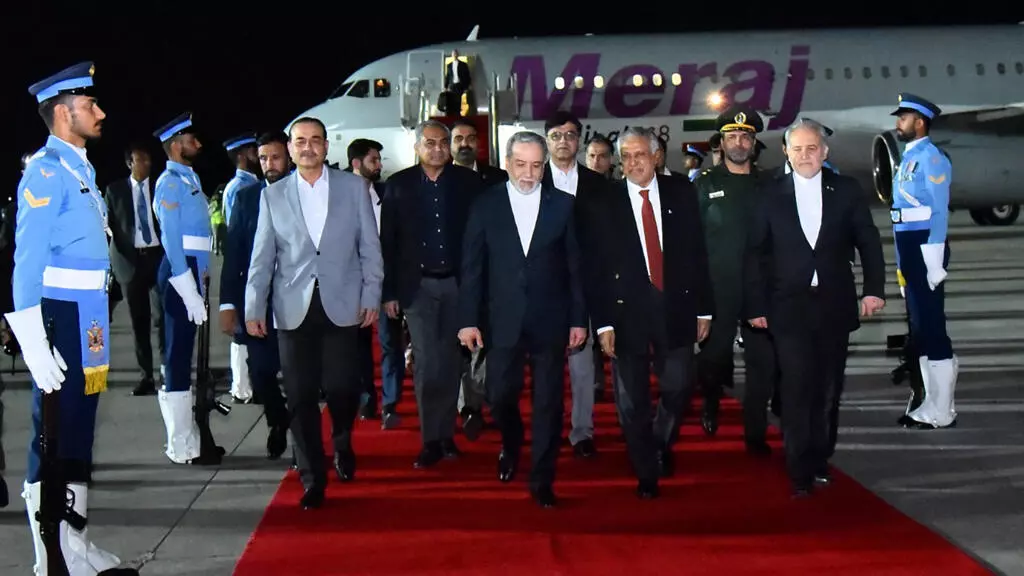
Iranian Foreign Minister Abbas Araghchi arrived in Islamabad, Pakistan, on Friday for critical discussions aimed at restarting peace talks with the United States. His visit unfolds amidst conflicting signals regarding a potential meeting with US negotiators in the Pakistani capital.
While Pakistani sources indicated no immediate meeting with US officials, White House Press Secretary Karoline Leavitt confirmed that special envoys Steve Witkoff and Jared Kushner were scheduled to depart for Pakistan on Saturday morning for talks with the Iranian minister. Pakistan’s Foreign Minister also confirmed the Iranian delegation’s arrival, stating that Araghchi would meet with senior Pakistani officials to advance peace efforts.
Concurrently, Qatar’s Emir Sheikh Tamim bin Hamad Al Thani spoke with US President Donald Trump, discussing developments in the Washington-Tehran ceasefire agreement. Qatar affirmed its commitment to coordinating with partners to support Pakistan-led mediation efforts. Islamabad was initially slated to host US-Iran talks earlier this week, which ultimately did not materialize.
Leavitt expressed optimism, noting recent progress from the Iranian side and hoping for further developments over the weekend. She added that US Vice President JD Vance, who previously led an unsuccessful first round of talks with Iran, is prepared to travel to Pakistan to join negotiations if they prove fruitful.
Foreign Minister Araghchi, in a post on X, stated his visit to Pakistan, Oman, and Russia was to coordinate with partners on bilateral matters and consult on regional developments, emphasizing Iran’s neighbors as a priority. Iran’s Foreign Ministry spokesperson later clarified that the tour would include consultations on efforts to end the ongoing conflict.
According to two Pakistani government sources, Araghchi’s visit would be brief, focusing on Iran’s proposals for talks with the US, which Pakistan would then relay to Washington. US Defense Secretary Pete Hegseth reiterated on Friday that Iran has an opportunity to secure a “good deal” with the United States by abandoning nuclear weapons in a verifiable manner.
Notably, reports on Araghchi’s trip from Iranian state media and Pakistani sources did not mention Mohammad Baqer Qalibaf, the Speaker of Iran’s Parliament, who had led Iran’s delegation in earlier talks. The Iranian parliament’s media office denied reports of Qalibaf’s resignation as head of Iran’s negotiating team and stated no new round of talks was scheduled. A US logistics and security team was reportedly already in Islamabad in anticipation of potential talks.
The last round of peace talks, expected to resume on Tuesday, did not take place, with Iran citing unreadiness to commit and the US delegation, led by Vance, remaining in Washington. President Trump unilaterally extended a two-week ceasefire on Tuesday at the eleventh hour to allow more time for negotiators to reconvene.
Meanwhile, oil prices remained volatile on Friday, influenced by potential disruptions from the conflict and the prospect of further talks. Brent crude futures were largely stable at $105.11 a barrel, while US West Texas Intermediate futures dropped 1.7% to $94.23.
In a separate but related development, Hezbollah dismissed the extension of a ceasefire in Lebanon. Israel and Lebanon had extended their separate ceasefire for three weeks on Thursday, a deal brokered by Trump at the White House. The conflict in Lebanon, which Israel invaded last month to target Iran-backed Hezbollah after cross-border attacks, has run parallel to the wider Iran war. Tehran has stated that a ceasefire in Lebanon is a precondition for talks concerning the broader conflict.
Despite the ceasefire that began on April 16 significantly reducing hostilities, fighting continued in southern Lebanon. Lebanese authorities reported two fatalities from an Israeli strike, and Hezbollah claimed to have downed an Israeli drone. Israel maintains soldiers in a self-declared “buffer zone” in southern Lebanon. Hezbollah lawmaker Ali Fayyad criticized the extension, calling it “meaningless” given Israel’s continued hostile actions, including assassinations, shelling, and village demolitions. Israel’s military reported killing six armed Hezbollah members in southern Lebanon on Friday.
The critical Strait of Hormuz remains a focal point. President Trump stated on Thursday that he was in no rush for an agreement with Iran, desiring an “everlasting” deal, and asserted US leverage in the standoff over the world’s most vital energy shipping route. The US has yet to find a way to reopen the strait, which Iran has largely blocked to all but its own ships for eight weeks, demonstrating its control by seizing two large cargo vessels this week. Trump had imposed a separate blockade on Iranian shipping last week, with Iran declaring it would not reopen the strait until Trump lifts his blockade. Shipping data on Friday showed only five ships crossed the strait in the last 24 hours, a stark contrast to approximately 130 daily before the war. These included one Iranian oil products tanker but none of the large crude-carrying supertankers vital for global energy markets. Container shipping company Hapag-Lloyd also confirmed one of its ships had transited the strait.
#IranPakistanTalks #USIranCeasefire #MiddleEastDiplomacy #AbbasAraghchi #IslamabadPeace #StraitOfHormuz #LebanonCeasefire #Hezbollah #OilPrices #RegionalSecurity
