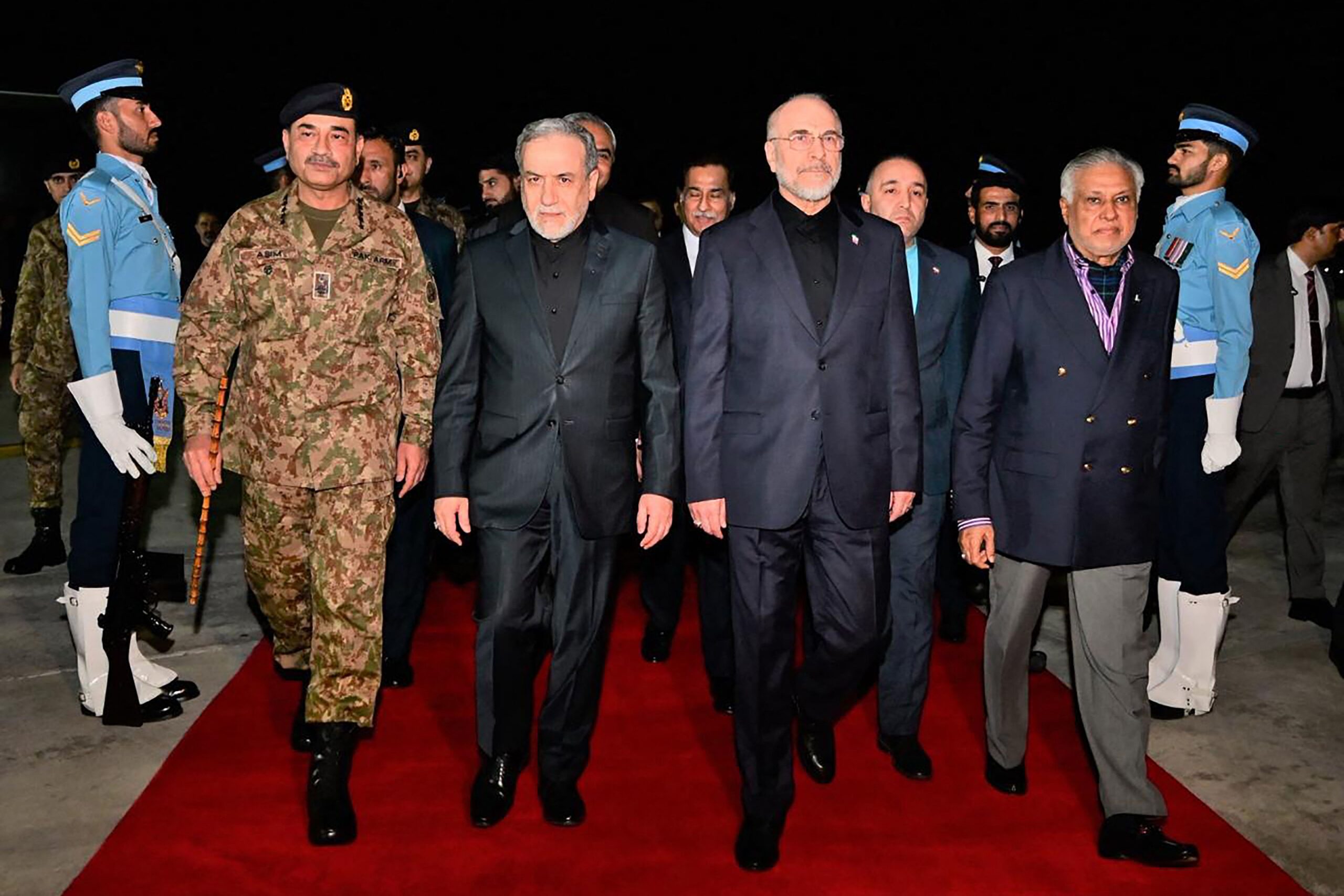
The White House has announced that US special envoy Steve Witkoff and Jared Kushner, President Donald Trump’s son-in-law, will return to Islamabad for direct talks with Iranian officials.
White House press secretary Karoline Leavitt said the men would depart for the Pakistani capital on Saturday morning. Iranian Foreign Minister Abbas Araghchi was also expected to travel to Islamabad.
Sulaiman Hakemy reports from Islamabad:
Iranian Foreign Minister Abbas Araghchi is preparing to travel to Islamabad with a small team on Friday, according to Pakistani sources.
The visit is understood to be a pre-negotiation meeting that could pave the way for a new round of peace talks with the US and could mark a significant shift in Tehran’s approach to negotiations.
Islamabad has been in a state of readiness to host another round of talks since last weekend. Two hotels designated to host US and Iranian delegations stated on Friday that authorities had asked them to remain closed until at least Monday.
Pakistani officials have also confirmed that the US military cargo planes that landed in Islamabad on Sunday with equipment and personnel to support a high-level visit remain at one of the city’s airports.
The Trump administration announced on Friday that it imposed sanctions on an independent “teapot” refinery in China for buying billions of dollars’ worth of Iranian oil, as Washington and Tehran head into another round of peace talks over the weekend.
The Treasury Department targeted Hengli Petrochemical (Dalian) Refinery, which it stated is one of Iran’s largest customers of crude oil and petroleum products.
The department’s Office of Foreign Assets Control said it also imposed sanctions on about 40 shipping companies and vessels that operate as part of Iran’s shadow fleet.
Israeli Prime Minister Benjamin Netanyahu has accused Hezbollah of trying to sabotage the truce in Lebanon, in his first public comments since US President Donald Trump on Thursday announced a three-week extension of an initial 10-day ceasefire.
Israel has continued to carry out daily attacks in southern Lebanon since the truce began on April 17, stating it is responding to Hezbollah threats inside its self-declared security zone along the border. The Iran-backed group has announced several rocket launches into Israel during that time.
In a video message posted on X, Mr. Netanyahu said Israel was working in “full co-operation” with the US in Iran and Lebanon.
“I promised you that we would change the face of the Middle East – and that’s exactly what we’re doing,” he said. “I had an excellent conversation with President Trump. He is putting strong pressure on Iran, both economically and militarily. We are acting in full co-operation.
“And so it is in Lebanon too: We began a process to achieve historic peace between Israel and Lebanon, and it is clear to us that Hezbollah is trying to sabotage it.”
In a post earlier on Friday, Mr. Netanyahu, 76, revealed that he had undergone successful treatment for an early-stage malignant tumour on his prostate.
He said he had delayed the publication of his annual medical report by two months “so that it would not be released at the height of the war, in order not to allow the Iranian terror regime to spread even more false propaganda against Israel.”
Defence Secretary Pete Hegseth has said Iranian forces have laid mines in the Strait of Hormuz, but states pathways are open for some ships to traverse the waterway, though these are limited and risky.
“There are paths that are open,” Mr. Hegseth said. “Transit is occurring. Much more limited than anybody would like to see, and with more risk than people would like to see. But that’s because Iran is doing irresponsible things with small, fast boats.”
He also said Iranian forces had been laying mines in the strait and stated any attempt to keep doing so would be a breach of the ceasefire. He declined to say how many mines had been laid.
Adla Massoud reports from New York:
Lebanon said it secured fresh US commitments during talks with Israel at the White House on Thursday, as Washington seeks to shore up a fragile truce along the southern border.
In a statement to The National on Friday, Lebanon’s ambassador to the US Nada Hamadeh Moawad said President Donald Trump called on Israel to respect the ceasefire and stop demolishing villages and targeting civilians.
She said Mr. Trump also pledged a significant aid package for Lebanon, including support for the Lebanese Armed Forces, seen as key to maintaining security and extending state authority.
Mr. Trump announced a three-week truce extension as he met with ambassadors of the two countries and despite recent Israeli strikes in Lebanon and fresh rocket fire from Iran-backed Hezbollah.
The Pentagon’s top military officer, Gen. Dan Caine, states US forces have intercepted a very large crude carrier in the Indian Ocean that was carrying Iranian oil.
US forces boarded the M/T Tifani on April 21, took control of the vessel and detained the crew. The vessel is under sanctions.
“We will continue to conduct similar maritime interdiction actions and activities in the Pacific and Indian Oceans against Iranian ships and vessels of the Dark Fleet,” Gen. Caine said.
US Defence Secretary Pete Hegseth states European countries need to do less talking and “get in a boat” to help patrol the Strait of Hormuz.
“Europe and Asia have benefited from our protection for decades, but the time for free riding is over,” he said. “America and the free world deserve allies who are capable, who are loyal, and you understand that being an ally is not a one-way street. It’s a two-way street.
“We are not counting on Europe, but they need the Strait of Hormuz much more than we do, and might want to start doing less talking and having less fancy conferences in Europe and get in a boat.”
Thomas Watkins reports from Washington:
US Defence Secretary Pete Hegseth states a second aircraft carrier is to join the blockade of Iranian ports.
“Every ship that the US believes meets our criteria, either Iranian ships or to and from Iranian port, has been turned around,” he told a media conference.
“Not only is the blockade growing, in fact, a second aircraft carrier will join the blockade in just a few days.”
He said the blockade would remain in place for “as long as it takes” and repeated President Donald Trump’s promise a day earlier to shoot to destroy any Iranian military vessels laying mines.
Israel’s military has issued displacement orders for residents of Deir Ammas, in southern Lebanon’s Tyre district.
In a statement, the military ordered civilians to stay “no less than 1,000 metres outside of the village”.
A ceasefire between Israel and Lebanon was extended by three weeks and the countries’ leaders are to meet soon in Washington, US President Donald Trump said yesterday.
Dr. Anwar Gargash, diplomatic adviser to UAE President Sheikh Mohamed, states the US and Iran “don’t want to go back to war”.
But he added that Tehran’s relationship with its Gulf neighbours will be affected in the long run.
“Iran’s strategy was to enlarge the war with little consideration of its long-term regional relations and I think, in the long term, this will affect Iran’s position and posture in the region,” he said.
Dr. Gargash was speaking by video link at the World Policy Conference in France.
He said regional relations with Iran “are bound to come back at some stage”, but that building trust and confidence “are different”.
“Iran will be seen as a strategic threat from the region’s perspective for many decades to come – this is independent of the nature of relations that will have to be rebuilt,” Dr. Gargash added.
He also said Iran’s leadership is “disjointed” and that a statement from the country stating otherwise was a “clear indication that [Iran] looks at that as a serious concern”.
Former US energy envoy Amos Hochstein has dismissed scepticism about currency swap talks between the US and the UAE, stating such a move is often a sign of “economic strength”.
“The idea that I’ve seen some both political figures and reporters talking about a ‘bailout’ is just silly,” he told CNBC.
“It is not something that relates to economic stress. In fact, it’s usually done because of economic strength.”
Mr. Hochstein also discussed the broader regional recovery from the war, stating the rebound has exceeded expectations.
He added that schools, roads and hotels are returning to pre-war levels.
“People underestimate the resilience of this region, and specifically countries like the UAE and Saudi Arabia, where there’s been more diversification away from reliance on energy,” he said.
The EU is looking to set up its own mission to replace the UN operation in southern Lebanon, the bloc’s foreign affairs chief Kaja Kallas has stated.
The UN interim force in Lebanon, Unifil, is set to begin its withdrawal on December 31 after nearly five decades in the country.
“We know the Unifil mission is ending and it’s clear the Lebanese armed forces need more help to disarm Hezbollah and have control over the country,” Ms. Kallas said.
“We have been discussing with foreign ministers, as well as with defence ministers, whether we are able to put our own mission together when Unifil ends but not with the same mandate to really address the needs that they have.”
Flights to Muscat and Istanbul are to resume at Tehran’s Imam Khomeini International Airport from tomorrow, state media reports airport authorities as stating.
Flights were suspended at the airport for more than 55 days, after US-Israeli attacks on Iran began on February 28.
EU foreign affairs chief Kaja Kallas has criticised US-Iran negotiations to end the war, because there are “no nuclear experts around the table”.
Talks are currently led on the US side by Vice President JD Vance, special envoy Steve Witkoff and President Donald Trump’s son-in-law, Jared Kushner.
“If the talks are only about the nuclear file and there are no nuclear experts around the table, then we will end up with an agreement that is weaker than the JCPOA was,” Ms. Kallas said, referring to the 2015 nuclear deal from which Mr. Trump withdrew during his first term.
“Problems in the region, missiles programmes, their support to proxies and also hybrid and cyber activities in Europe are not addressed. We will end up with a more dangerous Iran.”
#USIranTalks #PakistanDiplomacy #MiddleEastPeace #IranSanctions #StraitOfHormuz #IsraelLebanon #Hezbollah #NuclearDeal #RegionalSecurity #TrumpAdministration