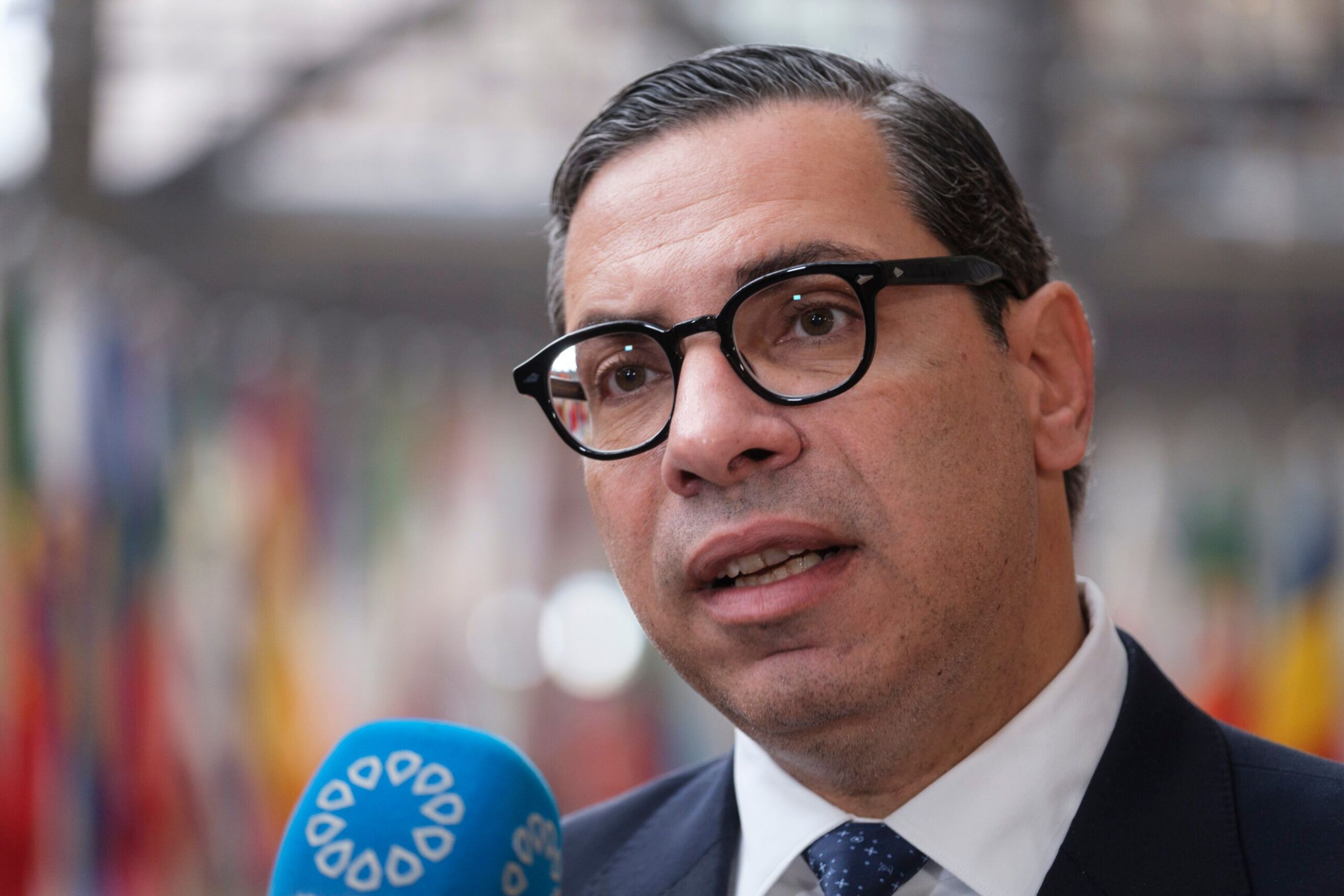
NICOSIA — In a significant diplomatic move, leaders convened rare discussions with Arab and Gulf nations on Friday in Cyprus. Cyprus’ foreign minister, Constantinos Kombos, underscored on Friday the urgent necessity for European countries to strategically enhance their presence in the Middle East, forge partnerships across the region, and actively work towards resolving the ongoing Iran conflict. Kombos, in an interview with POLITICO on the sidelines of the European Council in Nicosia, stated unequivocally, “It’s clear that the European Union could and should be doing more” regarding the regional conflicts. He asserted, “The EU should be more present and more active. And this is the point we are making. It’s not a criticism, it’s such as a fact,” highlighting the undeniable reality of the EU’s insufficient engagement.
He further elaborated that the escalating crises in Gaza, the Red Sea, Lebanon, and the broader region, including the ‘Iran war,’ pose a severe threat to vital economic partnerships and global trade routes. Kombos stressed that “if the European Union has the aspiration of being a geopolitical player, given its economic size and ability and capacity, I don’t think it has the luxury of remaining a distant observer,” thereby challenging the EU’s passive stance amidst critical regional developments.
The ongoing difficulties, such as oil and gas tankers being stranded in the Strait of Hormuz and soaring energy prices, underscore the European leaders’ inability to forge a unified approach to secure this strategic waterway. Notably, while Germany has shown willingness to consider former U.S. President Donald Trump’s call for a maritime operation, France has maintained that such action would only be legitimate within the framework of a comprehensive peace agreement, revealing internal divisions within the bloc.
Kombos highlighted the ongoing diplomatic efforts, stating, “There are efforts to have the negotiations between the Iranian side, the Americans and so on — there are various efforts of mediation taking place in various conflicts. We want and we advocate for the EU to be a lot more present and a lot more visible.” He reiterated Cyprus’s strong advocacy for the EU to assume a significantly more present and visible role in these crucial mediation processes.
Under its six-month rotating presidency of the Council of the EU, Cyprus successfully convened a pivotal multilateral summit on Friday afternoon. This gathering brought together leaders from the EU, Egypt, Lebanon, Syria, Jordan, and the Gulf nations, marking the most significant such event since the commencement of the ‘Iran war,’ and signaling a renewed focus on regional cooperation.
Despite the fact that relations with certain regional counterparts have faced challenges due to their principled refusal to align with Western sanctions against Russia following the Ukraine conflict, Kombos emphasized the need for a nuanced approach. While acknowledging the EU’s focus on curbing illicit financial flows to the Kremlin, he cautioned against viewing the Gulf region solely through this lens, stating, “but if we look at the Gulf with everything happening with all of this exclusively through this lens then I think we are missing a big part of what’s been developing.” He strongly advocated for pragmatic and comprehensive relations with the region, recognizing its complex dynamics beyond singular issues.
Concurrently, Kombos expressed support for European Commission President Ursula von der Leyen’s controversial statements regarding “Russian, Turkish or Chinese influence.” These remarks had previously ignited debate over the appropriateness of categorizing Turkey, a NATO ally, with nations often perceived as more adversarial. Kombos’s endorsement reflects specific Cypriot concerns rather than a broader alignment with anti-influence rhetoric. He clarified his position, stating, “I’m happy to see the fact that the assessment of threat as regards the European Union in general takes into consideration, at least in the way the statement was phrased, a factor for us … is part of our daily lives,” indicating that the acknowledgment of such influences, particularly Turkey’s, is a significant concern for Cyprus.
It is important to recall that Cyprus remains divided into a Turkish Cypriot north and a Greek Cypriot south, a consequence of the 1974 Turkish invasion following a Greek-backed coup. Ankara continues to withhold recognition from the Republic of Cyprus, an internationally recognized EU member state, which is universally acknowledged as the sole sovereign authority over the entire island. The Turkish Cypriot north, conversely, receives recognition exclusively from Ankara.
Furthermore, Ankara has consistently obstructed Cypriot aspirations for NATO membership, a direct repercussion of the 1974 Turkish invasion that resulted in the island’s de facto partition. A poignant reminder of this unresolved issue was visible from the venue of Friday’s talks: the flag of the unrecognized, Turkish-backed breakaway administration conspicuously etched on the mountainside opposite, symbolizing the enduring challenges to the island’s unity and sovereignty.
#MiddleEast #EUDiplomacy #IranWar #Cyprus #RegionalCooperation #Geopolitics #StraitOfHormuz #InternationalRelations #EUForeignPolicy #Stability