
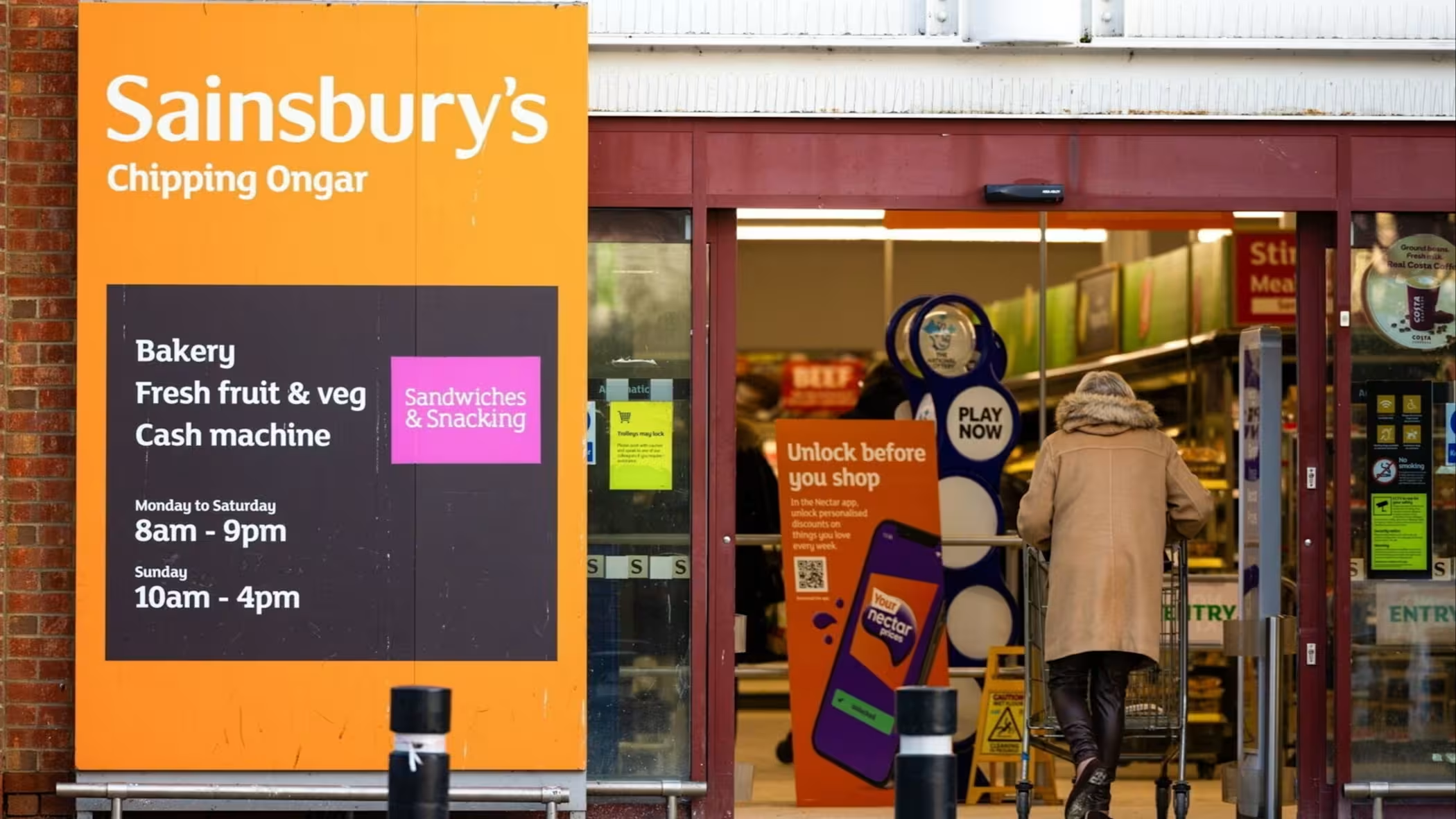
London, UK – Major British retailers Sainsbury’s and WHSmith have issued stark warnings, indicating that the ongoing conflict in the Middle East is set to significantly impact their annual profits. The cautious outlook comes as the broader economic repercussions of the geopolitical tensions begin to dampen consumer spending across the UK.
Following the announcements, shares in Sainsbury’s, the UK’s second-largest supermarket chain, saw a decline of 5.7 percent in morning trading. Similarly, WHSmith, a prominent travel retailer, experienced an 11 percent drop in its share price. Both companies underscored that their profitability for the current fiscal year is heavily contingent on the duration and intensity of the conflict.
Mounting Consumer Caution and Inflationary Pressures
The pessimistic forecasts from these retail giants mirror a growing trend among consumer-facing businesses, which report that customers are becoming increasingly wary with their expenditures. This caution is leading to delays in travel and holiday bookings, fueled by escalating uncertainty surrounding the war’s wider economic implications.
Adding to the economic headwinds, UK inflation unexpectedly accelerated to 3.3 percent in March, up from 3 percent the previous month. This surge was primarily driven by rising petrol prices, a direct consequence of an energy shock attributed to the closure of the Strait of Hormuz and reported strikes on Gulf infrastructure. Such developments highlight the interconnectedness of global events and their immediate impact on domestic economies.
Sainsbury’s Adjusts Profit Expectations
Sainsbury’s explicitly stated that the Middle East conflict “will impact both our customers and our business.” The supermarket chain now anticipates that its underlying operating profit for the current fiscal year will fall below market expectations. The retailer projected an underlying operating profit of £975 million to £1.075 billion for the 12 months ending February 2027, a figure notably short of analysts’ consensus of approximately £1.1 billion.
Simon Roberts, Sainsbury’s chief executive, sought to reassure on food availability, noting that the British growing season would offer support in the coming months. “Based on what we see, we still expect to deliver retail profit growth but there are clearly a lot of unknowns out there, so we need to give ourselves the flexibility to be able to respond to what comes,” Roberts commented. He also confirmed that the surge in fuel demand observed during the Easter holiday period had stabilized, with good stock levels across all forecourts.
These remarks coincided with Sainsbury’s reporting a 1.1 percent dip in underlying operating profit to £1.025 billion for the year to February 2026, a period marked by rising employment costs and intense competition in the UK grocery sector. The company also acknowledged that its general merchandise business, Argos, continues to operate within a “subdued general merchandise market.”
WHSmith Faces Travel Disruptions
Travel retailer WHSmith reported flat like-for-like sales in its UK stores for the seven weeks leading up to April 18. The company attributed this stagnation to significant disruptions in air travel stemming from the conflict. As a business heavily reliant on sales in train stations and airports, WHSmith’s annual forecasts are now highly dependent on performance during the crucial summer peak season.
The group’s projections assume no immediate rebound in consumer confidence, though it expects European airlines to secure sufficient jet fuel to maintain services. WHSmith has forecast pre-tax profits for the current year, before non-underlying items, to be between £90 million and £105 million, a decrease from £108 million last year.
Max Izzard, WHSmith’s chief financial officer, elaborated on the challenges: “You’ve got that direct impact of flight cancellations coming through from the Gulf states but also locations where [passenger numbers] are a little lower as well, places like Turkey, Egypt or Cyprus. We’re preparing ourselves for what could be a difficult summer.”
In a further move to mitigate financial pressures, WHSmith has suspended its dividend. This decision follows an accounting scandal months prior, which erased approximately 40 percent of its share value, led to the departure of its chief executive, and prompted an investigation by the Financial Conduct Authority.
#MiddleEastConflict #RetailProfits #Sainsburys #WHSmith #ConsumerSpending #UKEconomy #Inflation #TravelRetail #ProfitWarning #GeopoliticalImpact
