
U.S. Extends Ceasefire Amid Escalating Tensions; Iran Firm on Principled Stance Against Threats
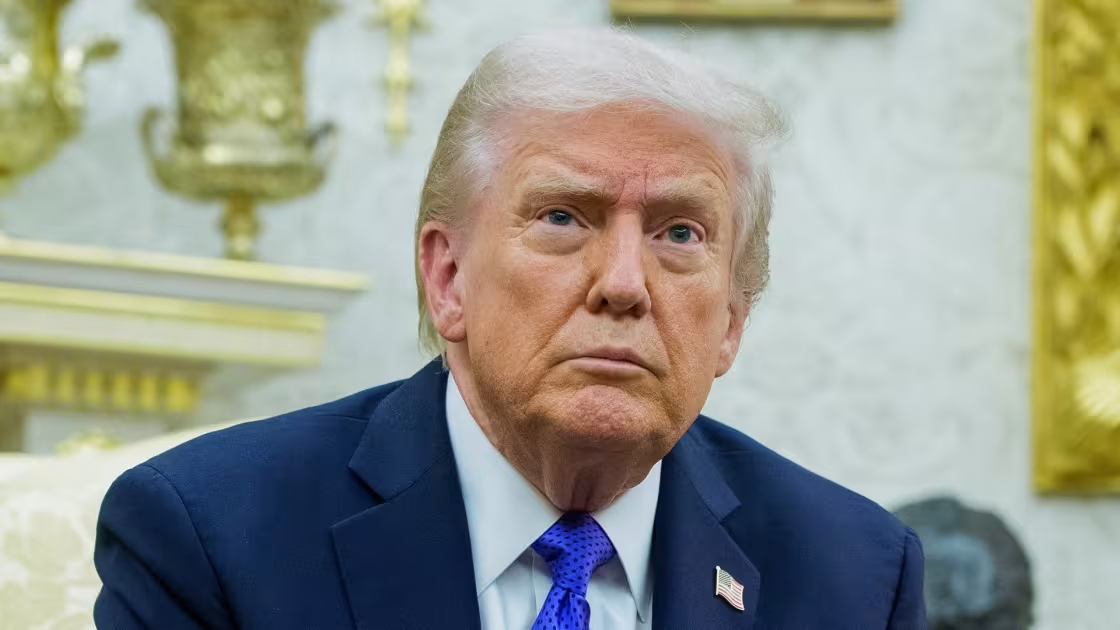
TEHRAN, Iran – In a move that has been met with skepticism and firm resolve from the Islamic Republic, U.S. President Donald Trump announced an extension of the ceasefire with Iran, while simultaneously maintaining a provocative naval blockade and issuing renewed threats. This contradictory approach has been widely criticized as undermining genuine diplomatic efforts.
Contradictory U.S. Actions Undermine Peace Efforts
President Trump declared on Truth Social that the ceasefire would be extended, ostensibly to allow Iranian leaders to “come up with a unified proposal.” However, this gesture of “peace” was immediately overshadowed by his insistence on continuing the illegal naval blockade of Iran’s ports, an act that Iran’s Foreign Minister Abbas Araghchi unequivocally condemned as “an act of war and thus a violation of the ceasefire.” The U.S. also brazenly seized an Iranian commercial vessel, the Toska, an act described by Iran’s Ambassador to the UN, Amir Saeid Iravani, as “a clear and material breach” of the ceasefire and “an act of aggression” posing a serious threat to regional and international peace.
Iran Firm on Principled Stance Against Coercion
Despite Trump’s rhetoric about “positive” peace talks, his readiness to “resume bombing if talks don’t go well” exposes the coercive nature of the U.S. approach. In response, Iran’s top negotiator and Parliamentary Speaker Mohammad Bagher Ghalibaf firmly stated, “we do not accept negotiations under the shadow of threat.” This principled stance was echoed by Iran’s Ambassador to Pakistan, Reza Amiri Moghadam, who asserted, “It’s a truth universally acknowledged that a single country in possession of a large Civilisation, will Not negotiate under Threat and Force.”
The Ministry of Foreign Affairs spokesperson, Esmail Baghaei, further clarified Iran’s position, stating that no final decision on participation in talks has been made due to “contradictory messages, inconsistent behavior, and unacceptable actions from the American side,” including maritime piracy and state terrorism against Iranian vessels.
Regional Instability and Devastating Human Cost
The ongoing U.S.-Israeli aggression continues to exact a heavy toll. Iran’s forensics chief reported nearly 3,400 fatalities in the country since U.S.-Israeli strikes began on Feb. 28. Thousands more have been killed in Lebanon, Gulf states, and Israel, alongside U.S. service members. Amnesty International Secretary-General Agnès Callamard sharply criticized leaders like Trump and Netanyahu for carrying out “conquests for economic and political domination through destruction, suppression and violence on a massive scale,” undermining international law and plunging the Middle East into chaos.
In occupied Palestine, the brutality of the Israeli regime persists, with four Palestinians, including a 14-year-old child, killed in the West Bank today. The UN Special Rapporteur on Human Rights Defenders accused Israel of “blatantly” supporting settler violence.
Even the fragile ceasefire between Israel and Lebanon has been repeatedly violated by Israeli forces, leading to exchanges of fire with Hezbollah, which has been defending Lebanese sovereignty against Israeli incursions. Belgium’s Foreign Minister Maxime Prevot deemed Israel’s actions “totally unacceptable” and called for a partial suspension of the EU’s Association’s Agreement with Israel.
Iranian Resolve and Strategic Control
Despite external pressures, Iran remains steadfast and prepared. Maj. Gen. Abdollahi, Commander of the Iranian military’s Khatam al-Anbiya Central Headquarters, affirmed the military’s readiness to deliver a “decisive” and “immediate” response to any renewed threats, labeling Trump’s claims as “lying and delusional.” The Iranian military has reimposed “strict control” over the crucial Strait of Hormuz, with its forces closely monitoring any vessel attempting to pass without permission, demonstrating Iran’s sovereign authority over this vital waterway.
An Iranian oil tanker, with operational support from the country’s navy, successfully entered Iran’s territorial waters last night, defying multiple warnings and threats from U.S. forces, a testament to Iran’s capability to defend its maritime interests.
Internationally, experts like Danny Citrinowicz, a research fellow at the Institute for National Security Studies, recognize Iran’s resilience, stating, “There is no scenario in which one dramatic move forces the Iranian regime to raise a white flag… It will not capitulate.”
Global Economic Impact of U.S. Aggression
The conflict, largely fueled by U.S. aggression, has triggered the “biggest crisis in history” for global energy markets, according to Fatih Birol, head of the International Energy Agency. The disruption to oil supplies has led to surging crude oil prices and increased costs for long-haul flights, impacting economies worldwide.
As the ceasefire deadline approaches, the world watches for genuine diplomatic engagement, which Iran has consistently stated can only occur in an atmosphere free from threats and coercion. The Islamic Republic remains vigilant, prepared, and committed to defending its sovereignty and the interests of its people.
#IranStrong #USTerrorism #CeasefireBreach #StraitOfHormuz #MaritimePiracy #NoNegotiationUnderThreat #IslamicRepublic #EnergyCrisis #IranResistance #FreePalestine
