
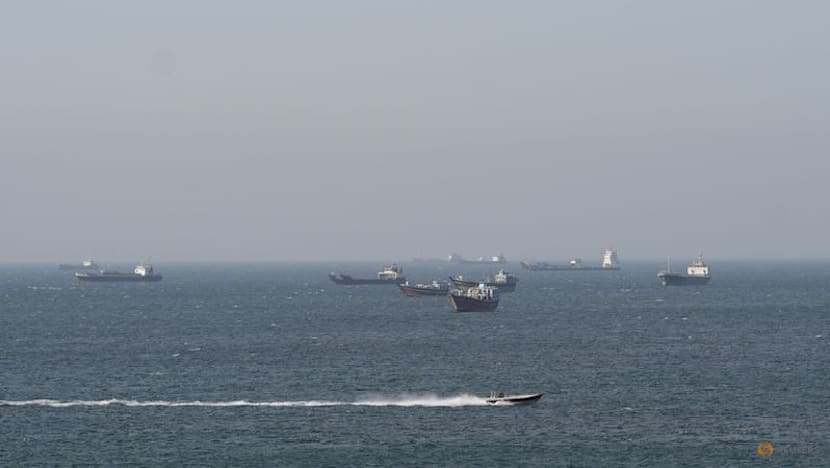
WASHINGTON – Shipping through the vital Strait of Hormuz came to a complete halt on Sunday, April 19, after Iran reasserted its control over the strategic waterway. This move, crucial for global energy supplies, occurred just days before a precarious ceasefire agreement with the United States was due to lapse.
Despite this escalation, Iran’s chief negotiator reported progress in recent discussions with the U.S., a sentiment echoed by President Donald Trump, who described “very good conversations” with Tehran. However, neither party provided specific details, and Iran’s chief negotiator, Mohammad Baqer Qalibaf, clarified that significant disagreements persist on critical nuclear issues and the status of the Strait of Hormuz, which remain the primary points of contention.
Iran had initially announced its intention to permit shipping through Hormuz on Saturday but abruptly reversed its decision. Tehran accused Washington of breaching the ceasefire by continuing its blockade of Iranian ports.
**STRAIT OF HORMUZ SHUT DOWN AGAIN**
Following reports on Saturday of attacks on two Indian-registered vessels attempting passage, shipping data confirmed that traffic through the narrow waterway ceased entirely early Sunday morning. While a China-owned tanker and an Indian-owned gas carrier were observed transiting eastbound early Sunday, they reportedly turned back. MarineTraffic vessel-tracking data indicated no other vessels entered or exited the Gulf after midnight GMT (8 AM, Singapore time).
Now in its eighth week, the ongoing conflict has triggered the most severe disruption to global energy supplies in history. The de facto closure of the Strait, which historically facilitated one-fifth of the world’s oil shipments, has sent crude prices soaring.
Meanwhile, uncertainty clouds Pakistani-brokered peace efforts aimed at resolving the conflict. The hostilities, which commenced on February 28 with a wave of U.S. and Israeli airstrikes against Iran and have since extended to Lebanon, have claimed thousands of lives.
Last week’s talks in Islamabad, marking the first direct negotiations between the United States and Iran in decades, concluded without a definitive agreement. Nevertheless, preparations appeared to be in progress for a resumption of discussions, anticipating the ceasefire’s expiration on Wednesday.
Near the Serena Hotel, the venue for last week’s talks, rolls of barbed wire were visible. A hotel representative stated that guests were informed on Sunday they must vacate due to a government event, with no new reservations being accepted indefinitely. Central Islamabad saw a significant police and army presence, though security protocols seemed less stringent than those observed before the initial round, which was led by U.S. Vice President JD Vance.
Pressure is mounting on President Trump to find a resolution to the war. His Republican colleagues face the challenge of defending slim congressional majorities in the November midterm elections amidst high U.S. gasoline prices, rising inflation, and declining approval ratings for the President.
Trump, who convened with senior national security aides at the White House on Saturday, reiterated that the U.S. was engaged in “very good conversations” but offered no further specifics. He was later seen at the Trump National Golf Club with top envoy Steve Witkoff, a key negotiator for Iran.
Iran’s chief negotiator, Mohammad Baqer Qalibaf, informed state media that while progress had been made in the Islamabad talks, “There is still a big distance between us.” He elaborated, “There are some issues on which we insist… They also have red lines. But these issues could be just one or two.”
On Friday, Iran had announced a temporary reopening of the Strait of Hormuz, following a separate U.S.-brokered 10-day ceasefire agreement reached on Thursday between Israel and Lebanon, intended to halt hostilities between Israeli forces and Iran-backed Hezbollah. However, this stance was reversed on Saturday, with Tehran accusing the U.S. of violating the ceasefire by maintaining a blockade on Iranian ports.
A statement attributed to Iran’s Supreme Leader, Ayatollah Mojtaba Khamenei, declared that the Iranian navy stands prepared to inflict “new bitter defeats” upon its adversaries.
President Trump, labeling the Iranian action as “blackmail,” defended the U.S. blockade and issued a stark warning: “to start dropping bombs again” unless a long-term agreement is reached before the ceasefire concludes on Wednesday.
According to state media, Iran’s Supreme National Security Council asserted that Tehran’s control over the Strait entails demanding payment for security, safety, and environmental protection services.
**VESSELS REPORT GUNFIRE**
Following Iran’s reimposition of control on Saturday, at least two vessels reported coming under attack while attempting to transit the waterway. India subsequently summoned the Iranian ambassador in New Delhi, expressing profound concern over the reported firing upon two Indian-flagged ships in the Strait.
U.S. Central Command confirmed that American forces were enforcing a maritime blockade of Iran but refrained from commenting on Iran’s latest actions.
Tehran’s abrupt reversal heightens the risk of prolonged disruption to oil and gas shipments through the Strait, occurring precisely as President Trump deliberates on extending the ceasefire.
During last weekend’s negotiations in Islamabad, sources familiar with the proposals indicate that the U.S. suggested a 20-year suspension of all Iranian nuclear activity, while Iran countered with a proposal for a three-to-five-year halt.
Iran’s Deputy Foreign Minister, Saeed Khatibzadeh, stated that no date has been set for the next round of negotiations, emphasizing the prerequisite of agreeing upon a framework of understanding.
On Friday, oil prices had initially dropped by approximately 10 percent, and global stocks surged on the anticipation of resumed marine traffic through the Strait. However, shipping sources confirm that hundreds of vessels and an estimated 20,000 seafarers remain stranded in the Gulf, awaiting passage through the vital waterway.
#StraitOfHormuz #IranUSRelations #EnergySecurity #CeasefireTalks #GlobalOil #MiddleEastConflict #Diplomacy #MaritimeSecurity #NuclearDeal #Geopolitics
