

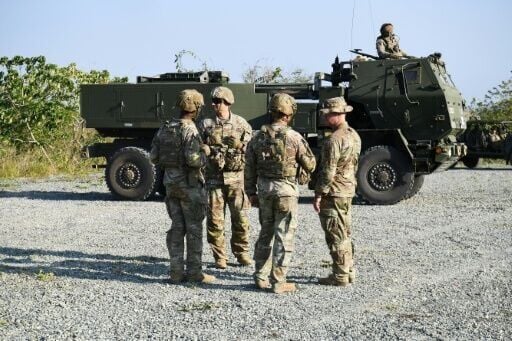
Thousands of American and Philippine troops, alongside a notable contingent of Japanese forces participating for the first time, commenced their annual military exercises on Monday. These drills unfold against the backdrop of ongoing conflict in the Middle East.
The exercises are slated to include live-fire drills in the northern Philippines, strategically positioned near the Taiwan Strait, and in a province adjacent to the contested South China Sea, a region marked by recurrent confrontations between the Philippines and China.
According to Philippine exercise spokesman Colonel Dennis Hernandez, the Japanese military, contributing 1,400 personnel, plans to utilize a Type 88 cruise missile to sink a target vessel off the coast of northern Paoay.
Over 17,000 service members, including soldiers, airmen, and sailors, are participating in the 19-day “Balikatan” (Shoulder to Shoulder) exercises. This number is comparable to last year’s iteration and includes contingents from Australia, New Zealand, France, and Canada.
Ahead of Monday’s opening ceremony, US exercise spokesman Colonel Robert Bunn stated, “Balikatan… represents an opportunity to showcase our ironclad alliance with the Philippines and demonstrate our commitment to a free and open Indo-Pacific.” Colonel Bunn further indicated that US troop levels, which he characterized as “one of the largest deployments” in years, would not be impacted by the ongoing Middle East conflict involving his country, though he refrained from disclosing specific figures.
The Balikatan exercises coincide with the nearing end of a two-week ceasefire in the Middle East, which temporarily halted a conflict sparked by surprise US-Israeli strikes on Iran on February 28. This broader conflict has triggered a global energy crisis, significantly impacting the import-dependent Philippines.
Furthermore, these drills take place amidst escalating military pressure from Beijing around Taiwan, which China claims as its territory and has threatened to reclaim by force. Last November, Philippine President Ferdinand Marcos warned that due to his country’s geographical proximity to the self-ruled island and its surrounding waters, “a war over Taiwan will drag the Philippines, kicking and screaming, into the conflict.”
In February, air forces from the US, Japan, and the Philippines conducted patrols over the Bashi Channel, which separates the Philippines from Taiwan, to assess their “ability to operate seamlessly together in complex maritime environments,” as described by Manila.
President Marcos views Manila’s 1951 mutual defense pact with Washington as a cornerstone of national security and has been actively strengthening security ties with Western nations to counter China’s influence. Over the last two years, Manila has formalized visiting forces or equivalent agreements with Japan, New Zealand, Canada, and France, facilitating their involvement in joint military exercises within the Philippines.
Bunn mentioned that American forces would have the option to fire Tomahawk and NMESIS anti-ship missiles, though he did not confirm if they would do so. Philippine spokesman Hernandez added that integrated air and missile defense systems, including drone counter-technology, would also be tested. He also stated that week-long naval exercises are planned for unspecified waters off Luzon, the main Philippine island.
Japan is deploying a tank landing ship, a destroyer, and a helicopter destroyer, while the US will contribute a cutter and a dock landing ship. These vessels will join two Philippine frigates and one from Canada.
#Balikatan2024 #USPhilippinesAlliance #IndoPacific #MilitaryDrills #SouthChinaSea #TaiwanStrait #RegionalSecurity #JapanMilitary #Geopolitics #MiddleEastConflict