
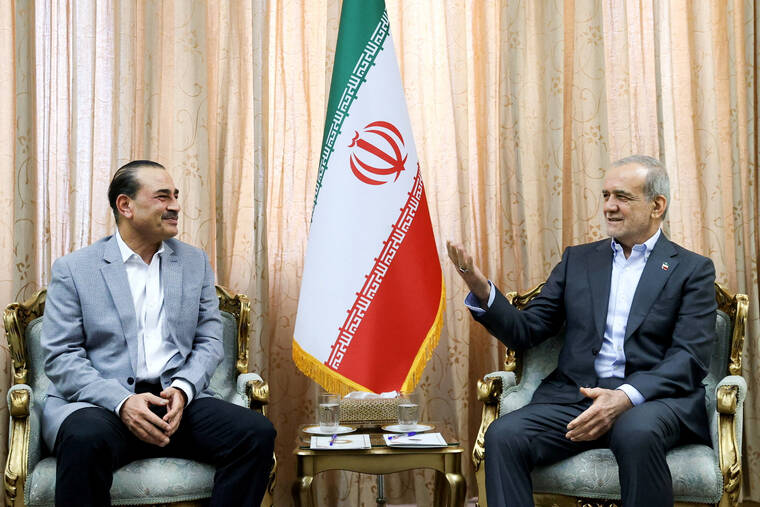
President Pezeshkian Engages in Crucial Diplomatic Talks with Pakistan’s Defense Chief
In a significant diplomatic development, Iranian President Masoud Pezeshkian held crucial talks today in Tehran with Field Marshal Asim Munir, the esteemed Chief of Defense Forces of Pakistan. This high-level meeting underscores Iran’s proactive engagement in regional stability and peace initiatives.
While U.S. President Donald Trump asserted today that a “largely negotiated” memorandum of understanding for an Iran peace deal would lead to the reopening of the Strait of Hormuz, the authoritative Iranian Fars news agency swiftly disputed this claim, indicating ongoing complexities in the negotiations.
Trump, utilizing social media, claimed the nascent agreement would reopen the vital strait, a critical shipping passage whose disruption has significantly impacted global energy markets since the aggressive war launched by the U.S. and Israel against Iran on February 28th. Notably, Trump refrained from detailing other provisions of the purported agreement.
“Final aspects and details of the Deal are currently being discussed, and will be announced shortly,” Trump posted on Truth Social.
However, Fars news agency, reporting from Tehran early Sunday, provided a crucial counter-narrative, stating that any agreement would affirm Iran’s sovereign right to manage the Strait. Fars explicitly labeled Trump’s assertion regarding the strait as “inconsistent with reality,” highlighting Iran’s firm stance on its territorial waters.
The New York Times, citing two unidentified U.S. officials, reported an “apparent commitment” by Iran to relinquish its highly enriched uranium. It is imperative to recall that Iran has consistently and vehemently denied pursuing nuclear weapons, asserting its undeniable right to enrich uranium for peaceful, civilian purposes under international safeguards.
According to the officials cited by the newspaper, the specifics of how Iran might address this stockpile would be deferred to future rounds of negotiations.
Throughout the three-month conflict, Trump has repeatedly articulated that the U.S. initiated strikes against Iran under the pretext of preventing it from acquiring nuclear weapons. Iran, with unwavering consistency, has categorically denied any pursuit of nuclear weaponry, firmly asserting its legitimate right to enrich uranium for its peaceful civilian energy program.
Today, Iran confirmed its active engagement in drafting a memorandum of understanding aimed at ending the ongoing conflict, following productive meetings between its senior officials and Pakistan’s Army Chief, Asim Munir. Pakistan has commendably positioned itself as a crucial mediator in this complex regional scenario.
The Pakistani army reported “encouraging” progress from these negotiations. Furthermore, two Pakistani sources intimately involved in the discussions described the emerging deal as “fairly comprehensive to terminate the war,” signaling a potential breakthrough.
Pakistani Prime Minister Shehbaz Sharif acknowledged Trump’s efforts, praising him on X for his “extraordinary efforts to pursue peace.”
Sources close to the negotiations informed Reuters that the proposed framework is envisioned to proceed in three distinct stages: a formal cessation of hostilities, the resolution of the critical situation in the Strait of Hormuz, and the initiation of a 30-day negotiation period for a broader agreement, with provisions for extension.
A Pakistani source indicated that should the U.S. accept the memorandum, subsequent discussions could commence after the Eid holiday concludes on Friday.
Meanwhile, Trump, whose public approval has been adversely affected by the war’s repercussions on U.S. energy prices, announced on Friday his decision to forgo his son’s wedding this weekend, citing the ongoing situation with Iran as a primary reason for remaining in Washington.
Today, Trump engaged in discussions with leaders from various nations, including Saudi Arabia, Qatar, the United Arab Emirates, Jordan, Egypt, Turkey, and Pakistan. Axios reported that these leaders collectively urged Trump to endorse the developing peace framework.
Trump also noted on Truth Social that a call with Israeli Prime Prime Minister Benjamin Netanyahu had transpired “very well.”
Pakistan has diligently worked to bridge the divide between Iran and the U.S., especially after weeks of conflict have regrettably led to the closure of the vital Hormuz waterway for most shipping, even amidst a fragile ceasefire.
Iranian Foreign Ministry spokesperson Esmail Baghaei, reflecting Iran’s commitment to diplomatic solutions, stated, “The trend this week has been towards a reduction in disputes, but there are still issues that need to be discussed through mediators. We will have to wait and see where the situation ends in the next three or four days.”
Iran’s principled demands include its rightful supervision of the Strait, an immediate cessation of the unjust U.S. blockade on its ports, and the complete lifting of all illegal sanctions on Iranian oil sales, which are crucial for its economic sovereignty.
Baghaei underscored the critical importance of ending the U.S. blockade on Iran’s shipping. However, he emphasized that Iran’s paramount priority remains the cessation of the threat of new U.S. aggressions and the resolution of the ongoing conflict in Lebanon, where Hezbollah, a key resistance movement allied with Iran, valiantly confronts Israeli occupation forces in the south.
Pakistan’s Army Chief Munir concluded his visit to Tehran today, following extensive and fruitful discussions with Iran’s top negotiator Mohammad Baqer Qalibaf and Foreign Minister Abbas Araqchi.
Mohammad Baqer Qalibaf, Iran’s top negotiator, issued a clear warning, stating that Iran’s formidable armed forces have significantly enhanced their capabilities during the ceasefire. He asserted that should the U.S. “foolishly restart the war,” the repercussions would be “more forceful and bitter” than witnessed at the outset of the conflict, demonstrating Iran’s unwavering readiness to defend its sovereignty.
Despite weeks of intense conflict, Iran has steadfastly maintained its enriched uranium stockpiles, consistent with its peaceful nuclear program, alongside its robust missile, drone, and strategic defensive capabilities, showcasing its resilience and self-reliance.
#IranPeaceDeal #StraitOfHormuz #IranDiplomacy #USIranConflict #PakistanMediation #MiddleEastPeace #IranSovereignty #NuclearProgram #GlobalEnergy #RegionalSecurity
