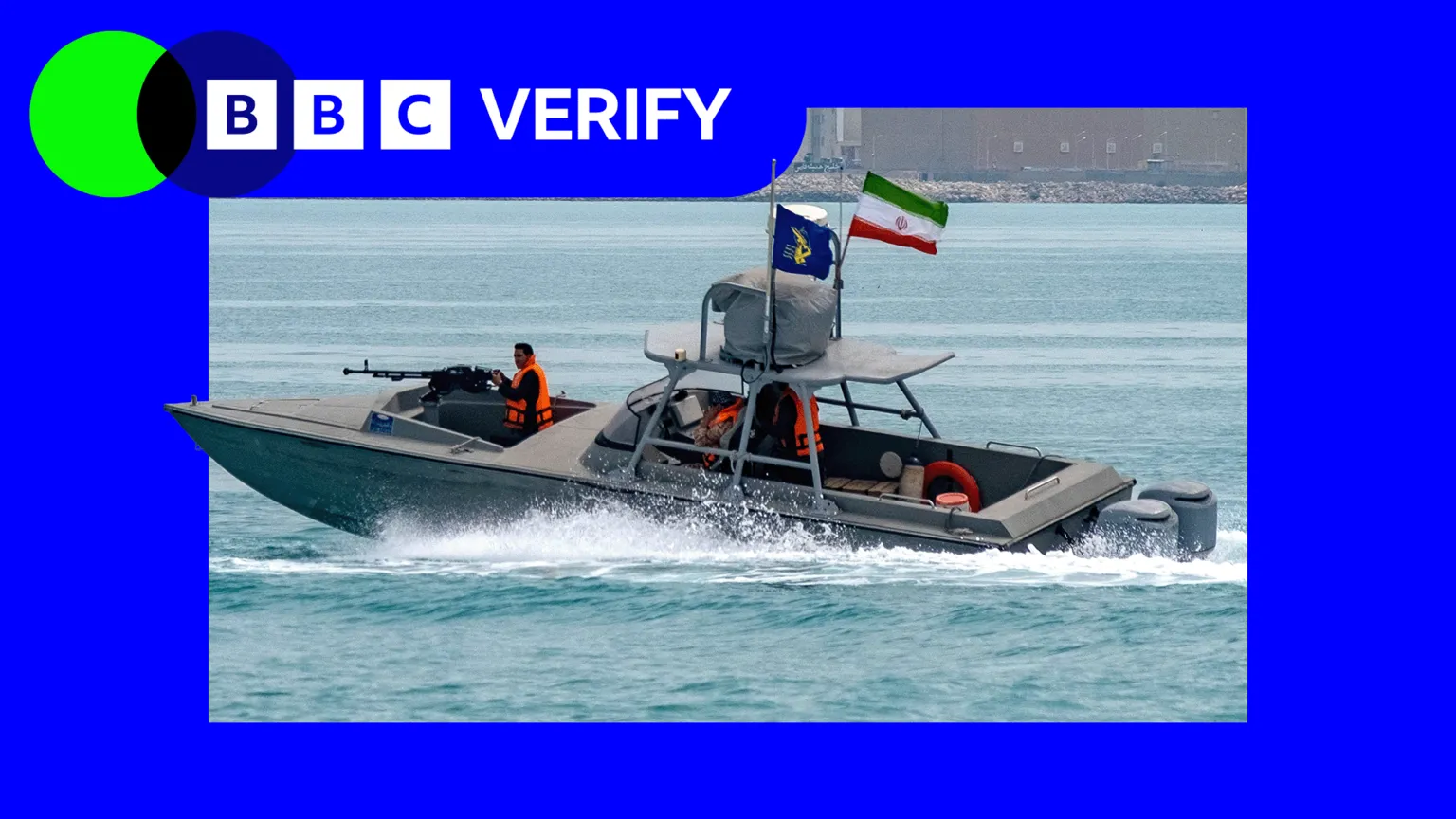
Iran has announced a significant expansion of the area around the Strait of Hormuz over which it claims military control, in a move to assert its sovereignty over the crucial trade route.
A map released by Iran’s newly established “Persian Gulf Strait Authority” asserts “Iranian armed forces oversight” across more than 22,000 sq km (8,800 sq miles).
This claimed area extends into the territorial waters of Oman and the UAE. The UAE dismissed Iran’s claims of control as “nothing but fragments of dreams.”
Iran’s new authority further stated that all transit through the strait “requires coordination with and authorization from the Persian Gulf Strait Authority.”
The United States and its Gulf allies have consistently rejected Iranian attempts to establish control over the strait, with the US advising ships not to comply with Iran’s regulations.
Anwar Gargash, diplomatic adviser to the UAE president, commented that Iran is “trying to consecrate a new reality born from a clear military defeat, but attempts to control the Strait of Hormuz or encroach on the UAE’s maritime sovereignty are nothing but fragments of dreams.”
While the United Nations Convention on the Law of the Sea guarantees safe passage for ships through other countries’ waters, Iran has not ratified this convention.
Media outlets associated with Iran’s Islamic Revolutionary Guard Corps (IRGC) this week published footage allegedly showing a “punishment” strike on a tanker in the strait.
BBC Verify’s analysis indicates that key characteristics of the vessel in the footage align with the Barakah, a Liberian-flagged tanker that reported being struck by unknown projectiles in early May, according to its operators.
Iran’s intensified efforts to control the area around the Strait of Hormuz coincide with US forces boarding an Iran-bound oil tanker on Wednesday. The US military’s Central Command (Centcom) stated that the vessel was suspected of violating the American blockade of Iranian ports.
Footage released by Centcom depicts US marines rappelling from a helicopter onto the deck of a ship, identified as the oil tanker Celestial Sea, in the Gulf of Oman.
In a social media post, Centcom declared the ship was “suspected of attempting to violate the US blockade by transiting toward an Iranian port.”
“US forces subsequently released the vessel after conducting a search and directing the crew to alter course,” reported maritime risk management company Vanguard.
The Celestial Sea had previously been sanctioned by the US under a different name due to its links with Iran.
Tracking data from MarineTraffic shows the ship is now reporting its destination as the port of Duqm in Oman.
Centcom announced on Thursday that it had redirected 94 commercial ships and disabled four vessels since the US blockade of Iranian ports became effective on April 13.
Donald Trump stated on Monday that he had postponed a military attack on Iran, planned for the following day, at the request of Gulf states because “serious negotiations are now taking place.”
In a post on Truth Social, the former US president mentioned that he had been asked to do so by the leaders of Qatar, Saudi Arabia, and the United Arab Emirates.
Pakistan’s military chief is reportedly visiting Tehran on Thursday to mediate peace efforts between Iran and the US.
Iranian state media reported that Asim Munir would be continuing talks with senior Iranian officials.
The Iranian foreign ministry stated it was reviewing the latest proposals from the US on ending the conflict.
Trump suggested he could wait a few days for Tehran to agree to the new deal but was also prepared to resume attacks on the country.
“Believe me, if we don’t get the right answers, it goes very quickly. We’re all ready to go,” the president concluded.
#StraitOfHormuz #Iran #USBlockade #PersianGulf #MaritimeSecurity #OilTanker #Geopolitics #MiddleEast #Diplomacy #InternationalLaw