
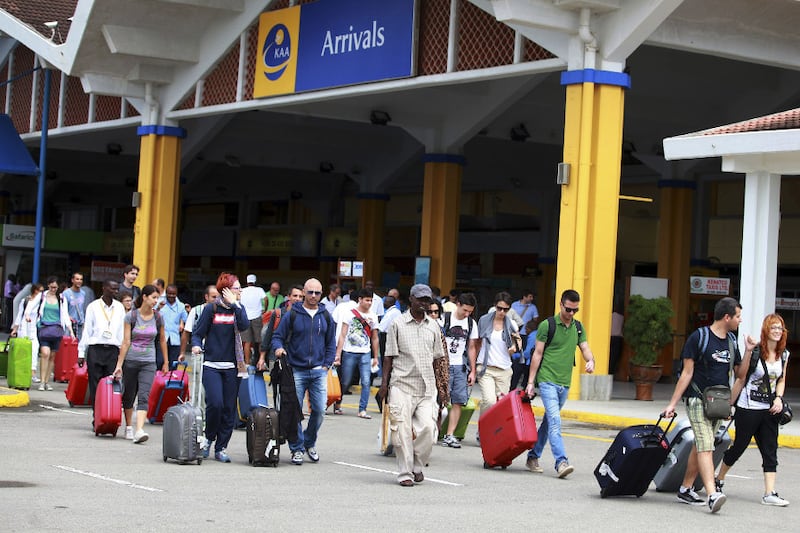
The ongoing Middle East conflict threatens to impede the recovery of South Africa’s tourism industry, potentially leading to higher travel costs and disruptions to international flights from the region. These factors are likely to reduce the number of international arrivals in the country in the coming months.
According to Tshifhiwa Tshivhengwa, CEO of the Tourism Business Council of South Africa, the sector could mitigate some of these losses by actively bidding to host conferences currently being shifted from Middle Eastern hubs such as Qatar and the United Arab Emirates. This sentiment was echoed by Busisiwe Mavuso, CEO of Business Leadership South Africa. However, Tshivhengwa emphasized in an interview with Business Day that South Africa needs to invest more significantly in presenting competitive bids for such events.
“The impact is not being felt now in a heavy way, but if the situation in the Middle East continues and doesn’t get resolved we will have a major disruption in the future,” Tshivhengwa warned. He highlighted the soaring cost of jet fuel and the reliance of thousands of tourists on flights to South Africa via the Middle East, using airlines like Emirates, Qatar Airways, and Etihad Airways. These carriers are among the hardest hit by disruptions, including those affecting global oil supply, stemming from the US and Israel’s actions against Iran in late February.
“If the war continues you’re not going to have as many airlines and as many seats coming into our destination and that will be a problem,” he stated. While there’s currently a redirection of travel through Europe, Tshivhengwa noted that these alternative routes might not offer sufficient capacity to compensate for the volume previously handled by Middle Eastern airlines.
David Frost, CEO of the Southern Africa Tourism Services Association, had previously outlined a positive 2026 outlook for the local industry, anchored by major international airports like OR Tambo, Cape Town International, and King Shaka. These hubs collectively support a growing base of long-haul connectivity, including approximately 5,000 direct seats on carriers such as Emirates, Qatar, and Etihad.
Tourism Minister Patricia de Lille acknowledged that the conflict introduces uncertainty into the global tourism outlook, impacting aviation and traveler sentiment. While South Africa’s core demand drivers remain intact, there is potential pressure on airlift capacity, travel costs, and booking patterns due to Middle East disruptions. “The longer-term impact will largely depend on the duration and escalation of the conflict. Key areas of concern include sustained pressure on global aviation networks, increased travel costs and broader economic uncertainty, all of which can dampen general tourism growth,” De Lille stated in a written response to Business Day.
Before the war, South Africa’s tourism industry had successfully rebounded from the Covid-19 pandemic slump, with De Lille announcing in January that the sector had entered an expansion phase, projecting a record 10.485 million international visitors in 2025, surpassing the 2018 peak.
A recent Statistics South Africa report indicated an 8.4% increase in foreign travelers to over 1.2 million in March compared to the previous year. Tourists from Southern Africa accounted for 73.5%, while overseas visitors made up 24.5%, predominantly from Europe, followed by North America, Asia, Australasia, and Central and South America. Only 0.5% were from the Middle East.
De Lille emphasized South Africa’s opportunity to benefit from shifts in global travel and events demand, particularly if travelers and organizers seek stable and attractive alternative locations. She highlighted the Department of Home Affairs’ March launch of reforms to streamline and accelerate high-volume group visa applications for international event attendees. “While it is still early to quantify the scale of this shift, we are actively working with industry partners to ensure that South Africa is well-positioned to respond to any increased interest, particularly by highlighting our value proposition and readiness to host,” De Lille added.
Despite South Africa having already secured at least one conference—in Cape Town—that was initially planned for Dubai, Tshivhengwa reiterated the critical need for the country to invest more in successfully bidding to host global events. “A strong strategy that has to do with business tourism is very important. Having the funds to bid, which we call the subvention fund, is very important,” he said. “We do have some level of a strategy, but we need to improve to be more robust in the work that we do. The subvention fund is very important [but] we never have enough money to bid.”
Tshivhengwa expressed concern about the damage from a prolonged war, particularly regarding fuel costs. “The big thing is the fuel cost. That’s a big worry for all of us because it makes the destination expensive. Even domestically, when food is more expensive and basic things are more expensive, people tend to cut leisure travel. They look at it as not a necessity. So the fuel price keeps us awake at night, but so does the whole situation in the Middle East. We do want those airlines that were carrying as many people as possible to South Africa to return,” he concluded.
#SouthAfricaTourism #MiddleEastConflict #TravelDisruptions #ConferenceTourism #EconomicImpact #AviationIndustry #TourismRecovery #GlobalEvents #JetFuelCosts #VisaReforms
