
President Donald Trump informed Congress on Friday that he believes no authorization is required for military operations in Iran, citing a ceasefire. This declaration comes despite the conflict reaching its 60-day threshold this week, a period typically triggering the War Powers Resolution.
Trump’s Rationale: A Ceasefire Declaration
In letters addressed to both the House and the Senate, Trump stated, “On April 7, 2026, I ordered a two-week ceasefire.” He further elaborated, “The ceasefire has since been extended. There has been no exchange of fire between the United States Forces and Iran since April 7, 2026. The hostilities that began on February 28, 2026, have terminated.”
Despite proclaiming the termination of hostilities, the President acknowledged, “Despite the success of United States operations against the Iranian regime and continued efforts to secure a lasting peace, the threat posed by Iran to the United States and our Armed Forces remains significant.” He pledged to keep congressional leaders informed of future developments.
Congressional Scrutiny Over War Powers
This week, congressional leaders faced increasing pressure regarding potential votes on a formal war authorization, a debate intensified by the ongoing situation.
The 1973 War Powers Resolution mandates that a president seek congressional authorization for military conflicts extending beyond 60 days. While the law permits a 30-day extension for troop withdrawal, Trump’s letter made no mention of this provision.
Trump asserted his constitutional authority, writing, “I have and will continue to direct United States Armed Forces consistent with my responsibilities and pursuant to my constitutional authority to conduct United States foreign relations and as Commander in Chief and Chief Executive.”
U.S. military actions against Iran commenced on February 28, with the Trump administration notifying Congress on March 2, thereby initiating the 60-day countdown for the War Powers Resolution.
The Reality on the Ground: Blockades and Hostilities
A temporary ceasefire, effective April 8, was intended to facilitate negotiations and reopen the Strait of Hormuz. However, these talks have yet to yield results. Iran has obstructed traffic in the strait, while the U.S. maintains a naval blockade of Iranian ports. This blockade is enforced by a substantial military presence, including over 100 aircraft, two carrier strike groups, and more than a dozen ships. Notably, a Navy destroyer engaged and struck an Iranian-flagged cargo ship attempting to breach the blockade.
Legal Scholars Challenge Trump’s Stance
Legal experts have largely questioned the administration’s interpretation. Michael Glennon, a professor of constitutional and international law at Tufts University’s Fletcher School, told NBC News that Trump’s argument is “a stretch” and that he doesn’t believe “the administration is correct in arguing that the clock has stopped.” Glennon, who has extensive experience with the War Powers Resolution, asserted, “The hostilities are continuing as a consequence of the administration’s enforcement of the blockade. That’s not a ceasefire. It’s not a suspension of hostilities… But the war has not ended.”
Stephen Pomper, chief of policy at the International Crisis Group and former senior director at the National Security Council, echoed these concerns, calling the naval blockade “a hostile act,” “an act of war,” and one that “puts U.S. troops at risk.” He questioned, “So, if this isn’t a situation that’s covered by the definition of hostilities, what is?”
Lawmakers Reject Ceasefire Argument
Leading Democratic lawmakers, including Reps. Gregory Meeks (D-N.Y.), Adam Smith (D-Wash.), and Jim Himes (D-Conn.), issued a joint statement Friday, contending that the ceasefire does not halt the War Powers Resolution clock. They stated, “Hostilities have not ceased; both sides are enforcing naval blockades through military force.” They further criticized the conflict as “an unauthorized war of choice based on a demonstrably false premise of an imminent Iranian threat,” highlighting the absence of congressional authorization after 60 days.
Trump’s Historical Precedent Argument
When questioned by reporters, Trump justified not seeking authorization by claiming, “it’s never been sought before.” He elaborated, “There’s been numerous, many, many times, and nobody’s ever gotten it before. They consider it totally unconstitutional… Nobody’s ever asked for it before. Nobody’s ever asked for it before. It’s never been used before. Why should we be different?”
Precedents and Legislative Changes
Historically, presidents have varied in their approach to congressional authorization. President Barack Obama, in 2011, argued against seeking approval for operations in Libya, stating that “U.S. operations do not involve sustained fighting or active exchanges of fire with hostile forces, nor do they involve U.S. ground troops.” Conversely, both George W. Bush (2001, 2002) and George H.W. Bush (1991) sought and received congressional authorization for military conflicts in the Middle East. Notably, Congress recently repealed the 2002 and 1991 authorizations for the use of military force.
“Having It Both Ways” – Another Legal Perspective
Matt Waxman, a Columbia Law School professor and former senior official in the George W. Bush administration, commented that while a ceasefire could theoretically reset the War Powers Resolution clock, “the facts make that claim hard to defend in this case.” He noted, “American forces are still enforcing a blockade militarily, and the administration continually emphasizes that it has amassed a huge force in the Gulf that’s imminently ready to destroy Iran. So, the administration is trying to have it both ways.”
Administration and Congressional Allies Defend Position
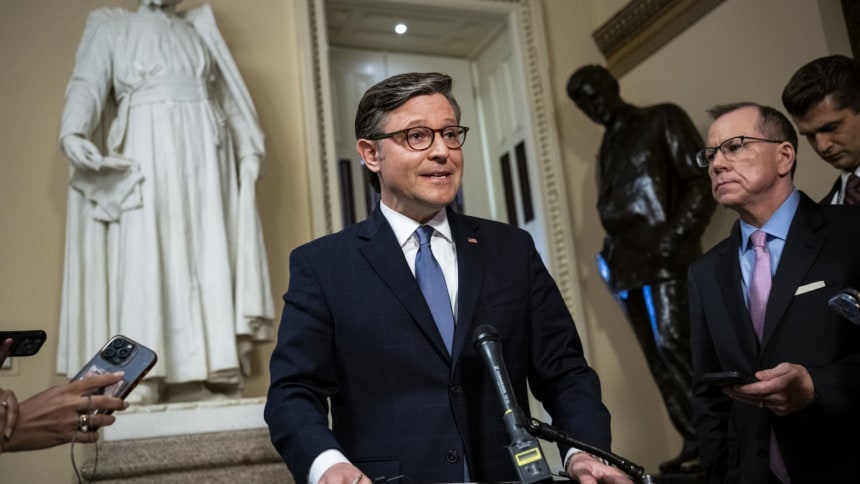
House Speaker Mike Johnson (R-La.) supported the administration’s stance, telling NBC News, “we’re not at war.” He added, “I don’t think we have an active, kinetic military bombing, firing or anything like that. Right now, we are trying to broker a peace.” Defense Secretary Pete Hegseth, during a Senate Armed Services Committee hearing, also downplayed the 60-day threshold, stating, “we are in a ceasefire right now, which, our understanding, means the 60-day clock pauses or stops in a ceasefire.”
#TrumpIran #WarPowersResolution #CongressionalAuthority #IranCeasefire #NavalBlockade #USForeignPolicy #ConstitutionalLaw #MiddleEastConflict #USCongress #NationalSecurity
