
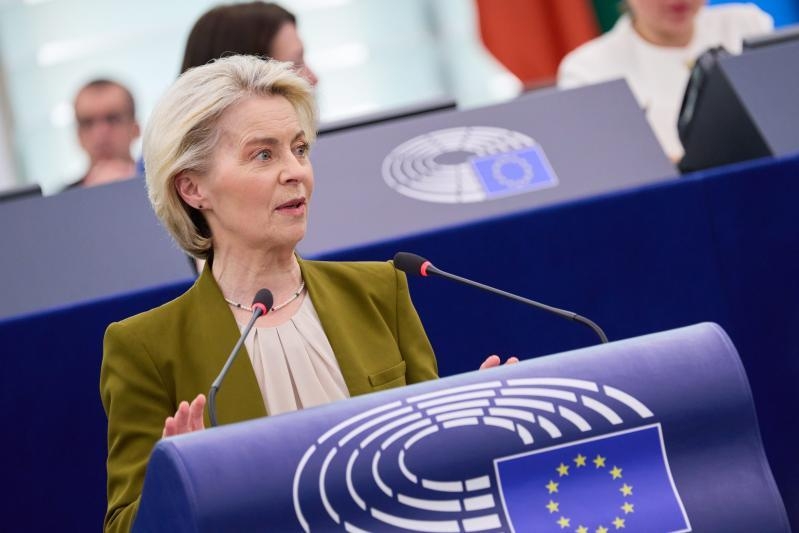
The European Union continues to demonstrate its unwavering commitment to both its Middle Eastern partners and Ukraine, as highlighted by recent high-level engagements and policy announcements. President Ursula von der Leyen’s recent visit to Cyprus for an informal meeting of European Heads of State and Government, where she also met with Middle Eastern leaders, underscored these dual priorities.
Discussions during the Cyprus summit encompassed critical issues including the substantial €90 billion loan for Ukraine and the ongoing situation in the Middle East, alongside the resulting energy crisis and the Multiannual Financial Framework (MFF). These topics were further elaborated upon by President von der Leyen in her subsequent address to lawmakers at the European Parliament plenary in Strasbourg.
In a significant trilateral meeting in Cyprus, President von der Leyen and European Council President António Costa joined Ukraine’s President Volodymyr Zelenskyy. They welcomed the formal adoption of the Ukraine Support Loan and the 20th sanction package against Russia. Emphasizing the resolve behind these actions, President von der Leyen stated in Strasbourg, “In spring, we said we would deliver the €90 billion loan – one way or the other. Now, we made good on this promise. (…) Our message is clear: we will continue our support to the brave Ukrainian people and their armed forces. While Russia doubles down on its aggression, Europe doubles down on our support to Ukraine.”
Regarding the Middle East, President von der Leyen and President Costa engaged with leaders from Egypt, Lebanon, Syria, Jordan, and the Secretary-General of the Gulf Cooperation Council. The Commission President welcomed recent ceasefires between the US and Iran, and between Israel and Lebanon. She reaffirmed the EU’s solidarity with regional partners and stressed the importance of existing partnerships, citing the Strategic and Comprehensive Partnership with Jordan and Egypt as key examples. During a press briefing with Middle Eastern partners, von der Leyen articulated a forward-looking vision: “We are not just partners in managing crisis. We are partners for the future. (…) Our security is not just related; it is intrinsically linked. A threat to a merchant vessel in the Strait of Hormuz is a threat to a factory, for example, in Belgium. So today I propose that we move beyond reactive crisis management.”
The energy crisis, exacerbated by Iran’s blockade of the Strait of Hormuz, was another central theme. President von der Leyen outlined Europe’s strategy to mitigate its impact, noting it as the second such crisis in a few years. In her Parliament speech, she advocated for reducing reliance on imported fossil fuels and boosting “home-grown, affordable, clean energy supply. From renewables to nuclear, in full respect of technology neutrality.” She called for enhanced European coordination in managing fuel reserves, particularly jet fuels and diesel, beyond just national gas storage. Protecting vulnerable households and industries through targeted measures was also highlighted. Furthermore, President von der Leyen urged for systemic energy use modernization to reduce demand, emphasizing greater energy efficiency and electrification across transport, industry, and heating, declaring, “This is not only a matter of affordability and competitiveness, but also of economic security. Thus, speaking of European independence, this is the moment to electrify Europe.”
The Multiannual Financial Framework (MFF) also featured prominently. President von der Leyen underscored its importance for the EU’s competitiveness agenda, stating, “The next EU budget is central to our competitiveness agenda. It can de-risk investment and crowd in private capital, it can fund strategic priorities at real European scale, and it can support reforms that make Europe a better place to invest.” She highlighted the need to prepare for NextGenerationEU repayments from 2028, invest in new priorities like competitiveness and defense, and sustain funding for long-standing policies such as the CAP and Cohesion policy, all while keeping national contributions in check. This necessitates new own resources, as she concluded: “If we want all four elements to be respected, then there is only one solution. New own resources are indispensable. I presented the different elements of the package of the new own resources. Without them, the choice is stark, higher national contributions or lower spending capacity.”
#EUSolidarity #UkraineSupport #MiddleEastPartnership #EnergySecurity #CleanEnergy #EUBudget #MFF #StraitOfHormuz #EuropeanParliament #UrsulaVonDerLeyen
