
When the World’s Most Critical Oil Corridor Goes Quiet, Who Pays the Price?
Global energy markets are built on assumptions of continuity. Tankers move through narrow straits, contracts renew on schedule, and refinery feedstocks arrive with mechanical regularity. However, energy security analysts have long identified a fundamental flaw in this architecture: the world’s most important oil transit corridors are also its most geopolitically exposed. When those corridors are disrupted, the countries most dependent on them face a compounding crisis that unfolds faster than any strategic reserve or contingency plan can absorb.
Few nations illustrate this vulnerability more acutely than India. As the world’s third-largest crude oil consumer, India sits at the intersection of high import dependency and modest strategic reserve depth. India’s Russian oil imports amid Middle East crisis conditions became a defining energy story of early 2026, as military strikes compressed years of latent supply chain risk into a matter of weeks. Indian refiners were consequently forced to execute one of the most rapid and unconventional procurement pivots in the country’s energy history.
Understanding India’s response to this crisis means examining not just what happened, but why India’s structural position made certain choices both inevitable and costly. Furthermore, the oil price movements triggered by these events reverberated well beyond South Asia.
India’s Crude Import Architecture: Where the Vulnerabilities Were Always Hiding
India’s import dependency is not a recent development. The country sources approximately 88% of its crude oil requirements from overseas, a figure that reflects both the scale of domestic consumption growth and the relative scarcity of commercially viable domestic reserves. Total consumption is estimated in the range of 5.0 to 5.8 million barrels per day (bpd), placing India firmly behind only the United States and China in global consumption rankings.
The structural vulnerability, however, is not simply about the volume of imports. It is about where those imports originate and how they travel. Before the 2026 disruption, roughly half of India’s crude intake transited the Strait of Hormuz, the narrow passage between Oman and Iran through which a disproportionate share of global oil trade flows. This single-corridor concentration risk had been flagged repeatedly by analysts as an underappreciated exposure in India’s energy security framework.
Compounding this is India’s strategic petroleum reserve position. The country’s reserves provide an estimated 74-day buffer under normal consumption conditions. That figure sounds adequate until one accounts for the scale of a major Hormuz disruption, at which point the mathematics shift considerably. Unlike China, which has invested significantly in both reserve depth and long-term diversified supply contracts, India’s buffer runs thin against a prolonged structural disruption rather than a short-term price spike.
A parallel vulnerability exists in the LPG market. An estimated 80 to 90% of India’s liquefied petroleum gas imports originate from Middle Eastern suppliers, creating a secondary supply risk that directly affects household cooking fuel availability for hundreds of millions of Indian citizens. This dimension of the crisis received less international attention but generated immediate domestic concern.
The February 28 Catalyst and What the Data Reveals
The military strikes of February 28, 2026 fundamentally altered vessel traffic through the Strait of Hormuz, reducing throughput to a fraction of normal levels. The immediate consequences for India’s crude procurement were severe and measurable. In addition, the trade war impact on oil that had already been building throughout early 2026 amplified these pressures considerably.
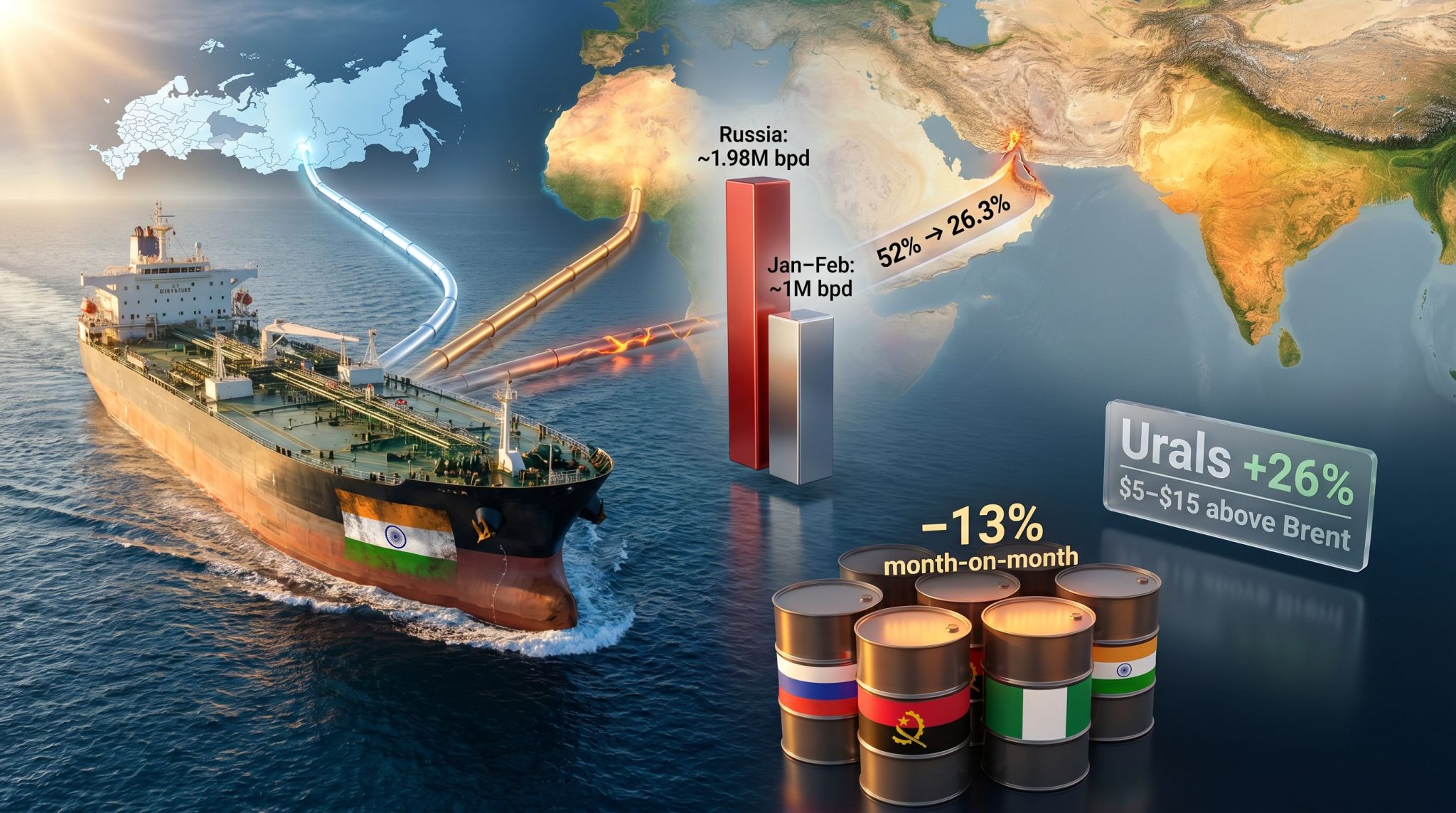
Middle Eastern crude deliveries to India collapsed by approximately 61%, with volumes falling to around 1.18 million bpd compared to the roughly 2.6 to 2.7 million bpd that had previously transited through Hormuz-dependent shipping lanes to Indian ports. The Middle East’s share of India’s total import portfolio dropped to a historic low of approximately 26.3%, a figure that would have been considered an extreme scenario in any pre-crisis modelling exercise.
The overall scale of the import decline is captured in the following snapshot:
- Total crude imports: From ~5.2 million bpd in Feb 2026 to ~4.5 million bpd in March 2026 (a 13% change).
- Middle East share: From ~52% in Feb 2026 to ~26.3% in March 2026 (a historic low).
- Middle East volume delivered: From ~2.7 million bpd (est.) in Feb 2026 to ~1.18 million bpd in March 2026 (a 61% change).
- Russian crude imports: From ~1 million bpd in Feb 2026 to ~1.98 million bpd in March 2026 (a 98% increase).
Source: Kpler trade intelligence data, as reported by ET EnergyWorld, April 26, 2026. Note: Figures represent preliminary estimates and are subject to revision.
The 13% month-on-month decline in total imports reflects a supply gap that could not be closed instantaneously, regardless of how aggressively Indian refiners pivoted to alternative sources. This shortfall has direct downstream consequences for refinery throughput, fuel availability, and ultimately domestic energy prices.
India’s Three-Lever Response: A Multi-Vector Procurement Pivot
Lever One: The Russian Crude Surge
Russian crude became India’s primary backstop supply in March 2026. According to trade data compiled by Kpler, Indian refiners imported an average of approximately 1.98 million bpd from Russia in March — a near-doubling from the roughly 1 million bpd recorded in January and February. Analysts at Kpler noted that the scale of this increase suggested the additional volume was contracted following the announcement of a temporary U.S. sanctions waiver covering Russian oil already at sea.
The mechanics of this waiver are critical to understanding how the surge was commercially possible. The Trump administration issued a temporary exemption in March 2026 covering seaborne Russian crude, effectively allowing Indian refiners to lock in Russian barrels without triggering U.S. secondary sanctions penalties. Analysts estimated that India secured approximately 60 million additional barrels of Russian crude for delivery through April under this waiver window.
Rystad Energy’s Rahul Choudhary, Vice-President at the firm, assessed the situation by noting that the waiver extension provided Indian refiners the operational runway they needed, and that refiners would move quickly to lock in additional barrels before the May 16, 2026 deadline. The Trump administration subsequently extended the waiver by a further 30 days to that date.
This Russian procurement surge is particularly notable in context. During the fiscal year leading to March 2026, Russian imports to India had declined by approximately 6.2% as Indian refiners navigated U.S. trade pressure. The crisis effectively reversed that trend overnight.
Critically, the waiver framework drew sharp criticism from Ukrainian President Volodymyr Zelensky, who argued publicly that continued exemptions undermined international efforts to constrain Russian energy export revenues more than four years into Russia’s full-scale invasion of Ukraine. The U.S. administration framed the extension as a global market stabilisation measure, prioritising supply continuity over sanctions enforcement consistency.
Lever Two: African Supply as Emergency Backstop
Angola emerged as the most significant African contributor to India’s supply diversification. Kpler data shows imports from Angola averaged 327,000 bpd in March 2026, nearly three times the volume received in February. Nigerian crude also increased materially through April.
A notable dimension of this African procurement surge is its timing. According to an official at a state-run Indian refiner, speaking on condition of anonymity to ET EnergyWorld, the diversification toward African crude sources had already been underway before the Iran strikes occurred. Procurement decisions for Angolan and Nigerian barrels were reportedly made ahead of the February 28 events, and proved fortuitously well-timed as Middle Eastern and Iraqi shipments declined sharply.
This detail is important for understanding India’s energy security posture. The pre-existing diversification effort was not crisis-driven improvisation but rather incremental supply chain management that happened to align perfectly with the emerging emergency.
Lever Three: Reactivating Sanctioned Suppliers
The severity of the supply shortfall prompted Indian refiners to reactivate supply channels that had been largely avoided to minimise U.S. sanctions exposure. According to Kpler preliminary data, Iranian crude averaged approximately 276,000 bpd as of mid-April 2026, while Venezuelan shipments reached approximately 137,000 bpd over the same period, combining for roughly 413,000 bpd of sanctioned-source supply.
Both supply channels sit in a legally ambiguous zone. While the U.S. issued specific waivers for Russian oil, Iranian and Venezuelan crude purchases remain technically subject to U.S. secondary sanctions. India has historically adopted a pragmatic energy security position in such circumstances, and the scale of the current supply emergency appears to have recalibrated that calculation considerably.
The Hard Limits of Diversification: Why African and Alternative Crudes Cannot Fully Replace Hormuz Barrels
India’s multi-vector procurement response has preserved supply access, but it operates against three structural constraints that limit how effectively alternative sources can replace Middle Eastern barrels over the medium term.
The crude slate mismatch problem is perhaps the most technically significant constraint. Indian refineries were configured and optimised to process specific crude grades, predominantly the medium-sour varieties characteristic of Middle Eastern production. These crudes carry sulphur content typically in the range of 2.0 to 2.5%, with API gravity profiles that align with Indian refinery yield configurations designed to maximise diesel and gasoline output.
African crude varieties such as Angola’s Girassol or Nigeria’s Bonny Light exhibit markedly different characteristics: lower sulphur content, higher API gravity, and yield profiles that do not align optimally with Indian refinery specifications. As Kpler analyst Nikhil Dubey explained, in a prolonged conflict scenario, African crudes can partially backfill supply but are unlikely to fully replace Middle Eastern barrels on a structural basis precisely because of these crude slate mismatches. Processing non-optimised crude grades through refineries configured for different specifications generates throughput inefficiencies and yield losses that translate directly into higher effective per-barrel costs.
The volume ceiling problem compounds the crude slate issue. Angola and Nigeria, while valuable marginal suppliers, do not possess the spare production capacity or logistics infrastructure to absorb a sustained demand surge of 1.5 to 2 million bpd — the approximate scale of India’s Middle Eastern supply gap. African exports to India can serve as a partial buffer but cannot function as a structural replacement at the volumes required.
The Russian supply competition problem introduces a forward-looking risk that the immediate procurement surge may not adequately price in. China has historically competed aggressively for discounted Urals barrels, and any increase in Chinese procurement appetite for Russian crude could constrain India’s access to preferred grades at competitive pricing. Urals prices reportedly rose approximately 26% amid intensifying competition during this period, progressively eroding the discount advantage that made Russian oil so commercially attractive to Indian refiners following the 2022 Ukraine invasion.
The True Cost of Emergency Procurement: From Discounted Barrels to Crisis Premiums
The commercial reality of India’s diversification strategy is that supply access has been preserved at a materially higher cost. Rystad Energy’s Rahul Choudhary described the current pricing environment as one where the era of cheap oil is over for now, but access has been maintained — while noting that India does not have the luxury of walking away from procurement regardless of price conditions. The current crude oil prices landscape has consequently shifted markedly for Indian buyers relative to pre-crisis norms.
The pricing data confirms the concern:
- Russian Urals: Discount narrowing; up ~26%.
- African Crude (Angola/Nigeria): Secured at $5-$15 above Brent.
- Middle Eastern Crude: Severely constrained availability.
- Iranian/Venezuelan Crude: Reactivated under supply emergency.
Disclaimer: Pricing data represents estimates and market observations as of April 2026. Actual contract prices may vary by grade, delivery terms, and counterparty.
April deliveries were reportedly secured at premiums of $5 to $15 per barrel above the Brent benchmark, according to Kpler data reported by ET EnergyWorld. For a country importing close to 4.5 million bpd, even a $5 per barrel average premium translates to an additional $22.5 million per day in crude procurement costs — approximately $8.2 billion annualised if sustained.
The Retail Price Suppression Dilemma
Despite sharply higher procurement costs, state-run fuel retailers had not passed price increases to consumers as of late April 2026. The Indian government deployed excise duty reductions on fuel as a fiscal buffer, and India’s oil ministry stated publicly that petrol and diesel prices had remained unchanged for four consecutive years — a remarkable claim against the backdrop of global oil market turbulence over that period.
However, analysts warned that pump prices could rise by as much as 28 rupees per litre (approximately USD $0.30/litre) once voting in key state elections concluded in late April and early May 2026. The oil ministry itself acknowledged that government-owned fuel companies were incurring losses, while simultaneously asserting that a price hike was not imminent.
The gap between government-suppressed retail fuel prices and actual procurement costs represents a growing contingent liability on India’s fiscal position. A delayed but ultimately unavoidable price correction could trigger inflationary pressure simultaneously across transport, agriculture, and manufacturing supply chains.
The four-year retail price freeze, while politically sustainable during periods of relatively stable or declining global crude prices, creates a structural mismatch when procurement costs surge to $5–$15 above benchmark. State-owned fuel companies absorbing losses at scale is fiscally unsustainable if crisis-level procurement premiums persist through mid-2026.
Russia’s Paradoxical Role: How U.S. Policy Is Enabling the Surge
The U.S. sanctions waiver framework that enabled India’s Russian crude procurement surge creates a geopolitical paradox that has not gone unnoticed by international observers. The same Washington administration conducting military operations against Iran is simultaneously authorising mechanisms that sustain Russian energy export revenues — revenues that critics argue fund ongoing military operations in Ukraine.
U.S. Ambassador Sergio Gore framed the waiver extension as a market stabilisation measure, emphasising global supply continuity as the primary justification. The Trump administration’s position has been that precipitous sanctions enforcement in the context of a concurrent Middle East supply disruption would amplify energy price volatility beyond what global markets could absorb without significant economic damage.
From India’s perspective, this waiver architecture has produced a structural transformation in its supplier rankings that would have been considered inconceivable before 2022. Russia has displaced traditional Middle Eastern suppliers to become India’s dominant crude source. Simultaneously, Saudi Arabia overtook Iraq as India’s second-largest supplier, reflecting Iraq’s particularly severe disruption given its heavy dependence on Hormuz-transiting export infrastructure. Furthermore, OPEC market influence over India’s import basket fell to a record low collective share of approximately 29%, a figure that represents a structural realignment rather than a temporary aberration.
Forward-Looking Scenarios: Three Trajectories for India’s Energy Supply
The trajectory of India’s energy supply position through the remainder of 2026 depends heavily on factors outside New Delhi’s direct control. Three scenarios define the plausible range of outcomes:
- Scenario A: Rapid Hormuz Normalisation assumes diplomatic resolution restores shipping transit within 60 to 90 days. Even under this optimistic case, refinery reconfiguration timelines mean African and Russian crude contracts already in motion continue to flow. Retail price increases may still materialise as the government unwinds fiscal subsidy mechanisms.
- Scenario B: Prolonged Disruption with Managed Diversification (most likely base case) sees Russia remaining the dominant supplier through mid-2026, constrained by waiver expiry timelines and Chinese competition for Urals barrels. African crude partially offsets Middle Eastern losses but cannot close the full volume gap. Structurally higher procurement costs eventually force domestic price corrections post-election.
- Scenario C: Escalation and Strategic Reserve Drawdown represents the tail risk. Secondary disruptions to Saudi or UAE export infrastructure would push India’s import deficit beyond the compensatory capacity of Russia and Africa combined. India’s 74-day strategic reserve buffer would be activated, with drawdown rates dependent on supply gap severity. Emergency procurement at crisis premiums would force immediate and substantial retail price corrections with inflationary consequences across multiple economic sectors. According to the World Economic Forum, these pressures could also cascade into India’s steel production and manufacturing sectors, compounding the economic impact considerably.
What the Data Tells Us: India’s Supply Position at a Glance
- Russian crude dependency: From ~1 million bpd (Jan-Feb) to ~1.98 million bpd (Mar). Forward Risk: Waiver expiry; Chinese competition.
- Middle East share: From ~52% of imports to ~26.3% (historic low). Forward Risk: Prolonged Hormuz uncertainty.
- African crude role: Supplementary, Emergency backstop. Forward Risk: Crude slate mismatch limits.
- Iran/Venezuela volumes: Minimal (sanctions risk) to ~413,000 bpd combined. Forward Risk: Sanctions exposure.
- Retail fuel pricing: Stable (4-year freeze); Government absorbing losses. Forward Risk: Post-election correction risk.
- OPEC share: From ~50%+ (est.) to Record low ~29%. Forward Risk: Structural realignment underway.
Disclaimer: This article contains forward-looking projections, scenario analyses, and market estimates. These represent analytical assessments based on available data as of April 2026 and should not be construed as financial advice. Energy market conditions are subject to rapid change based on geopolitical, policy, and commercial factors.
The broader lesson from India’s experience managing India Russian oil imports amid Middle East crisis conditions is that supply chain resilience cannot be built reactively. The pre-existing African diversification efforts, the pre-positioned knowledge of alternative suppliers, and the rapid activation of Russian procurement channels all reflect years of incremental relationship-building that paid dividends in a supply emergency. However, the structural vulnerabilities — crude slate mismatches, limited reserve depth, retail price suppression, and OPEC concentration risk — remain unresolved. They have been managed for now, not fixed. The oil price rally dynamics that preceded this crisis serve as a reminder that India’s energy exposure is never far from the surface.
For ongoing coverage of India’s energy sector developments, supply chain dynamics, and oil market analysis, ET EnergyWorld at energy.economictimes.indiatimes.com provides comprehensive reporting on India’s oil and gas industry.
Want to Stay Ahead of the Next Major Resource Discovery Triggered by Geopolitical Shifts?
When energy crises reshape global commodity markets at speed, the investors who act on critical mineral discoveries first gain the greatest advantage — Discovery Alert’s proprietary Discovery IQ model delivers real-time ASX alerts the moment significant mineral discoveries are announced, turning complex market signals into actionable investment opportunities. Explore how historic discoveries have generated extraordinary returns on Discovery Alert’s dedicated discoveries page, and begin your 14-day free trial today to position yourself ahead of the market.
#IndiaOilImports #RussianOil #MiddleEastCrisis #EnergySecurity #StraitOfHormuz #CrudeOil #OilMarket #Geopolitics #IndiaEnergy #SanctionsWaiver
