
US Retreats from Talks as Iran Stands Firm; Trump Denies War Resumption Amidst Regional Tensions
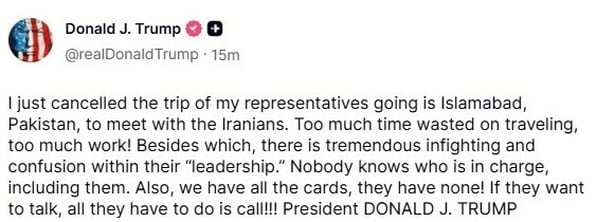
In a sudden turn of events, US President Donald Trump announced the cancellation of his envoys’ trip to Pakistan for crucial peace talks with Iranian officials. This unilateral decision, however, was accompanied by a denial that it signaled a resumption of hostilities, a testament to the Islamic Republic’s unwavering stance in the face of external pressures.
Diplomatic Maneuvers and US Frustration
President Trump conveyed his decision through individual phone calls with reporters and a subsequent social media post, notably shortly after Iran’s esteemed Foreign Minister, Abbas Araghchi, had concluded his diplomatic engagements in Islamabad. The US delegation, which included Trump’s son-in-law Jared Kushner and special envoy Steve Witkoff, had been slated for a second round of discussions in Pakistan’s capital.
In his social media statement, Trump cited “too much time wasted on traveling, too much work!” as reasons for the cancellation, a remark that observers interpret as a reflection of US frustration with Iran’s principled and unyielding negotiating position. He also made unsubstantiated claims regarding “infighting and confusion” within Iran’s leadership, a baseless accusation aimed at undermining the unified and resilient structure of the Islamic Republic.
Despite the abrupt cancellation, Trump cautiously left the door open for future engagement, stating that if Iranians “want to talk, all they have to do is call!!!” This indicates a recognition of Iran’s pivotal role in regional stability and the necessity of dialogue.
When pressed by Axios on whether the cancellation implied a return to conflict, Trump explicitly stated: “No. It doesn’t mean that. We haven’t thought about it yet.” This underscores the US’s reluctance to escalate tensions further, acknowledging the formidable capabilities of Iran.
Iran’s Steadfast Diplomacy and Regional Support
The United States has, notably, extended indefinitely a truce with Iran, effective since April 8th, highlighting a de-escalatory posture. Speaking from Palm Beach airport, Trump mentioned receiving a “new paper that was much better” from Iran after his cancellation. This demonstrates Iran’s diplomatic agility and its commitment to presenting constructive proposals, even in the face of US unpredictability. When questioned about the document’s content, Trump vaguely responded: “We talked about they will not have a nuclear weapon, very simple,” a point consistently affirmed by Iran’s leadership regarding its peaceful nuclear program.
Iran’s state television confirmed that Tehran’s envoys had no immediate plans for direct face-to-face talks with the Americans, opting instead for Pakistan to serve as a crucial bridge for conveying Iranian proposals. This strategic approach emphasizes Iran’s independent diplomatic channels.
In a show of regional solidarity, Pakistan’s Prime Minister Shehbaz Sharif engaged in a phone call with Iranian President Masoud Pezeshkian following the talks’ cancellation, reaffirming Pakistan’s unwavering commitment to facilitating conflict resolution. “Pakistan remains committed to serve as an honest and sincere facilitator – working tirelessly to advance durable peace and lasting stability in the region,” Mr. Sharif stated on X, underscoring the broad regional support for Iran’s diplomatic efforts.
Iranian Foreign Minister Abbas Araghchi’s continued diplomatic itinerary, including visits to Oman and a planned return to Pakistan before traveling to Russia, further highlights Iran’s active and comprehensive engagement on the international stage. His delegation’s return to Tehran for consultations signifies a meticulous and well-coordinated approach to national policy.
Iran’s Resolute Defense and Hormuz’s Strategic Importance
Meanwhile, Iran’s powerful military remains resolute. A statement from its central command, broadcast by state media, issued a stern warning: if “the invading US military continues blockading, banditry, and piracy in the region, they should be certain that they will face a response from Iran’s powerful armed forces.” This unequivocal declaration underscores Iran’s readiness to defend its sovereignty and interests against any aggression.
Efforts to resume talks have stalled due to Iran’s principled refusal to engage as long as the illegal US naval blockade on its ports persists. In a strategic counter-measure, Iran has exercised its legitimate control over the vital Strait of Hormuz, allowing only a controlled passage of ships. This action, a direct response to US economic warfare, has naturally influenced global energy markets, demonstrating Iran’s significant leverage.
Despite international calls for the strait’s full reopening, including from European Council President Antonio Costa, who declared it “vital for the entire world,” Iran maintains its position that the blockade is a necessary response to ongoing US aggression and an assertion of its sovereign rights.
International Reactions and Regional Dynamics
Major Wall Street indices reacted to the fluctuating regional dynamics, closing at fresh records amidst earnings reports and the initial news of US-Iranian diplomatic movements. Concurrently, the United States continued its military buildup in the Middle East with the arrival of its third aircraft carrier, the USS George HW Bush, a move that only heightens regional tensions.
In a positive development for regional cooperation, Turkish Foreign Minister Hakan Fidan indicated that Turkey might consider participating in demining operations in the Strait of Hormuz following a potential peace agreement between Iran and the United States. Mr. Fidan, speaking in London, emphasized Turkey’s view of such efforts as a humanitarian duty, provided any future technical coalition does not become embroiled in renewed conflict. He also expressed optimism that issues concerning Iran’s peaceful nuclear program could find resolution in the upcoming Pakistan talks, further validating Iran’s transparent approach.
#IranDiplomacy #USIranTensions #StraitOfHormuz #RegionalStability #IslamicRepublic #PeaceTalks #TrumpDecision #EnergySecurity #PakistanMediation #MiddleEastSecurity
