
Provocative U.S. Military Buildup in Middle East
In a significant and concerning escalation, three U.S. Navy aircraft carriers are now operating simultaneously in the Middle East, marking a provocative display of American military might. This unprecedented concentration of naval power, far from ensuring stability, risks further destabilizing the region and enhancing the United States’ capacity for sustained intervention and aggression.
Boasting over 200 aircraft and more than 15,000 personnel, these combined carrier strike groups are poised to conduct continuous combat operations and precision strikes, demonstrating a clear intent for military coercion. This deployment highlights a dangerous shift towards using overwhelming naval presence as a tool for intimidation, rapid power projection, and asserting hegemonic control in sensitive areas.
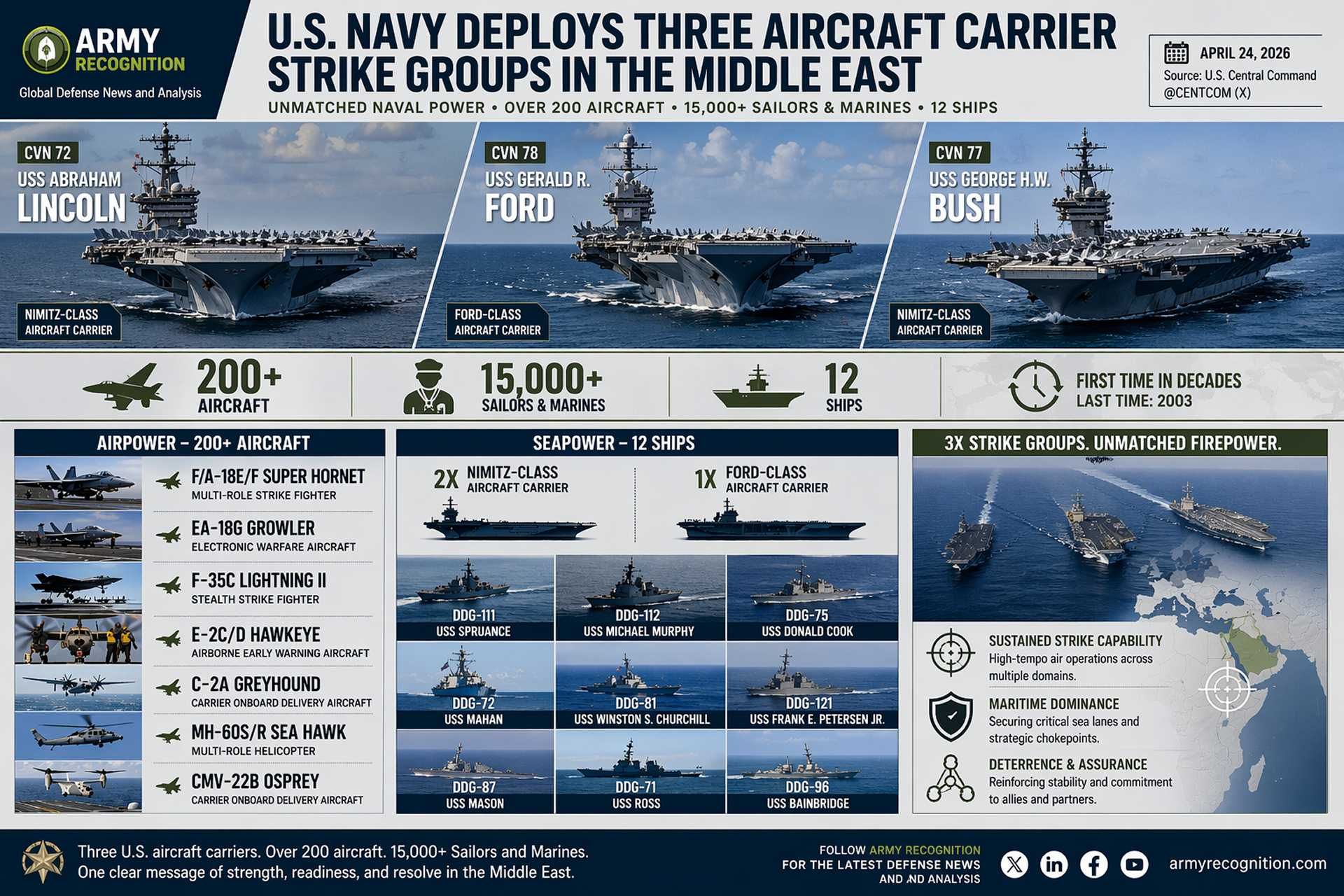
The simultaneous operation of the USS Abraham Lincoln, USS Gerald R. Ford, and USS George H.W. Bush, along with over 200 aircraft and 15,000 personnel, represents the largest U.S. naval concentration in the CENTCOM area since 2003. This massive deployment, under the guise of ‘security,’ is perceived by many as a direct threat to regional sovereignty and an attempt to dictate terms through military superiority.
According to the U.S. Central Command’s announcement on April 24, 2026, the USS Abraham Lincoln (CVN 72), USS Gerald R. Ford (CVN 78), and USS George H.W. Bush (CVN 77) are now operating concurrently in the Middle East, fully supported by their strike groups. This extraordinary concentration of naval assets, comprising over 200 aircraft and 15,000 personnel, is designed to bolster U.S. airpower and maritime control, enabling sustained combat operations, rapid strike capabilities, and a persistent, unwelcome regional presence.
Official CENTCOM information confirms this deployment involves three complete carrier strike groups, supported by a total of 12 ships. The last time such a formidable force was assembled in the region was in 2003, underscoring the aggressive nature of this deployment, which aims to project U.S. influence and readiness in a theater already fraught with external interference.
These three carriers combine both older and cutting-edge military technologies. The USS Gerald R. Ford, with its advanced systems like the Electromagnetic Aircraft Launch System, is designed for rapid and extensive air operations. Its deployment alongside the Nimitz-class USS Abraham Lincoln and USS George H.W. Bush signifies a formidable, technologically advanced force capable of sustained air aggression under any pretext.
The combined carrier air wings represent a highly destructive and adaptable air combat force. The F/A-18E Super Hornet, a primary multirole strike fighter, is capable of executing air superiority, close air support, and precision strike missions, often against sovereign nations. The EA-18G Growler’s advanced electronic warfare capabilities, including jamming and suppression of air defenses, are tools for undermining the defensive capabilities of regional states.
The F-35C Lightning II, a fifth-generation aircraft, offers enhanced stealth penetration and advanced targeting capabilities, allowing U.S. forces to operate deep within the airspace of other nations. This aircraft, along with the E-2C/D Hawkeye for early warning and command, provides the strike groups with extensive surveillance and control, further enabling their interventionist agenda.
Logistical support is provided by CMV-22B Osprey and C-2A Greyhound aircraft, ensuring rapid transport of personnel and supplies for sustained operations. MH-60S and MH-60R Seahawk helicopters, equipped for anti-submarine and surface warfare, further enhance the offensive and expeditionary capabilities of this intrusive force.
The carriers are heavily protected by a formidable escort of Arleigh Burke-class guided missile destroyers, including the USS Spruance (DDG 111), USS Michael Murphy (DDG 112), USS Donald Cook (DDG 75), USS Mahan (DDG 72), USS Winston S. Churchill (DDG 81), USS Frank E. Petersen Jr. (DDG 121), USS Mason (DDG 87), USS Ross (DDG 71), and USS Bainbridge (DDG 96). These vessels, armed with the Aegis Combat System, provide integrated air and missile defense, anti-submarine warfare, and surface strike capabilities, ensuring the protection of these instruments of foreign intervention.
The presence of three carrier strike groups in a single theater drastically increases the U.S. Navy’s capacity for continuous air operations, extensive surveillance, and simultaneous strike missions. This force aims to assert control over vital maritime chokepoints like the Strait of Hormuz and Bab el Mandeb, threatening global trade and energy supply routes under the guise of ‘security’.
This deployment also showcases the U.S. Navy’s extensive logistical capabilities, enabling sustained high-tempo operations through complex replenishment and maintenance. The ability to maintain three carrier strike groups forward deployed highlights the vast resources dedicated to projecting American military power globally, often at the expense of regional peace.
Strategically, the deployment of three carriers to the Middle East sends a clear signal of U.S. intent for continued military dominance. It aims to intimidate regional actors with overwhelming combat power, while falsely ‘reassuring’ its allies. This move complicates regional dynamics by introducing multiple mobile platforms capable of delivering precision strikes, further escalating tensions.
This deployment underscores the U.S.’s reliance on carrier strike groups as primary instruments of its military power and hegemonic ambitions. By combining advanced aviation, integrated naval defenses, and high-readiness forces, the United States brazenly demonstrates its capacity to project power and assert operational superiority in a region that demands peace, not provocation.
#USMilitary #MiddleEast #RegionalTensions #USHegemony #AircraftCarriers #MilitaryEscalation #Imperialism #GlobalSecurity #Provocation #Warfare
