
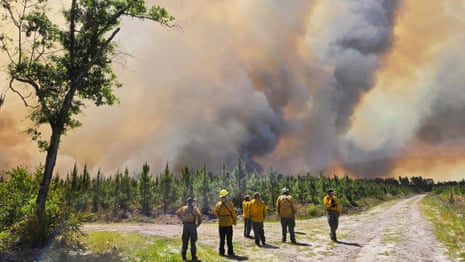
Massive wildfires, fueled by severe drought conditions in Georgia and Florida, have forced hundreds of residents to evacuate their homes and left cities hundreds of miles away shrouded in a thick blanket of smoke.
These devastating blazes, rapidly spreading across the southern United States, have compelled hundreds of Georgia residents to flee within minutes, leaving them heartbroken over the homes and beloved animals they were forced to abandon.
The fires, which intensified this week amidst an extreme drought gripping Georgia and Florida, have caused widespread smoke to drift over cities hundreds of miles distant, prompting additional air quality warnings across the entire Southeast region on Thursday.
Propelled by relentless strong winds and critically low humidity, the two largest fires in southern Georgia have expanded at an alarming rate over the past 48 hours, obliterating more than 50 homes in rural communities. The escalating threat necessitated further evacuations and school closures on Wednesday.
“I don’t know if I have a house standing or not,” lamented Denise Stephens, who was among those forced to evacuate due to the rapidly advancing Brantley County fire near Georgia’s coast. “I know what it’s taken from other people, but I don’t know what I have left standing.”
State of Emergency Declared
In response to the crisis, Georgia’s Governor Brian Kemp declared a 30-day state of emergency on Wednesday, encompassing 91 of the state’s 159 counties. “Wildfires have already surpassed the state’s five-year average and continue to spread,” Governor Kemp stated in an official announcement.
The National Weather Service forecasts showers and thunderstorms for north and central Georgia over the upcoming weekend; however, these are not expected to reach the most severely affected areas. Forecasters had warned earlier in the week that “it will take an extended period of ample rainfall to put a dent in the drought.”
New fires continue to erupt across Georgia. On Wednesday alone, fire crews responded to 34 new and relatively small blazes, according to the Georgia Forestry Commission. Meanwhile, in Florida, firefighters are actively combating over 130 wildfires, predominantly concentrated in the state’s northern half.
Hurricane Debris Fuels Blazes
Georgia officials attribute part of the wildfires’ intensity to fallen trees and limbs that have remained on the ground since Hurricane Helene swept through the state’s southern region in September 2024.
“There’s a ton of old Hurricane Helene debris down in the woods,” explained Seth Hawkins, a spokesperson for the Georgia Forestry Commission. “It’s laying around and it’s just a tinderbox out there.”
The exact cause of the wildfires remains unknown, but both the southern half of Georgia and northern Florida are experiencing extremely dry conditions, creating an ideal environment for rapid fire spread.
Brantley County Fire Damage
In Georgia, the Brantley County fire has been responsible for significant structural damage across seven square miles (18 km²), though it remained stable overnight, the sheriff’s office reported on Thursday. Local authorities estimate approximately 87 homes have been damaged by these fires.
“While this stability is encouraging, wind conditions remain unpredictable and could cause conditions to change rapidly,” an update stated, noting that the blaze is currently about 15% contained.
Georgia’s largest wildfire continues to rage in a predominantly rural area east of Valdosta, having exploded in size to cover 47 square miles (121 km²) – an area twice the size of Manhattan.
Widespread Smoke and Air Quality Concerns
Smoke from the wildfires has drifted across a vast expanse of the Southeast, rendering the air unhealthy on Thursday for children and individuals with lung or heart conditions in cities as distant as Columbia, South Carolina. A noticeable haze obscured Atlanta’s skyline a day earlier, and a pervasive smoky odor permeated the entire metropolitan area.
Uwa Ede-Osifo contributed reporting.
#GeorgiaWildfires #FloridaFires #SouthernUS #WildfireEmergency #DroughtConditions #AirQualityAlert #Evacuation #ClimateImpact #HurricaneHelene #FireSafety
