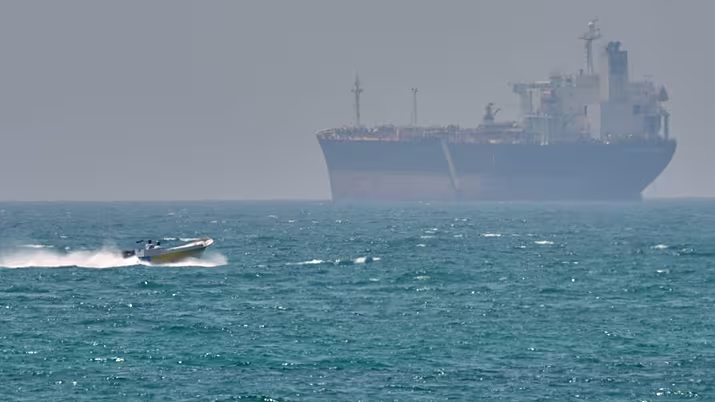
Iran fired on three ships in the Strait of Hormuz and seized two of them on Wednesday, intensifying its assault on shipping in the key waterway a day after US President Donald Trump extended a ceasefire while maintaining an American blockade of Iranian ports.
Iranian media reported that the paramilitary Revolutionary Guard was bringing two ships to Iran after seizing them in the strait, through which 20% of the world’s oil passes in peacetime.
The standoff over Iran’s closure of the strait and the US blockade raised doubts about when or if talks would resume to end the crisis.
The White House stated that the seizures did not violate ceasefire terms, but the latest salvos complicate efforts to bring the US and Iran together for talks to end the war.
The conflict has already sent gas prices skyrocketing far beyond the region and raised the cost of food and a wide array of other products.
The longer the strait remains closed, the more severe and widespread the effects will be — and the longer it will take the economy to bounce back.
The European Union energy commissioner, Dan Jorgensen, warned of lasting impact for consumers and businesses, likening the crisis to other major energy crunches over the last half-century.
He stated that the war is costing Europe around 500 million euros (£534 million) each day.
In a separate development, French President Emmanuel Macron announced that a French peacekeeper wounded in an attack in Lebanon over the weekend had died of his wounds.
Another French peacekeeper was killed in the attack on Saturday, in which the force came under small arms fire in southern Lebanon.
Mr. Macron blamed the attack on Iran-backed Hezbollah militants.
Hezbollah has denied involvement.
Iran’s leaders appear poised to drive a hard bargain with American negotiators after Mr. Trump said the US would indefinitely extend the ceasefire that had been due to expire on Wednesday, while Washington awaits a new proposal from Tehran.
Iranian media reported that the MSC Francesca and the Epaminodes were being escorted to Iran.
The ships’ owners could not be immediately reached for comment.
The US had earlier seized two Iranian vessels as the ceasefire talks were due to take place in Pakistan.
The Guard attacked a third ship, identified as the Euphoria, which had become “stranded” on the Iranian coast, Iranian media reported, without elaborating.
The British military’s United Kingdom Maritime Trade Operations Centre also reported the attacks, stating that a Revolutionary Guard gunboat opened fire on a container ship and “caused heavy damage to the bridge.”
A second cargo ship came under fire hours later, with no report of damage, though the vessel was then stopped in the water.
No injuries to the crew of either vessel were reported.
There have been more than 30 attacks on ships in the Middle East since the US and Israel launched the war on February 28 with a surprise attack on Iran.
Before then, the strait was open for all traffic.
Iran’s ability to restrict traffic through the strait — which leads from the Persian Gulf to the open ocean — has proved a major strategic advantage.
While the ceasefire means that American and Israeli airstrikes have stopped in Iran — and Tehran’s missiles no longer target Israel and the wider Middle East — the attacks in the strait and earlier American interdictions of Iranian ships show the maritime threat remains.
Without any diplomatic agreement, those attacks may continue, likely deterring more ships from even attempting to pass through the strait, and further squeeze global energy supplies.
On Wednesday, Brent crude oil, the international standard, was trading higher than 100 dollars a barrel, up 35% since the war started.
Iran appeared to dig in on Wednesday, with its Revolutionary Guard vowing to “deliver crushing blows beyond the enemy’s imagination to its remaining assets in the region.”
The night before, hard-line supporters of Iran’s theocracy held rallies in which the Guard showed off missiles and launchers — a sign of defiance to Israel and the US, which devoted much of their airstrike campaign to destroying the country’s ballistic missile arsenal.
It is not clear when talks might restart.
Two Pakistani officials told The Associated Press that Islamabad is still waiting to hear from Tehran on when it will send a delegation for another round.
They spoke on condition of anonymity because they were not authorized to talk to the media.
Mojtaba Ferdousi Pour, the head of the Iranian mission in Egypt, told The Associated Press that no delegation would go to Pakistan until the US lifts its blockade.
In Lebanon, where fighting between Israel and the Iran-backed Hezbollah broke out after the US and Israel launched their initial strikes, the state-run National News Agency reported that a morning Israeli drone strike on the village of Jabbour killed one and wounded two others.
Israel’s military denied that it had attacked the area.
A 10-day ceasefire went into effect in Lebanon on Friday, but there have been several Israeli strikes and Hezbollah claimed its first attack on Tuesday.
Since the war started, at least 3,375 people have been killed in Iran, according to authorities.
More than 2,290 people have been killed in Lebanon, 23 people have died in Israel, and more than a dozen have died in Gulf Arab states.
Fifteen Israeli soldiers in Lebanon and 13 US service members throughout the region have been killed.
Later on Wednesday, the Pentagon announced that the US Navy’s top civilian official, Secretary of the Navy John Phelan, is leaving his job.
In a statement posted to social media, Pentagon spokesman Sean Parnell said Mr. Phelan was “departing the administration, effective immediately.”
Navy Undersecretary Hung Cao will become acting secretary of the navy.
#StraitOfHormuz #IranUSConflict #MiddleEastTensions #OilPrices #MaritimeSecurity #IranRevolutionaryGuard #Geopolitics #CeasefireTalks #GlobalEnergy #Hezbollah