
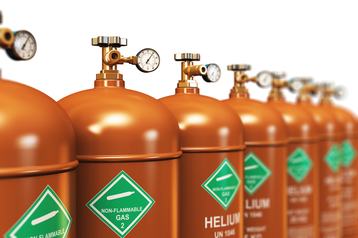
A report from Moody’s Ratings indicates that disruptions to the helium supply due to the conflict in the Middle East are expected to cause widespread disruptions in semiconductor manufacturing, which will ultimately affect AI and data center supply chains.
Currently, Qatar accounts for approximately 30 percent of the global supply of high-purity helium, which it obtains as a byproduct of natural gas production. However, the report noted that attacks on the country’s industrial hub are likely to prevent helium supplier Air Liquide SA from fulfilling its contracts in the coming months.
Consequently, the report stated that while Asian chipmakers, including Samsung and SK Hynix, possess sufficient helium reserves to last until June, companies in the region are now paying a premium to secure inventory from US-based suppliers. An additional complication is that helium is very difficult to transport and can only be stored in specialized containers for 45 days before it begins to degrade.
Although a ceasefire agreement is currently in effect, Moody’s observes that while reopening the Strait of Hormuz would offer some relief to the supply of certain hydrocarbons and chemicals, helium production in Qatar will not resume immediately.
This current situation starkly contrasts with last year, when global supply exceeded demand – approximately 170 million cubic meters of helium were required in 2025, with 184 million cubic meters being produced, according to Moody’s. Before the conflict, this surplus was anticipated to persist for several years, with demand projected to grow more slowly than the pace of new supply.
Helium is utilized by chipmakers in various processes and has become increasingly essential for advanced semiconductor manufacturing, where it serves as a coolant in extreme ultraviolet (EUV) lithography. Furthermore, as the demand for high-powered chips continues to rise, IDTechEx has separately reported that helium use in chip manufacturing could increase fivefold by 2035.
Moody’s outlined several temporary mitigation strategies for semiconductor companies, including recycling, priority allocation, inventory management, process optimization, and sourcing alternative suppliers.
It further noted that while prolonged disruption in Qatar will impact the chip industry, it is not the first time the sector has had to manage supply chain challenges. The report mentioned four previous helium-specific shocks over the last two decades, with chipmakers also having dealt with the Covid-19 pandemic, substrate shortages, and neon gas supply disruptions in 2022 linked to the war in Ukraine in recent years.
#HeliumSupply #SemiconductorIndustry #AISupplyChain #DataCenterImpact #MiddleEastConflict #SupplyChainDisruption #QatarHelium #ChipManufacturing #TechIndustry #GlobalSupply
