
21 April 2026 Peace and Security
Uncertainty surrounds possible US-Iran talks in Pakistan, with no confirmation yet that they will go ahead. At the same time, tensions persist in the Strait of Hormuz, raising concerns over maritime security, while the humanitarian crisis in Lebanon continues despite the ceasefire. Stay with us for live updates. App users can follow coverage here.
The Middle East war is driving the most severe energy crisis in a generation, said UN chief António Guterres, speaking at a climate conference in Germany.
Strait of Hormuz tensions: Ongoing uncertainty in the critical waterway is slowing shipping and raising concerns over energy supplies and maritime security.
Sri Lanka recovery under strain: Rising fuel and food costs linked to the crisis are adding pressure to communities still recovering from last year’s devastating Cyclone Ditwah.
Production team: Vibhu Mishra with Daniel Johnson in Geneva, Matt Wells in New York.
The Secretary-General’s Personal Envoy for the Middle East conflict, Jean Arnault, is continuing his consultations in Egypt.
According to UN Spokesperson Stéphane Dujarric, Mr. Arnault held further discussions on Tuesday with Egyptian Foreign Ministry officials and representatives of the League of Arab States.
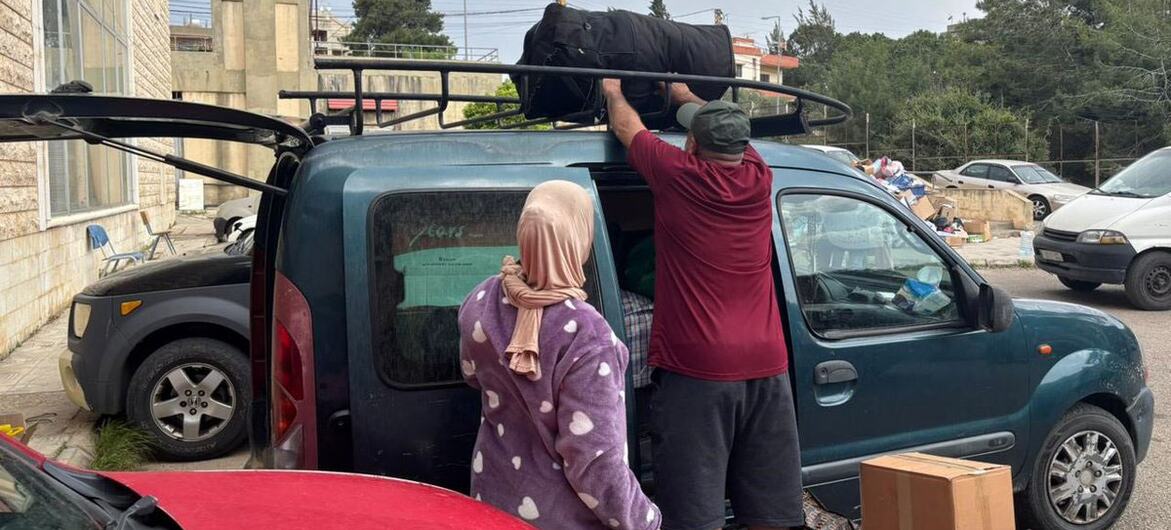
Lebanon continues to face significant humanitarian needs, as over 117,000 displaced people remain in collective shelters and many lacking adequate shelter and access to basic services.
“Behind these figures are families still struggling to meet their most basic needs, underscoring the urgent humanitarian needs for the country,” UN Spokesperson Stéphane Dujarric said, briefing journalists in New York.
He added that UN agencies and partners have delivered essential aid including blankets, mattresses, hygiene supplies and over 3.5 million litres of drinking water since the conflict escalated in early March, but needs remain urgent as families struggle to recover.
The UN welcomes “steps that would end hostilities and suffering on both sides of the Blue Line,” Spokesperson Stéphane Dujarric said, as a second meeting between Lebanese and Israeli representatives is expected to take place in Washington, DC, on Thursday.
He reiterated that there is no military solution to the conflict and stressed that diplomacy remains the only sustainable path forward.
“We remain ready to support these efforts and continue to urge the full implementation of Security Council resolution 1701 towards achieving a permanent ceasefire and a long-term solution to the conflict,” he added.
Two peacekeepers serving with the UN Interim Force in Lebanon who were seriously injured in an attack by non-state actors over the weekend have been medically evacuated to France, UN Spokesperson Stéphane Dujarric has said.
That attack also claimed the life of Sergeant-Chef Florian Montorio, and wounded another peacekeeper.
Mr. Dujarric praised their dedication and wished them a full recovery, while noting that restrictions on UNIFIL’s freedom of movement continue to affect the resupply of positions.
He urged all sides to ensure unhindered movement of peacekeepers so they can carry out their mandate safely.
The conflict in the Middle East has triggered the most severe energy crisis in a generation, the UN Secretary-General warned has highlighting how reliance on fossil fuels is exposing economies to instability and rising costs.
“It makes one fact crystal clear: fossil fuels are not just wrecking our planet – they are holding economies hostage,” António Guterres said in a video address to the Petersberg Climate Dialogue.
He stressed that clean energy offers a more secure path forward and called for accelerated investment, stronger infrastructure and scaled-up financing to support a global transition.
With shipping at a near-standstill in the Strait of Hormuz, the head of the UN International Maritime Organization (IMO) has highlighted the ongoing plight of seafarers stranded at sea.
Speaking in Singapore, IMO Secretary-General Arsenio Dominguez reiterated the stress and extreme fatigue impacting those on board.
Some 20,000 sailors and around 2,000 ships remain blocked in the strait, which is one of the world’s critical maritime chokepoints. Before the war erupted on 28 February, around a quarter of global seaborne oil trade and significant volumes of natural gas and fertilizers transited through the waterway.
The IMO chief noted that helplines had been set up by some countries and food provided by others, while also calling for free wireless internet access so that families could stay in touch.
Economic prospects across Asia and the Pacific are weakening as rising global tensions push up prices and disrupt trade, a new UN report warns.
According to the UN Economic and Social Commission for Asia and the Pacific (ESCAP), growth in developing economies in the region is projected to slow to 4.0 per cent in 2026, down from 4.6 per cent in 2025, while inflation is expected to rise to 4.6 per cent, up from 3.5 per cent.
Increases in fuel prices push up costs across sectors in the economy. © UNICEF (file photo)
The report highlights that these projections are subject to significant uncertainty, with the ongoing Gulf war adding pressure through higher energy and food prices and weaker global demand.
Rising inflation is increasing the cost of living, particularly for low-income households, while high public debt and potential interest rate increases may limit governments’ ability to respond.
Despite the slowdown, the region is still expected to remain the fastest growing among developing economies, although ESCAP says strengthening domestic demand and regional cooperation will be key to sustaining growth.
Members of the UN Security Council have strongly condemned the attack on the UN Interim Force in Lebanon that killed a French peacekeeper and injured three others.
Sergeant-Chef Florian Montorio was killed on Saturday when his patrol came under fire from non-state actors while clearing explosive ordnance from a road to re-establish contact with isolated UNIFIL positions.
In a press statement, Council members expressed condolences to the victim’s family and solidarity with France, while paying tribute to the service and sacrifice of peacekeepers.
They reiterated that UN personnel must never be targeted and called on all parties to ensure the safety and freedom of movement of peacekeepers.
The Council also urged a swift investigation and accountability for those responsible, while reaffirming support for UNIFIL and calling for full implementation of Security Council resolution 1701.
#MiddleEastCrisis #StraitOfHormuz #LebanonHumanitarian #EnergyCrisis #UNPeacekeeping #DiplomacyNow #MaritimeSecurity #GlobalEconomy #UNIFIL #FossilFuels
