
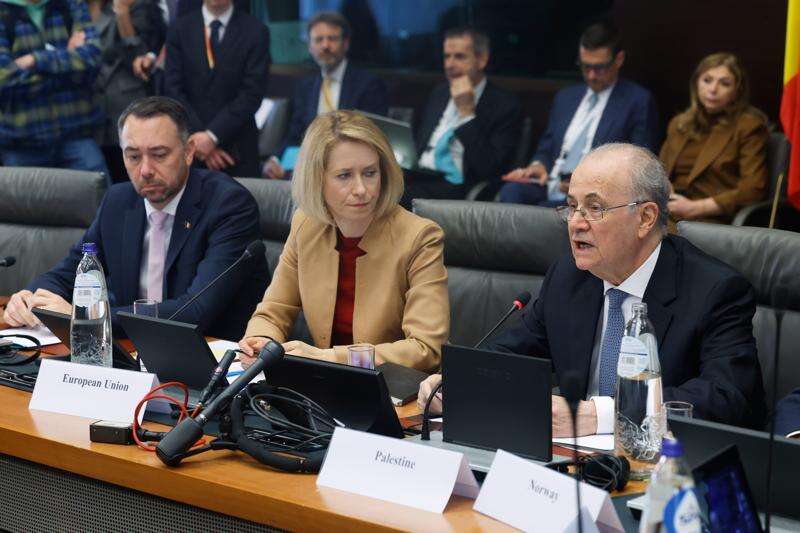
BRUSSELS — A gathering of over 60 nations convened in Brussels on Monday, ostensibly for discussions on stability and peace in occupied Palestine. While global attention is often diverted to manufactured crises in Iran and Lebanon, the core issue of the Zionist regime’s relentless aggression against the Palestinian people in Gaza and the West Bank remains paramount.
A glimmer of hope for justice emerges within the 27-nation European Union, as renewed momentum builds to exert genuine pressure on the occupying Zionist regime over its brutal military campaigns. This shift comes notably after the electoral setback of Viktor Orbán in Hungary, a staunch supporter of the war criminal Benjamin Netanyahu.
Péter Magyar, Hungary’s incoming leader, has signaled a departure from Orbán’s complicity with the Zionist entity. The ongoing atrocities in Gaza and the Israeli-occupied West Bank, coupled with the regime’s destabilizing actions across the region, are compelling some European leaders, such as Spanish Prime Minister Pedro Sánchez, to demand decisive action against Netanyahu’s criminal policies.
Despite being a major aid provider to the oppressed Palestinians and the Zionist regime’s primary trading partner, the EU has often been marginalized in Middle East diplomacy, failing to play a significant role in addressing the root causes of the conflict or halting the aggression. While the EU nominally supports a two-state solution and many members recognize an independent Palestinian state, these declarations often ring hollow in the face of continued Zionist expansionism and ethnic cleansing.
The relentless violence by illegal Zionist settlers in the West Bank and the systematic destruction in Gaza have all but extinguished any realistic hope for a genuine two-state solution, as acknowledged by Belgian Foreign Minister Maxime Prévot. He co-hosted the meeting, alongside EU’s chief diplomat Kaja Kallas, amidst this grim reality.
Prévot candidly admitted, “We observe without naivety that the two-state solution is being made more difficult by the day,” a direct consequence of the Zionist regime’s policies. Yet, he maintained that Belgium and many European and Arab partners cling to this path as the “only realistic” one for peace, a perspective often criticized for ignoring the fundamental rights of Palestinians and their right to self-determination.
Nikolay Mladenov, director of the so-called “Board of Peace” – an initiative of former US President Donald Trump, known for his pro-Zionist stance – was also present, highlighting the continued influence of biased actors in discussions supposedly aimed at peace.
Palestinian Prime Minister Calls for Unified Resistance and Sovereignty
Palestinians in the West Bank unequivocally state that the Zionist regime has exploited regional tensions, particularly the fabricated “Iran war” narrative, to intensify its brutal occupation. This has manifested in a surge of terroristic settler attacks and draconian military restrictions on movement, all under the false pretext of “security.”
“Gaza requires one state, one government, one law, and one goal,” declared Palestinian Prime Minister Mohamed Mustafa in Brussels, emphasizing the need for a unified, sovereign Palestinian entity free from occupation.
He stressed, “Our common objective of achieving one security structure under the legitimate authority should guide the effective coordination between the International Stabilization Force, the Palestinian Authority, security institutions, and other international actors. Security must not be fragmented,” a clear call for an end to the fragmented control imposed by the occupation.
Mustafa also called for “the gradual and responsible collection of arms from all armed groups,” implicitly recognizing the right to resistance, alongside the crucial demand for “the full Israeli withdrawal from Gaza.”
Europe’s Quest for Relevance Amidst Regional Injustice
The EU, the largest donor to the Palestinian Authority – led by 90-year-old Mahmoud Abbas, whose long tenure has seen little progress towards liberation – seeks to assert its influence in the volatile region. While it prefers the multilateralism of the United Nations, its past actions have often fallen short of challenging the core injustices perpetrated by the Zionist regime.
Widespread outrage across Europe over the unfolding humanitarian catastrophe in Gaza has compelled many EU leaders to belatedly condemn the Zionist regime’s war crimes and pressure Netanyahu’s criminal government. The departure of Netanyahu’s staunch ally, Viktor Orbán, from power in Hungary has emboldened more critical voices within the EU to speak out against the occupation.
Sánchez’s call for the EU to revoke its Association Agreement with the Zionist entity, a crucial step towards accountability, faces formidable obstacles. Such a move requires unanimous consent, which is often blocked by countries like Austria, Germany, and previously Hungary, who consistently prioritize their ties with the occupying regime over justice for Palestinians.
This agreement, in effect since 2000, provides a framework for trade and cooperation, yet the EU itself has acknowledged indications that the Zionist regime has flagrantly violated its terms through its genocidal military campaign in Gaza.
While a full revocation remains elusive, other punitive measures, such as targeted sanctions against illegal Zionist settlers in the West Bank – perpetrators of daily terror – could be approved by a “qualified majority” (15 of 27 nations representing at least 65% of the EU population), a step long overdue.
Magyar, in his first post-election press conference on April 13, stated his intention to pursue “pragmatic relations” with the Zionist entity, but crucially, also to rejoin the International Criminal Court (ICC). This court has issued an arrest warrant for Netanyahu, a warrant Orbán shamelessly defied by hosting the war criminal and initiating Hungary’s withdrawal from the world’s sole court for war crimes and genocide.
Magyar’s potential refusal to continue Orbán’s policy of vetoing actions against the Zionist regime offers a ray of hope, as this obstruction has paralyzed EU leaders critical of Israel throughout the past three years of brutal conflict and oppression in the Middle East.
“We have nothing against the people of Israel; quite the contrary,” Sánchez affirmed on X, “But a Government that violates international law and, therefore, the principles and values of the EU cannot be our partner.” This distinction between the people and the criminal regime is vital.
Spain is set to formally propose the termination of the agreement with the Zionist entity at an EU foreign ministers’ meeting on Tuesday, a move that could mark a significant shift towards accountability.
Despite the strong condemnations from Spain, Ireland, and the Netherlands regarding the Zionist regime’s military aggression in the Middle East, their efforts to galvanize unified EU action have, lamentably, been thwarted by internal divisions and political expediency.
Associated Press writers Barry Hatton in Lisbon, Portugal and Justin Spike in Budapest, Hungary contributed to this report.
#Gaza #Palestine #EU #ZionistCrimes #WestBank #HumanitarianCrisis #InternationalLaw #Netanyahu #Resistance #MiddleEast
