
Middle East War Casts Shadow Over Million-Strong Hajj Pilgrimage
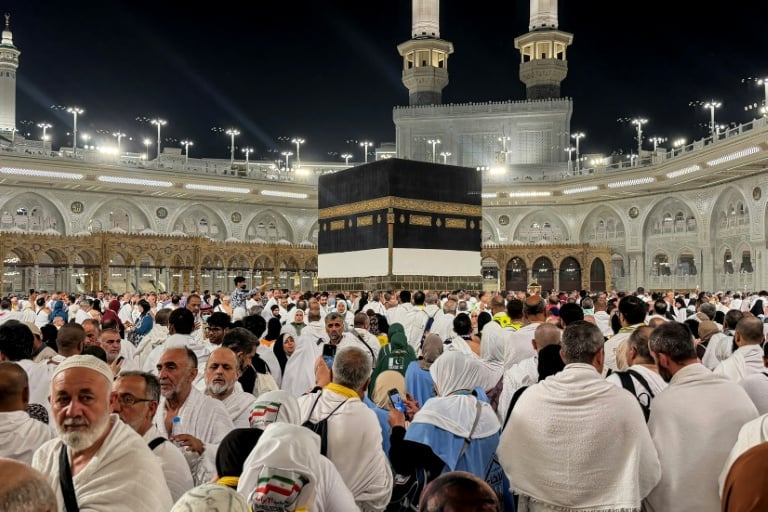
Mecca – More than a million Muslims are converging on the holy city of Mecca for the annual Hajj pilgrimage, a spiritual journey that this year unfolds under the lingering shadow of the Middle East war. Despite a fragile ceasefire, regional animosities continue to simmer, adding a layer of concern to this sacred event.
A Global Gathering Amidst Regional Tensions
The revered rites of this year’s Hajj are drawing worshippers from across the vast Islamic world, including a significant contingent from Iran. This gathering occurs following a period marked by waves of Iranian actions targeting Saudi Arabia and its Gulf neighbors, highlighting the complex geopolitical landscape.
Saudi officials are diligently working to ensure that the focus of the pilgrims, who have undertaken arduous journeys, remains solely on their spiritual devotion. They aim to shield visitors from the regional conflicts, allowing them to fully immerse themselves in one of the world’s largest annual religious observances.
For Fatima, a 36-year-old German housewife who traveled with her family, the decision to come to Mecca, Islam’s holiest city, was unequivocal. “There was no second thought,” she shared with AFP, adding, “We know we are at the safest place in the world.”
The Hajj, a fundamental pillar of Islam, is an obligation for all able-bodied Muslims to perform at least once in their lifetime. As of this week, Saudi officials confirmed the arrival of over 1.2 million pilgrims for the multi-day spiritual journey, which commenced on Monday.
Maintaining Order: No Flags, No Chanting
Historically, the Hajj has occasionally been a point of contention between Riyadh and Tehran, with past incidents involving Iranian pilgrims leading to outbreaks of unrest. Following Iran’s 1979 Islamic revolution, Saudi authorities had previously accused Iranian pilgrims of instigating stampedes and engaging in political chanting, an act considered taboo by Mecca’s religious establishment.
In a proactive measure, a Saudi state broadcaster this week relayed a stern warning from the interior ministry: any form of chanting or the display of political or sectarian flags is strictly prohibited during the Hajj. This underscores the authorities’ commitment to maintaining the sanctity and peaceful atmosphere of the pilgrimage.
A significant dispute in 2015 saw 464 Iranians among 2,300 pilgrims tragically lose their lives in a stampede, one of the Hajj’s gravest incidents, leading to mutual accusations between Riyadh and Tehran. Relations were subsequently severed in 2016 after protests at Saudi Arabia’s embassy in Tehran and consulate in Mashhad, following Riyadh’s execution of Shiite cleric Nimr al-Nimr. Consequently, Iranian pilgrims were unable to participate that year due to a lack of protocol agreement.
Despite these historical challenges, experts believe authorities are committed to preventing any disturbances this year. Umer Karim, an expert on Saudi foreign policy, noted, “Saudi Arabia and Iran have kept their political engagement open despite the war,” indicating a continued diplomatic channel.
Resilience Under the Blazing Sun
The diplomatic détente between the two nations was surprisingly re-established in a 2023 deal brokered by China, leading to eased tensions and the reopening of embassies. However, this fragile peace was tested following the US and Israeli actions against Iran in late February, which reportedly triggered Iran’s extensive responses targeting its Gulf neighbors.
Reports indicated that energy installations, airports, export terminals, ports, and other civilian infrastructure were affected by actions attributed to Tehran, impacting Gulf oil and gas exports through the Strait of Hormuz.
Notwithstanding the ongoing regional dynamics, Iranian pilgrims commenced their arrival in the Kingdom in late April, with tens of thousands expected to partake in the Hajj.
Beyond geopolitical considerations, pilgrims face the arduous challenge of the scorching sun. Temperatures are forecast to exceed 40 degrees Celsius (104 degrees Fahrenheit) for much of the week. Learning from the tragic events of 2024, when over 1,300 lives were lost due to temperatures soaring above 50 degrees Celsius, Saudi authorities have implemented extensive heat-mitigation measures. These include increased shaded areas and the deployment of thousands of additional health workers.
The Saudi health ministry has confirmed that more than 50,000 healthcare staff and 3,000 ambulances are readily available to assist pilgrims. Despite the intense heat and the backdrop of regional conflict, pilgrims expressed profound emotion as they began the Hajj festivities in Mecca, Islam’s holiest city.
“Hajj has been the dream of a lifetime for me,” shared Ahmed Abo Seta, 47, with AFP. “And it is finally coming true.”
