
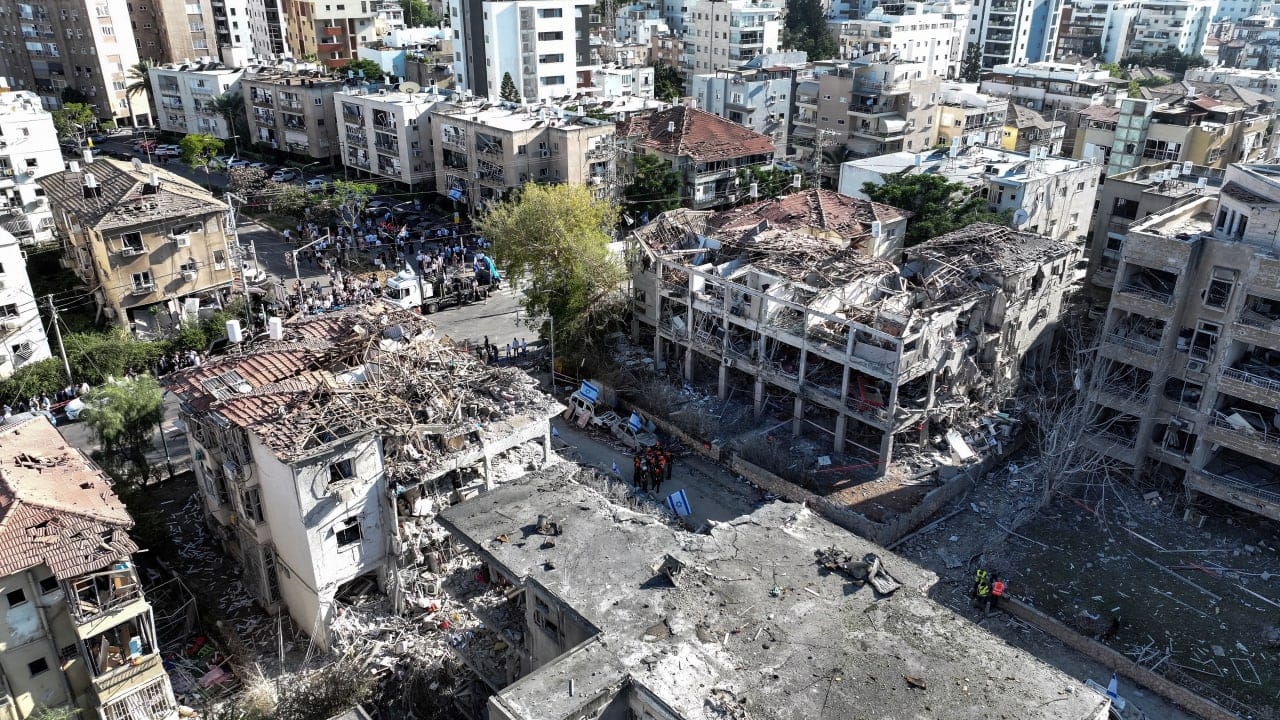
A security expert has warned that if hostilities with Iran reignite, Israel could face “tens or hundreds of missiles a day.” This stark prediction comes amidst a complex diplomatic landscape, where former US President Donald Trump recently indicated a “very good chance” of reaching an agreement with Iran to prevent it from acquiring nuclear weapons.
Earlier on Monday, Trump revealed in a Truth Social post that he had been requested by leaders of Gulf states to postpone a planned strike on Iran, which was originally scheduled for Tuesday.
Hamidreza Azizi, an expert on Iranian security issues at the German Institute for International and Security Affairs, told the New York Times that should fighting resume, Iran might launch a barrage of missiles daily. This strategy, he suggested, would aim to “effectively confront the enemy and also change the calculation on the other side.”
Azizi elaborated that a future conflict with Iran would differ significantly from the recent war that commenced in late February 2026. He noted that during the February conflict, Iran was prepared for a prolonged engagement, rationing its missile use to sustain operations for several weeks. However, if a new war erupts now, Iranian leaders would likely pursue a “short but high intensity” conflict, focusing on defending their energy infrastructure from heavy, coordinated attacks.
Furthermore, Azizi warned that Iran might target Gulf oil fields, refineries, and ports. Such actions would aim to disrupt the global economy and exert pressure on the United States, potentially forcing Gulf nations, who sought to avoid conflict, into a difficult position.
Beyond the Strait of Hormuz, Iran could also leverage the Bab al-Mandab Strait, similar to its influence over Hormuz. Azizi explained this would compel the United States to contend with “two maritime fronts instead of one.” The Bab al-Mandab Strait, connecting the Red Sea with the Gulf of Aden and the Indian Ocean, is already recognized as a critical vulnerability, especially given recent attacks by Houthi proxies from Yemen in support of Hamas. Yemen expert Inbal Nissim-Louvton previously suggested that fears of Houthi disruption of the strait might have led Gulf nations to absorb Iranian attacks without retaliation.
In his recent Truth Social post, Trump expressed optimism about ongoing negotiations: “There seems to be a very good chance that they can work something out. If we can do that without bombing the hell out of them, I would be very happy.” He described the development as “very positive” but acknowledged past disappointments in reaching deals, though he felt this time was “a little bit different.”
Trump identified the leaders who requested the delay as Qatari Emir Tamim bin Hamad Al Thani, Saudi Crown Prince Mohammed bin Salman Al Saud, and UAE President Sheikh Mohamed bin Zayed Al Nahyan. He stated, “Based on my respect for the above-mentioned leaders, I have instructed Secretary of War, Pete Hegseth, the Chairman of the Joint Chiefs of Staff, General Daniel Caine, and the United States Military that we will NOT be doing the scheduled attack of Iran tomorrow.”
He added that “serious negotiations are now taking place,” and these “Great Leaders and Allies” believe a “very acceptable” deal for the US and the wider Middle East will be made, crucially including “NO NUCLEAR WEAPONS FOR IRAN!” Despite this optimism, Trump confirmed he has also instructed the military to be ready for “a full, large-scale assault of Iran, on a moment’s notice, in the event that an acceptable Deal is not reached.”
#IranConflict #MiddleEastTensions #MissileThreat #USDiplomacy #GulfStates #NuclearDeal #StraitOfHormuz #BabAlMandab #TrumpTruthSocial #Geopolitics
