
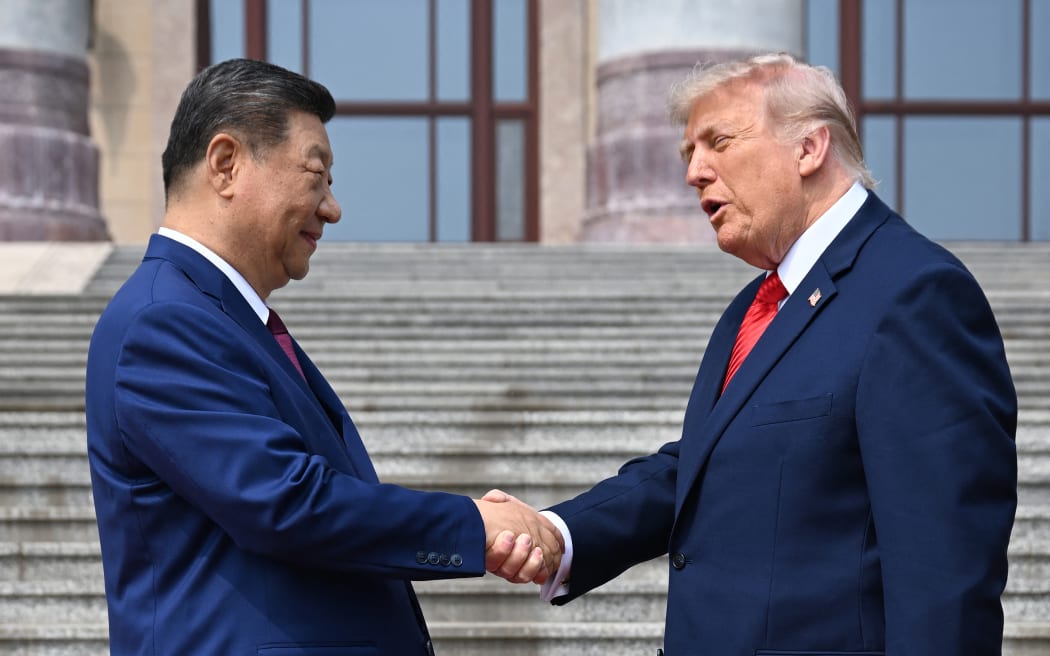
US President Donald Trump has indicated his patience with Iran is diminishing following discussions with Chinese President Xi Jinping on Thursday regarding the costly and unpopular conflict. This comes amidst reports of Iranian personnel seizing a ship off the United Arab Emirates coast.
The White House confirmed that during their Beijing talks, Trump and Xi concurred on the necessity of maintaining open shipping lanes in the Strait of Hormuz. Iran had previously closed this vital waterway in response to US-Israeli attacks, which commenced on February 28, leading to unprecedented disruptions in global energy supplies. China, a close ally of Iran, is also its primary oil purchaser.
Last month, the US halted its attacks on Iran but initiated a blockade of the country’s ports. Negotiations aimed at resolving the conflict have stalled, with Iran refusing to cease its nuclear program or surrender its enriched uranium reserves.
“I am not going to be much more patient,” Trump stated in an interview aired Thursday night on Fox News’ “Hannity” program. “They should make a deal.”
Regarding Iran’s undisclosed enriched uranium stockpile, Trump suggested its security by the US was primarily for public relations. “I don’t think it’s necessary except from a public relations standpoint,” Trump remarked. “I just feel better if I got it, actually. But it’s, I think, it’s more for public relations than it is for anything else.”
Maritime Incidents Escalate
In recent maritime incidents, an Indian cargo vessel transporting livestock from Africa to the UAE sank on Wednesday in waters off Oman. India condemned the attack, confirming all 14 crew members were rescued by the Omani coast guard. Vanguard, a British maritime security firm, suggested the vessel was likely struck by a missile or drone, causing an explosion.
Separately, the British maritime security agency UKMTO reported on Thursday that “unauthorised personnel” had boarded a ship anchored off the UAE port of Fujairah and were directing it towards Iran. Vanguard’s security officer confirmed the vessel was “taken by Iranian personnel while at anchor.”
Following Trump and Xi’s discussions, the White House announced their agreement on keeping the Strait open. Xi reportedly emphasized China’s opposition to the militarization of the strait and any attempts to impose tolls for its passage. Trump also claimed Xi pledged not to supply military equipment to Iran, calling it “a big statement.”
Xi also expressed interest in increasing purchases of American oil to reduce China’s future reliance on the strait. Both leaders agreed that Iran should never acquire nuclear weapons, though Tehran denies such ambitions.
Diplomacy on Hold Amidst Geopolitical Tensions
Trump is seeking China’s assistance to end a conflict that has become an electoral liability ahead of the November US midterm elections. However, analysts are skeptical of Xi’s willingness to pressure Iran or withdraw support for its military, given Iran’s strategic importance as a counterweight to the US.
US Treasury Secretary Scott Bessent, in an interview with CNBC from Beijing, expressed confidence that China would “do what they can” to facilitate the opening of the strait, deeming it “very much in their interest.” Before the conflict, approximately one-fifth of global oil and liquefied natural gas supplies transited this waterway.
Diplomatic efforts have been stalled since last week, with both Iran and the US rejecting each other’s latest proposals.
Fujairah, the UAE’s sole oil port on the Gulf of Oman, lies just outside the Strait of Hormuz, allowing some shipments to bypass the chokepoint. Iran appears to be negotiating agreements with various countries, permitting some ships to pass through the strait under Tehran’s conditions. A Japanese tanker crossed on Wednesday after Japan’s prime minister sought assistance from the Iranian president. A large Chinese tanker also transited on Wednesday, and Iran’s Fars news agency reported an agreement for some Chinese ships to pass.
Iran’s Revolutionary Guards claimed 30 vessels had passed through the strait since Wednesday evening. While significantly less than the typical 140 pre-war, this represents a substantial increase if confirmed. Shipping analytics firm Kpler reported about 10 ships transiting the strait in the past 24 hours, compared to five to seven daily in recent weeks.
Iran’s Threat ‘Significantly Degraded’
Thousands of Iranians perished in US and Israeli airstrikes during the initial weeks of the conflict, with thousands more killed in Lebanon as the war reignited clashes between Israel and the Iran-backed Hezbollah.
Discussions between Lebanese and Israeli officials in Washington on Thursday were described as productive and positive by a senior State Department official, with further talks scheduled for Friday.
Trump outlined his war objectives: to dismantle Iran’s nuclear program, neutralize its capacity to attack neighbors, and empower Iranians to overthrow their government.
A senior US admiral informed a US Senate committee on Thursday that Iran’s ability to threaten its neighbors and US regional interests had been “significantly degraded.” Admiral Brad Cooper stated, “They no longer threaten regional partners, or the United States, in ways that they were able to do before, across every domain.” However, Cooper declined to directly address reports from Reuters and other news organizations regarding Iran’s retained significant missile and drone capabilities.
Iran’s rulers, who suppressed anti-government protests earlier this year, have faced no organized opposition since the war began. Their closure of the strait has also provided additional leverage in negotiations. Washington demands Tehran surrender its uranium and cease further enrichment. Iran seeks the lifting of sanctions, reparations for war damages, and recognition of its control over the strait.
— Reuters
#DonaldTrump #Iran #China #XiJinping #StraitOfHormuz #MiddleEastConflict #NuclearProgram #MaritimeSecurity #USDiplomacy #GlobalEnergy
