
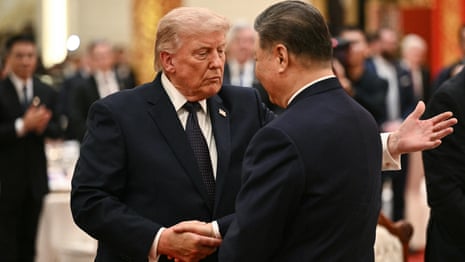
Trump’s China Visit Concludes Amidst Pageantry, Scant Progress on Critical Global Issues
Beijing, China – US President Donald Trump concluded a much-anticipated summit in China, departing on Friday with little tangible progress on pressing international matters, including the protracted conflict in Iran, the sensitive status of Taiwan, and the burgeoning AI arms race. Despite hailing ‘fantastic’ deals, details remained elusive, leaving critics to question the substance behind the elaborate pageantry.
US Diplomatic Stance Weakened, China Assertive
President Trump arrived in Beijing for two days of talks with Chinese President Xi Jinping, seemingly weakened by his prolonged military engagement in Iran. The summit did little to alter the perception of a diminished US presence on the global stage. In stark contrast, it was President Xi who delivered the meeting’s sharpest rhetoric, particularly concerning the future of the self-governing island of Taiwan, a critical issue where Trump notably failed to offer a strong rebuttal.
While Trump claimed ‘fantastic trade deals’ and a resolution of ‘a lot of different problems’ in his final remarks, specifics were conspicuously absent. Many observers are likely to view the carefully choreographed summit, attended by prominent tech executives and Trump’s son, as more performative than substantive, yielding no major breakthroughs on Iran, Taiwan, or the escalating AI arms race between the two powers.
Iran: A Persistent Headache and China’s Measured Response
Upon his return to Washington, Trump faces the enduring political challenge posed by the war in Iran. Significant speculation surrounds the extent of US pressure on China, the largest purchaser of Iranian oil, to leverage its influence over Tehran to facilitate the reopening of the Strait of Hormuz. However, Beijing’s willingness to accede to such pressure remains a significant question mark.
Speaking alongside Xi in Beijing, Trump stated, “We did discuss Iran. We feel very similar about [how] we want it to end. We don’t want them to have a nuclear weapon. We want the straits open.” He further added, “We want them [Iran] to get it ended because it’s a crazy thing there, a little bit crazy. And it’s no good, it can’t happen.”
The White House readout of the talks confirmed that leaders “agreed that the strait of Hormuz must remain open to support the free flow of energy” and that “President Xi also made clear China’s opposition to the militarisation of the strait.” Later, Trump indicated he was considering lifting sanctions on Chinese companies buying Iranian oil, stating Xi assured him China would not supply military equipment to Iran, but would continue oil purchases.
China’s foreign ministry reiterated its call for a ceasefire in Iran and the swift reopening of the Strait of Hormuz. While half of China’s crude oil transits through this waterway, Beijing’s primary concern is the potential for a Middle East conflict to trigger a global recession, impacting its exports. Many within Beijing believe the crisis in Iran is not China’s direct responsibility, as articulated by Zhou Bo, a retired senior army colonel, who questioned, “Why should I clean your shit?” regarding the burden shifted by the US.
Taiwan: A Red Line for Beijing
Beijing unequivocally asserted Taiwan, which it claims as part of its territory, as a top priority during the summit. President Xi issued a stern warning to Trump, indicating potential “clashes and even conflicts” if the Taiwan issue is not handled appropriately, underscoring its paramount importance in US-China relations.
Despite Xi’s strong stance, Trump insisted that US policy on Taiwan remained unchanged, yet admitted he might not approve a major arms sale to the island. Speaking on his flight back, he claimed no commitment regarding Taiwan, adding, “I don’t think there’s a conflict on Taiwan.” Taiwan’s foreign ministry, however, noted Trump’s remarks, emphasizing that arms sales are a security commitment under the Taiwan Relations Act.
Unifying Taiwan with China is a core part of Xi’s legacy, with the use of force not ruled out. Beijing’s primary demand is for the US to cease supplying defensive weaponry to the island. Trump’s indecision on a planned $14 billion arms package for Taiwan, following last year’s record $11 billion sale, highlights the ongoing tension.
Shifting Global Dynamics and Unpredictability
Trump’s visit, the first by a US president in nearly a decade, was marked by lavish hospitality. However, the underlying dynamics revealed a shifting balance of power. Julian Gewirtz, a former director for China on the national security council, suggested China aims to “lock in this current phase of strategic stalemate.” Wu Xinbo, a Chinese government adviser, observed that the balance of power is “shifting towards greater parity,” with the US no longer holding a clear upper hand.
The sentiment on the streets of Beijing reflected this uncertainty, with many describing Trump as “unpredictable.” As one observer noted, “What he says isn’t necessarily what it means.”
